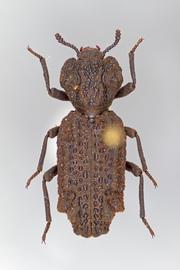
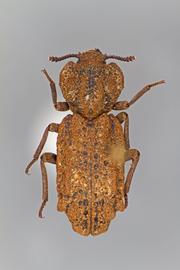
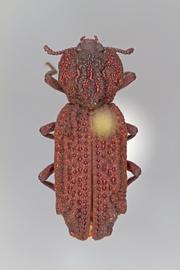
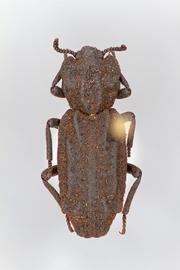
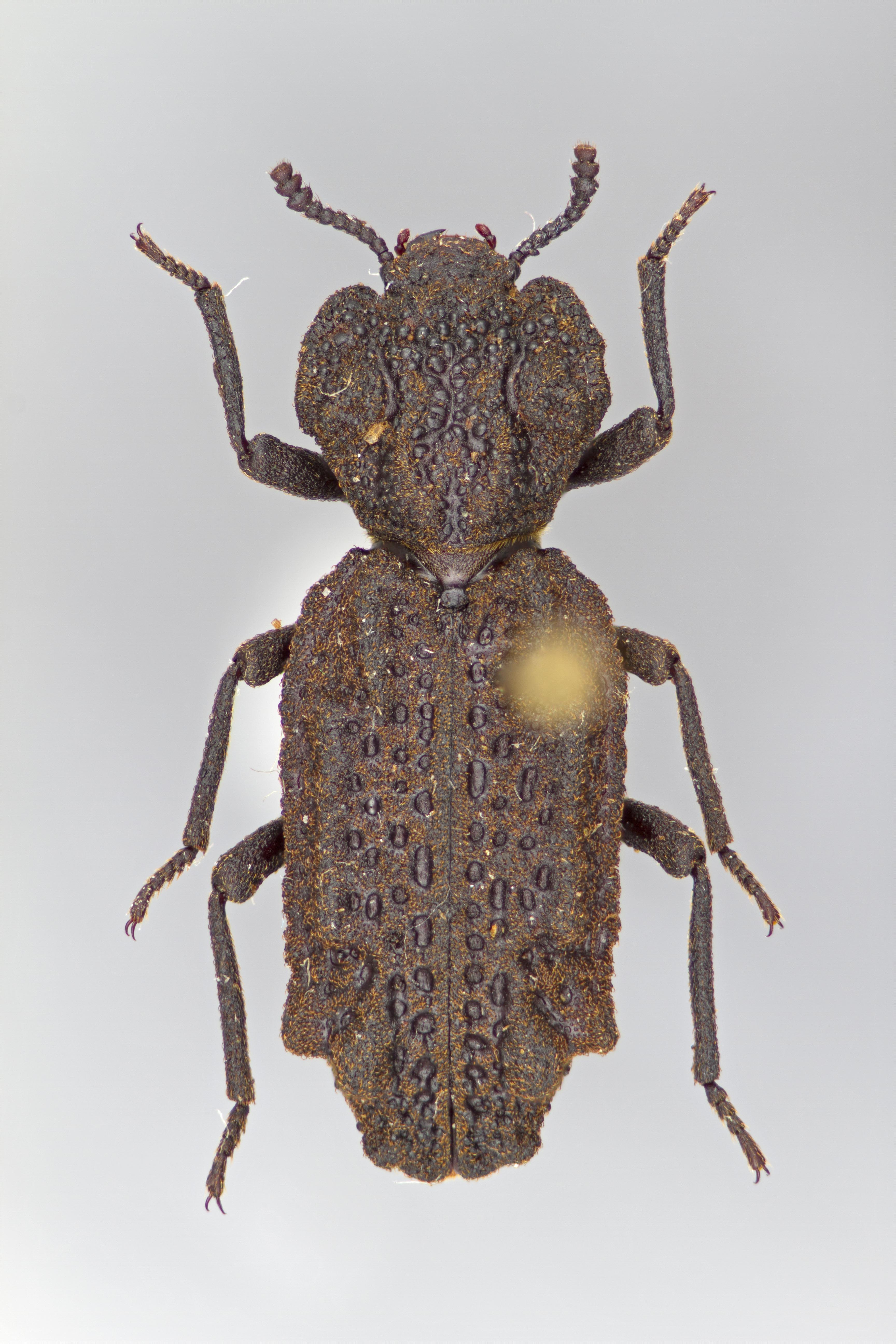
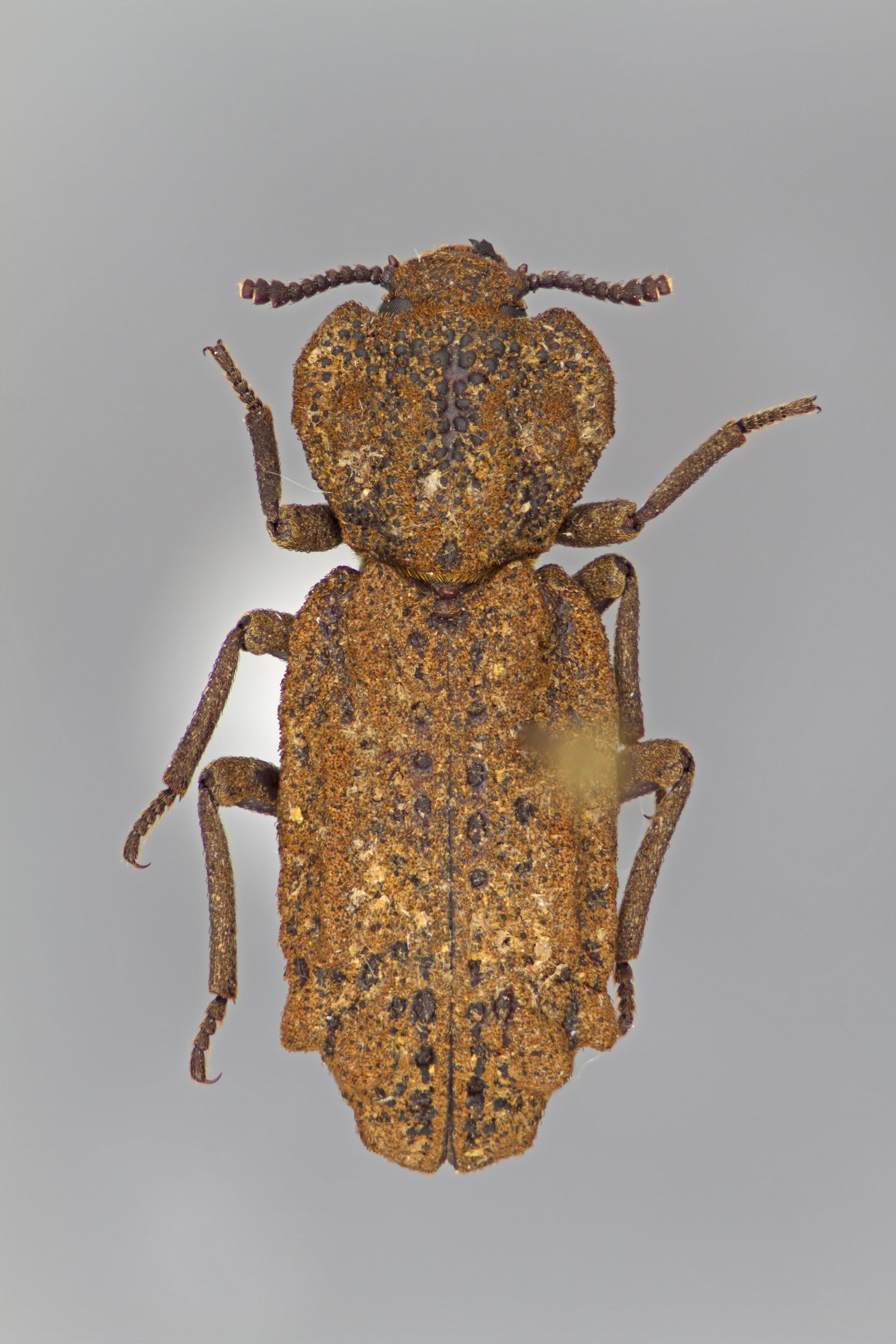
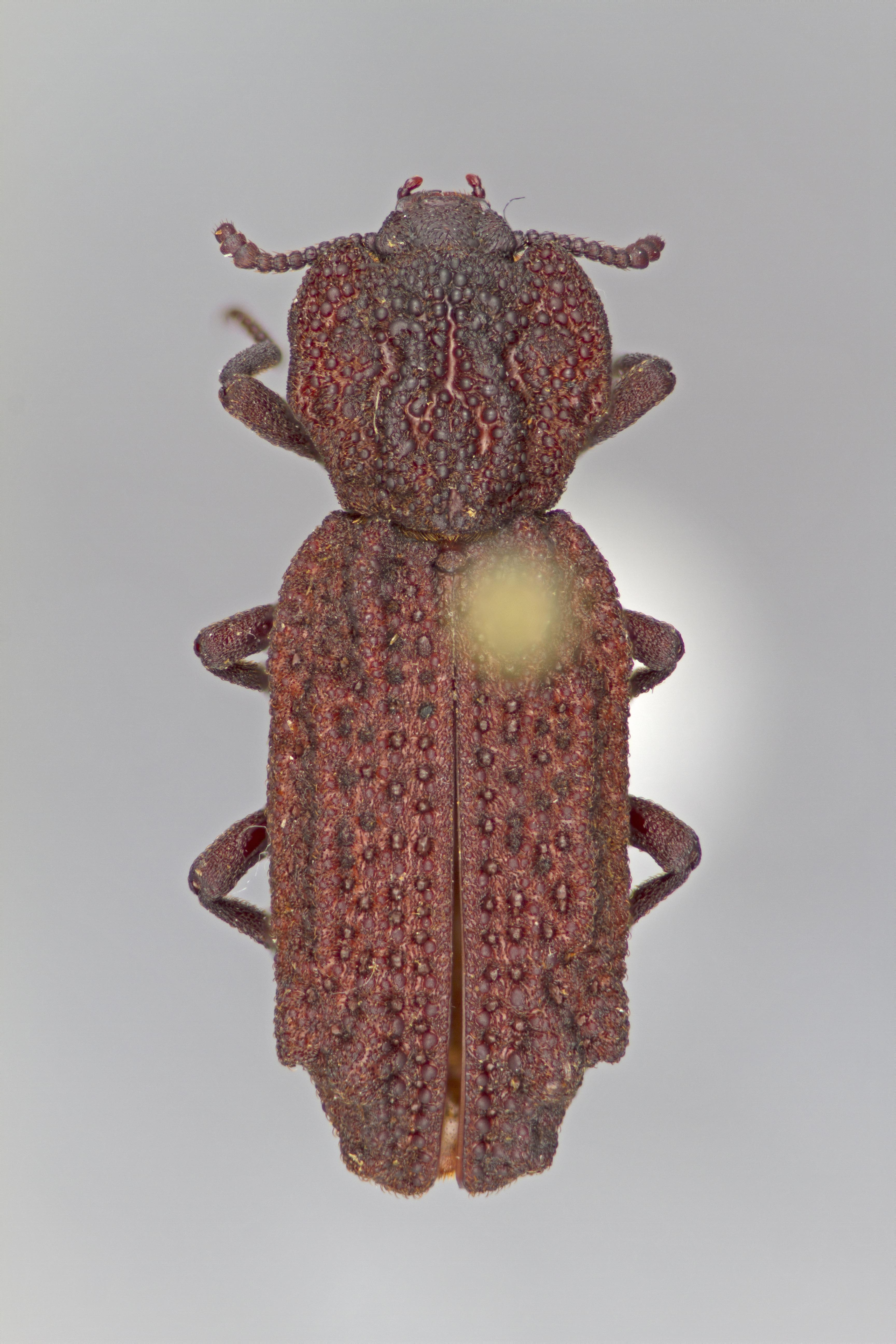
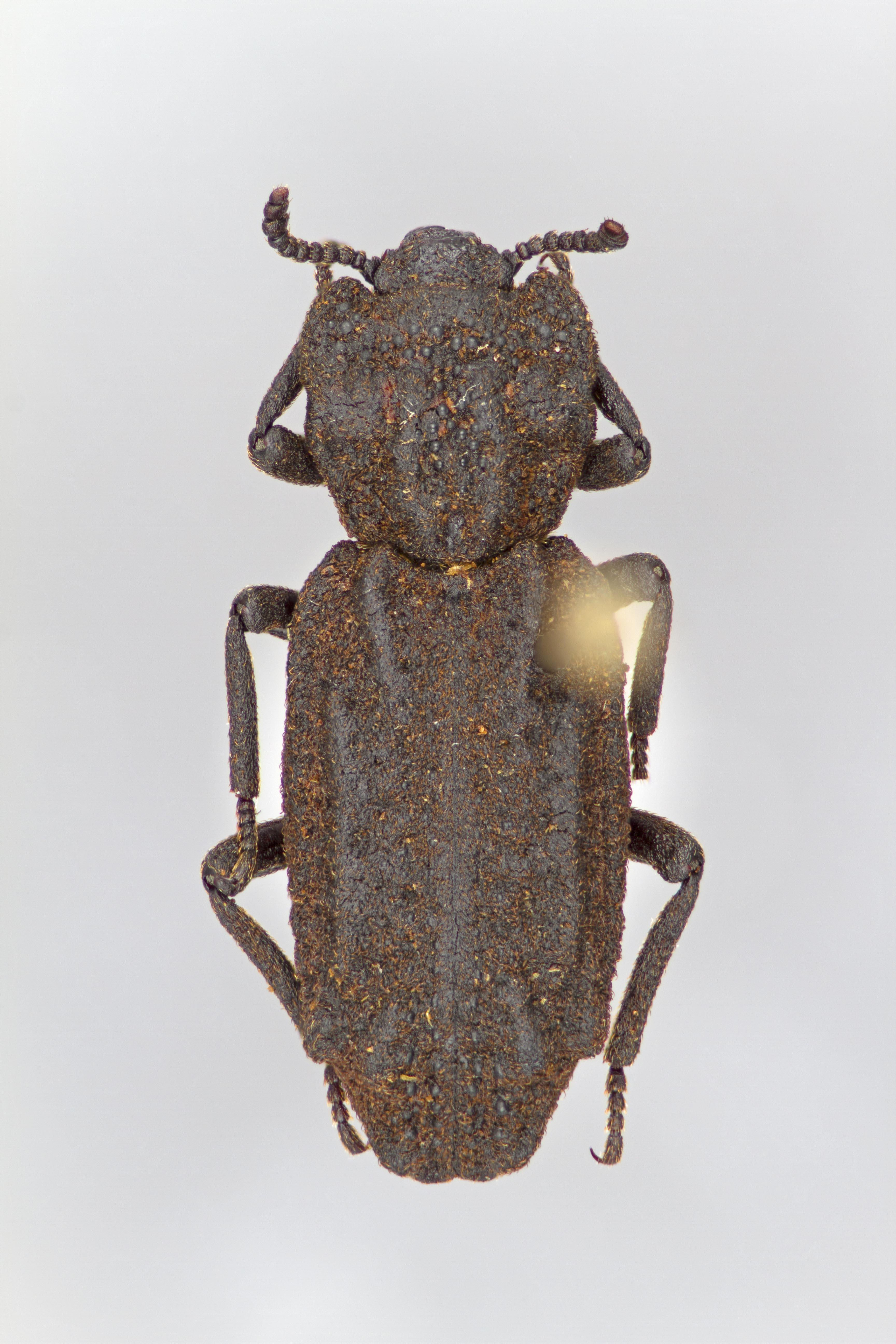
Description: Antennaeantennae:
paired, segmental appendages, borne one on each side of head, functioning as sense organs and bearing a large number of sensilla.
11-segmented with a 3-segmented club. Antennal setation sparse. Eyes well-developed, elongate-oval, somewhat reniformreniform:
kidney-shaped.
, coarsely faceted, extending well onto dorsal portion of head. Males with setose pit on submentum. Lateral margins of pronotumpronotum:
dorsal portion of the pronotum, lying above the lateral pronotal carinae when these are present.
arcuate to sinuatesinuate:
wavy, applying specifically to edges and margins.
, without distinct lobes. Pronotal discpronotal disc:
the area of the pronotum which is visible dorsally and usually delimited laterally by the two lateral carinae. Contrasted with the paired pronotal hypomera, which extend onto the ventral surface.
with several depressions and numerous small, round tuberclestubercle:
a small knoblike or rounded protuberance.
. Hypomeronhypomeron:
that portion of the pronotum which is visible from the ventral side; when there is a lateral pronotal carina, this is the portion below that carina (the pronotal disc being above it).
without depressions or antennal cavitiesantennal cavity:
a prothoracic cavity for housing the whole antenna or a portion of the antenna (usually the club).
. ProsternumProsternum:
used for the entire ventral plate lying in front of and between the procoxae and between the notosternal or pleurosternal sutures.
without distinct transverse groove. Procoxal cavitiesprocoxal cavities:
external closure: Externally closed when the postcoxal processes of the hypomera meet the prosternal process or meet one another.
narrowly open. Metacoxaemetacoxae:
the coxae of the metathorax.
widely separated, separation as wide or wider than metacoxal length. Scutellumscutellum:
posterior portion of mesotergum. Often referring only to that portion of the scutellum which is visible between the bases of the elytra (see Scutellar Shield).
small, visible. Abdominal ventriteabdominal ventrite:
visible ventral abdominal sclerite. Ventrite number does not correspond to true sternite number except in rare cases where sternite 1 is visible. Also called ventrite.
5 with a deep preapical groove divided medially into two setose depressions. Tarsal formulatarsal formula:
the number of tarsomeres on the fore, mid, and hind tarsi, respectively.
5–5–4. Dorsal surface granulose, tomentosetomentose:
covered with a form of pubescence composed of short, matted, woolly hair.
. Dorsal and ventral surfaces commonly encrusted with dirt and debris.
The genus Phellopsis is similar to the genera Sesaspis, Phloeodes, and Zopherus but can immediately be distinguished by the 11-segmented antennaeantennae:
paired, segmental appendages, borne one on each side of head, functioning as sense organs and bearing a large number of sensilla.
with a 3-segmented club, narrowly open procoxal cavitiesprocoxal cavities:
external closure: Externally closed when the postcoxal processes of the hypomera meet the prosternal process or meet one another.
, hypomeronhypomeron:
that portion of the pronotum which is visible from the ventral side; when there is a lateral pronotal carina, this is the portion below that carina (the pronotal disc being above it).
with lack of depression/antennal cavity, and a small but visible scutellumscutellum:
posterior portion of mesotergum. Often referring only to that portion of the scutellum which is visible between the bases of the elytra (see Scutellar Shield).
.
Phellopsis obcordata (Kirby, 1837), P. porcata (LeConte, 1853)
Southwest (CA, NV), Northwest (AK, ID, MT, OR, WA), Northeast (CT, MA, ME, MD, NH, NJ, NY, PA, VA, VT, WV), North Central (MI, WI), Southeast (GA, NC, TN) USA; Alberta, British Columbia, New Brunswick, Newfoundland, Nova Scotia, Ontario, Quebec, Canada.
Phellopsis feeds on fungus found in old growth boreal forests. Phellopsis obcordata have been reported to feed on Piptoporus betulinus (Polyporales) on birch (Betula papyrifera, B. lenta) and Heterobasidion annosum (Bondarzewiaceae) on balsam fir (Abies balsamea). Phellopsis porcata have been reported to feed on fungi on western hemlock (Tsuga heterophylla) and on Lentinus (Polyporaceae).
Abundance: Moderately common.
Phellopsis obcordata: Eastern species. Hypomeronhypomeron:
that portion of the pronotum which is visible from the ventral side; when there is a lateral pronotal carina, this is the portion below that carina (the pronotal disc being above it).
lacking dense setation in between tuberclestubercle:
a small knoblike or rounded protuberance.
. Distribution: Connecticut, Georgia, Maine, Michigan, Maryland, Massachusetts, North Carolina, New Hampshire, New Jersey, New York, Pennsylvania, Tennessee, Vermont, Virginia, Wisconsin, West Virginia, USA; New Brunswick, Newfoundland, Nova Scotia, Ontario, Quebec, Canada.
Phellopsis porcata: Western species. Hypomeronhypomeron:
that portion of the pronotum which is visible from the ventral side; when there is a lateral pronotal carina, this is the portion below that carina (the pronotal disc being above it).
with dense setation in between tuberclestubercle:
a small knoblike or rounded protuberance.
. Distribution: Alaska, California, Idaho, Montana, Nevada, Oregon, Washington, USA; Alberta, British Columbia, Canada.
The taxonomic history of this genus in North America is quite complex, but following the thorough revision by Foley and Ivie (2008a)Foley and Ivie (2008a):
Foley IA and Ivie MA. 2008a. A revision of the genus Phellopsis LeConte (Coleoptera: Zopheridae). Zootaxa 1689: 1-28., only two species are currently recognized.
Members of this genus are frequently encrusted with dirt and other debris which may conceal the diagnostic characters.
Foley and Ivie (2008a)Foley and Ivie (2008a):
Foley IA and Ivie MA. 2008a. A revision of the genus Phellopsis LeConte (Coleoptera: Zopheridae). Zootaxa 1689: 1-28., Foley and Ivie (2008b)Foley and Ivie (2008b):
Foley IA and Ivie MA. 2008b. A phylogenetic analysis of the tribe Zopherini with a review of the species and generic classification (Coleoptera: Zopheridae). Zootaxa 1928: 1-72., Ivie (2002c)Ivie (2002c):
Ivie, M.A. 2002c. 129. Zopheridae, pp. 457-462 In: R. H. Arnett, Jr., Jr. and M. C. Thomas (eds.), American Beetles. CRC Press, Gainesville, Florida., Kirby (1837)Kirby (1837):
Kirby, W. 1837. Part 4. The Insects. In: J. Richardson, Fauna Boreali-Americana, or the zoology of the northern parts of British merica. John Murray, London, Norwich, 325 pp., 8 pls., LeConte (1853)LeConte (1853):
LeConte, J.L. 1853. Description of twenty n. sp. of Coleoptera inhabiting the U.S. Proceedings of the Academy of National Science of Philadelphia, 6: 226–235., Ślipiński and Lawrence (1999)Ślipiński and Lawrence (1999):
Ślipiński, S.A. and J.F. Lawrence. 1999. Phylogeny and classification of Zopheridae sensu novo (Coleoptera: Tenebrionoidea) with a review of the genera of Zopherinae (excluding Monommatini). Annales Zoologici (Warszawa), 49: 1-53., Steiner (1992)Steiner (1992):
Steiner, W.E., Jr. 1992. "Ironclad Beetles", the family Zopheridae, in Maryland: notes on the natural history and distribution of Phellopsis obcordata (Kirby). Maryland Naturalist, 35: 25-30.
Authors: Lord NP, Nearns EH, Miller KB. 2011–2015.
Content updated Apr 2015; taxonomy updated Feb 2026
idtools.org