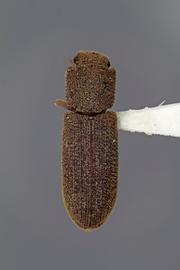
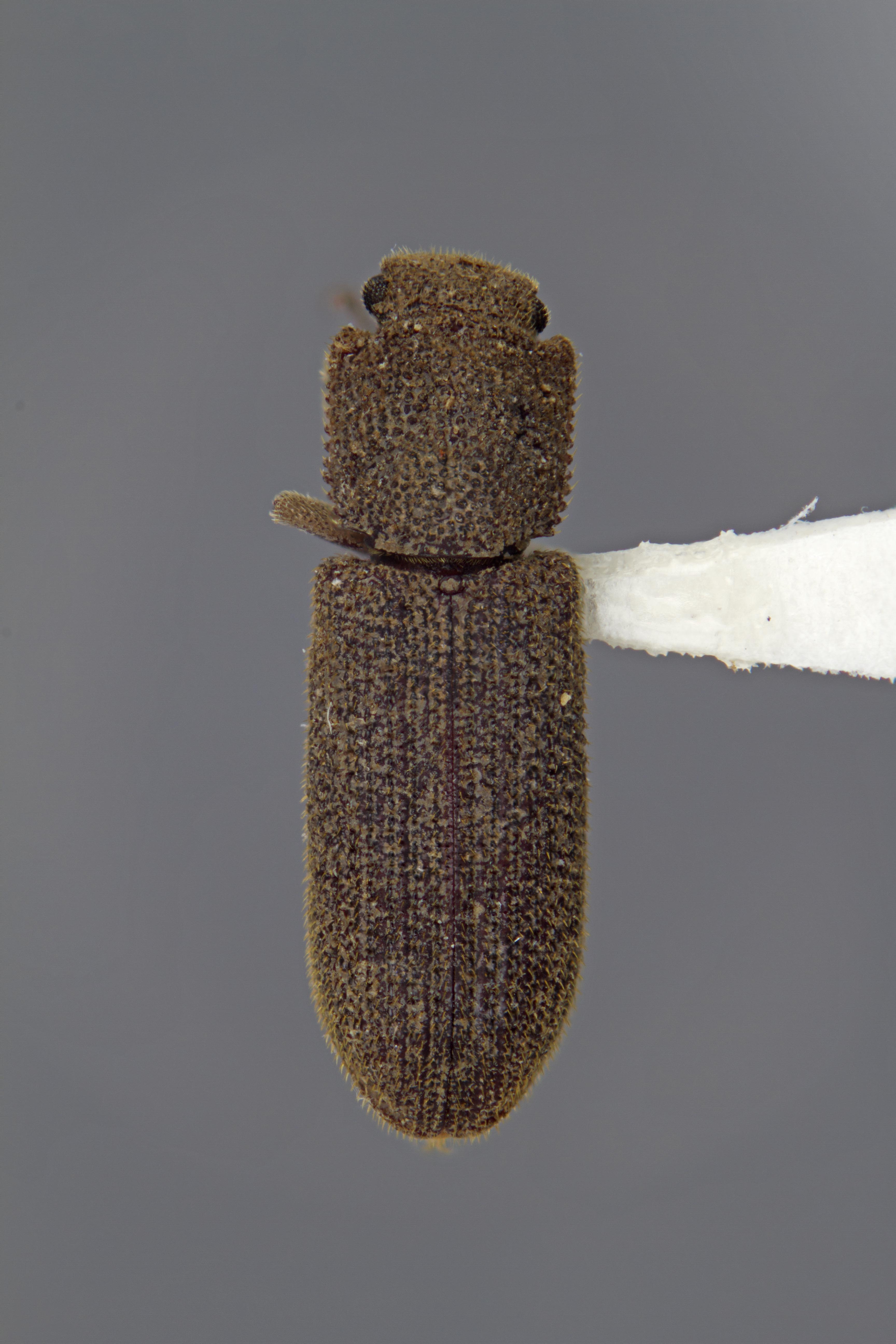
Body cylindrical. Antennaeantennae:
paired, segmental appendages, borne one on each side of head, functioning as sense organs and bearing a large number of sensilla.
11-segmented with a distinct, 2-segmented club. Antennal setation sparse. Antennomereantennomere:
antennal segment; including scape, pedicel and flagellomeres. NOTE: the flagellum is composed of all antennal segments proceeding the scape and pedicel. Any individual antennal segment is commonly called an antennomere.
3 distinctly elongate (at least twice as long as 4). Subantennal groovessubantennal groove:
groove or concavity lying below the antennal insertion and housing the base of the antenna. Placed between the eye (if present) and the mandibular articulation, and sometimes extends below or behind the eye.
short to absent. Eyes round, well-developed, facets coarse. Pronotumpronotum:
dorsal portion of the pronotum, lying above the lateral pronotal carinae when these are present.
subquadrate, disc with small, raised, dense tuberclestubercle:
a small knoblike or rounded protuberance.
. Pronotal lateral margins distinctly serrateserrate:
sawlike, i.e., with notched edges like the teeth of a saw.
, with a mid-lateral secretory poresecretory pore:
a pore that exudes a glandular secretion.
, difficult to see. Procoxal cavitiesprocoxal cavities:
external closure: Externally closed when the postcoxal processes of the hypomera meet the prosternal process or meet one another.
open. Metacoxaemetacoxae:
the coxae of the metathorax.
narrowly separated, separation less than metacoxal length. Elytraelytron:
the fore wing in Coleoptera, which is more or less uniformly sclerotized and in resting position is longitudinally oriented, usually meeting the opposite elytron along the midline.
with striae composed of alternating weak puncturespuncture:
a small impression on the cuticle, like that made by a needle.
and tuberclestubercle:
a small knoblike or rounded protuberance.
. Abdominal ventritesabdominal ventrite:
visible ventral abdominal sclerite. Ventrite number does not correspond to true sternite number except in rare cases where sternite 1 is visible. Also called ventrite.
1-3 fused. Tarsal formulatarsal formula:
the number of tarsomeres on the fore, mid, and hind tarsi, respectively.
apparently 3–3–3. Dorsal surface with small, bristle-like, erect, golden setaeseta:
a sclerotized, hairlike (or scalelike) projection of cuticula arising from a single trichogen cell and surrounded at the base by a small cuticular ring.
. Body usually encrusted with dirt or debris.
The genus Neotrichus superficially resembles the genus Endeitoma. The 4–4–4 tarsitarsus:
the fifth segment of the beetle leg, which is articulated proximally with the tibia and distally with the pretarsus; almost always subdivided into two to five tarsomeres.
, narrower antennal clubantennal club:
an enlarged portion of the antennal apex, consisting of a variable number of antennomeres (often 3). In an incrassate, antenna the antennomeres gradually enlarge towards to apex, but if there is an abrupt change in length or width at some point, then the antennomeres beyond this are considered to be part of the club.
, abdominal ventritesabdominal ventrite:
visible ventral abdominal sclerite. Ventrite number does not correspond to true sternite number except in rare cases where sternite 1 is visible. Also called ventrite.
1–3 not fused, and distribution readily distinguish Endeitoma.
Neotrichus latiusculus (Fairmaire, 1881)
Hawaiʻi, USA
Neotrichus latiusculus has been collected from under the bark of dead Pipturus and Terminalia.
Abundance: Rare.
This genus is found throughout the Australo-Pacific region. It has likely been introduced into the United States.
Ford (1968)Ford (1968):
Ford EJ Jr. 1968. Colydiid beetles of Hawaii, With the description of a new species. Pacific Insects 10: 161-165., Ivie (2002a)Ivie (2002a):
Ivie, M.A. 2002a. 127. Colydiidae, pp. 445-453 In: R. H. Arnett, Jr., Jr. and M. C. Thomas (eds.), American Beetles. CRC Press, Gainesville, Florida., Jamieson (1999)Jamieson (1999):
Jamieson, D.W. 1999. New arthropod records for Kaua'i. Bishop Museum Occasional Papers, 59: 19-26., Nishida (1992)Nishida (1992):
Nishida, G. M., ed. 1992. Hawaiian terrestrial arthropod checklist. Bishop Museum Technical Report, 1: i-viii and 1-262., Ślipiński and Lawrence (1997)Ślipiński and Lawrence (1997):
Ślipiński, S.A. and J.F. Lawrence. 1997. Genera of Colydiinae (Coleoptera: Zopheridae) of the Australo-Pacific region. Annales Zoologici (Warszawa), 47: 341-440.
Authors: Lord NP, Nearns EH, Miller KB. 2011–2015.
Content updated Apr 2015; taxonomy updated Feb 2026
idtools.org