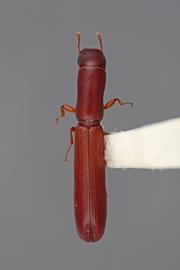
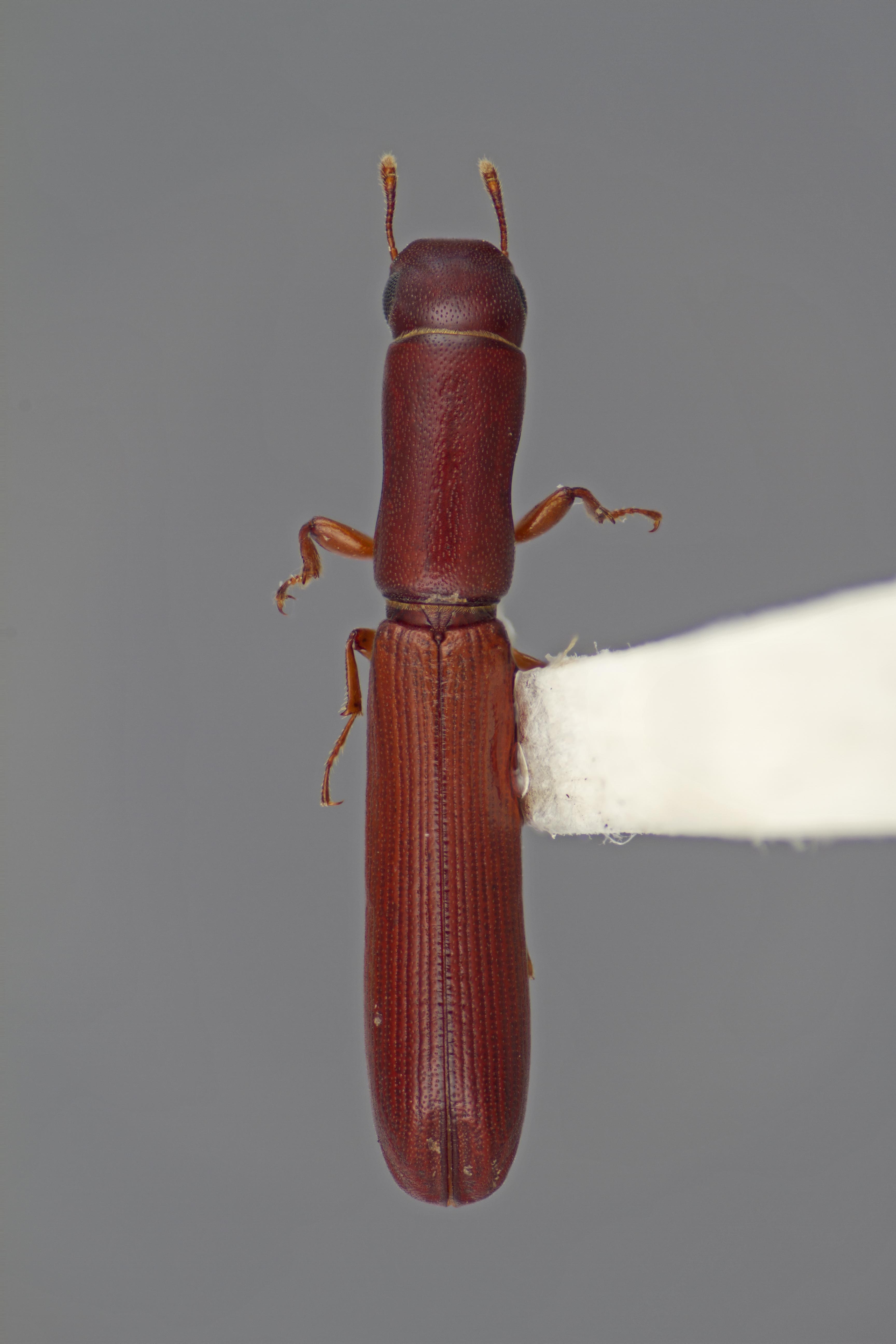
Body extremely elongate, cylindrical. Antennaeantennae:
paired, segmental appendages, borne one on each side of head, functioning as sense organs and bearing a large number of sensilla.
11-segmented with a distinct, 2-segmented club. Antennal setation sparse. Subantennal groovessubantennal groove:
groove or concavity lying below the antennal insertion and housing the base of the antenna. Placed between the eye (if present) and the mandibular articulation, and sometimes extends below or behind the eye.
present, distinct. Eyes well-developed, round, finely faceted, flush with head. Pronotal discpronotal disc:
the area of the pronotum which is visible dorsally and usually delimited laterally by the two lateral carinae. Contrasted with the paired pronotal hypomera, which extend onto the ventral surface.
simple, pronotumpronotum:
dorsal portion of the pronotum, lying above the lateral pronotal carinae when these are present.
longer than wide, lateral margins with large, shallowly depresseddepressed:
flattened down as if pressed.
area. Procoxal cavitiesprocoxal cavities:
external closure: Externally closed when the postcoxal processes of the hypomera meet the prosternal process or meet one another.
broadly closed. Metacoxaemetacoxae:
the coxae of the metathorax.
narrowly separated, separation less than metacoxal length. Elytral smooth, with finely impressed striae. Tarsal formulatarsal formula:
the number of tarsomeres on the fore, mid, and hind tarsi, respectively.
4–4–4. Dorsal surface glabrousglabrous:
without hairs (setae).
, densely and minutely punctured.
The genus Nematidium is extremely distinctive and is not readily confused with other zopherid genera.
Nematidium filiforme LeConte, 1863
Southeastern (AL, FL, GA, NC, SC, TN), South Central (LA) USA.
Likely occurs in South Central (MS) USA.
Nematidium filiforme had been collected at MV/UV lights. Adults and larvae of Nematidium have been found in the galleries of ambrosia beetles (Curculionidae: Platypodinae), and they are suspected to feed on the larvae of those beetles within the galleries (Beeson 1941Beeson 1941:
Beeson CFC. 1941. The Ecology and Control of Forest Insects. Forest Research Institute, Dehra Dun, and Imperial Forestry Institute, Oxford. 1007 pp., 203 figs., Ivie 2002aIvie 2002a:
Ivie MA. 2002a. 127. Colydiidae. In: Arnett RH Jr, Thomas MC, editors. American beetles. CRC Press, Gainesville, Florida. p 445–453., Roberts 1977Roberts 1977:
Roberts H. 1977. The Platypodidae (Coleoptera) of Fiji (with descriptions of two new species). Journal of Natural History. 11(5):555–578.). This genus is a beneficial insect, attacking destructive wood boring beetles.
Abundance: Uncommon.
This genus occurs worldwide, from South America to Indo-Malaysia.
Ivie (2002a)Ivie (2002a):
Ivie, M.A. 2002a. 127. Colydiidae, pp. 445-453 In: R. H. Arnett, Jr., Jr. and M. C. Thomas (eds.), American Beetles. CRC Press, Gainesville, Florida., LeConte (1863)LeConte (1863):
LeConte, J.L. 1863. New species of North American Coleoptera. Part I. Smithsonian Miscellaneous Collections, 167: 1-92., Stephan (1989)Stephan (1989):
Stephan, K.H. 1989. The Bothrideridae and Colydiidae of America north of Mexico (Coleoptera: Clavicornia and Heteromera). Occasional Papers of the Florida State Collection of Arthropods, 6: xii + 65 pp.
Authors: Lord NP, Nearns EH, Miller KB. 2011–2015.
Content updated Apr 2015; taxonomy updated Feb 2026
idtools.org