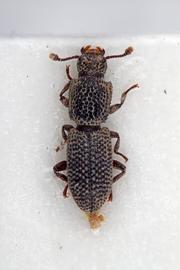
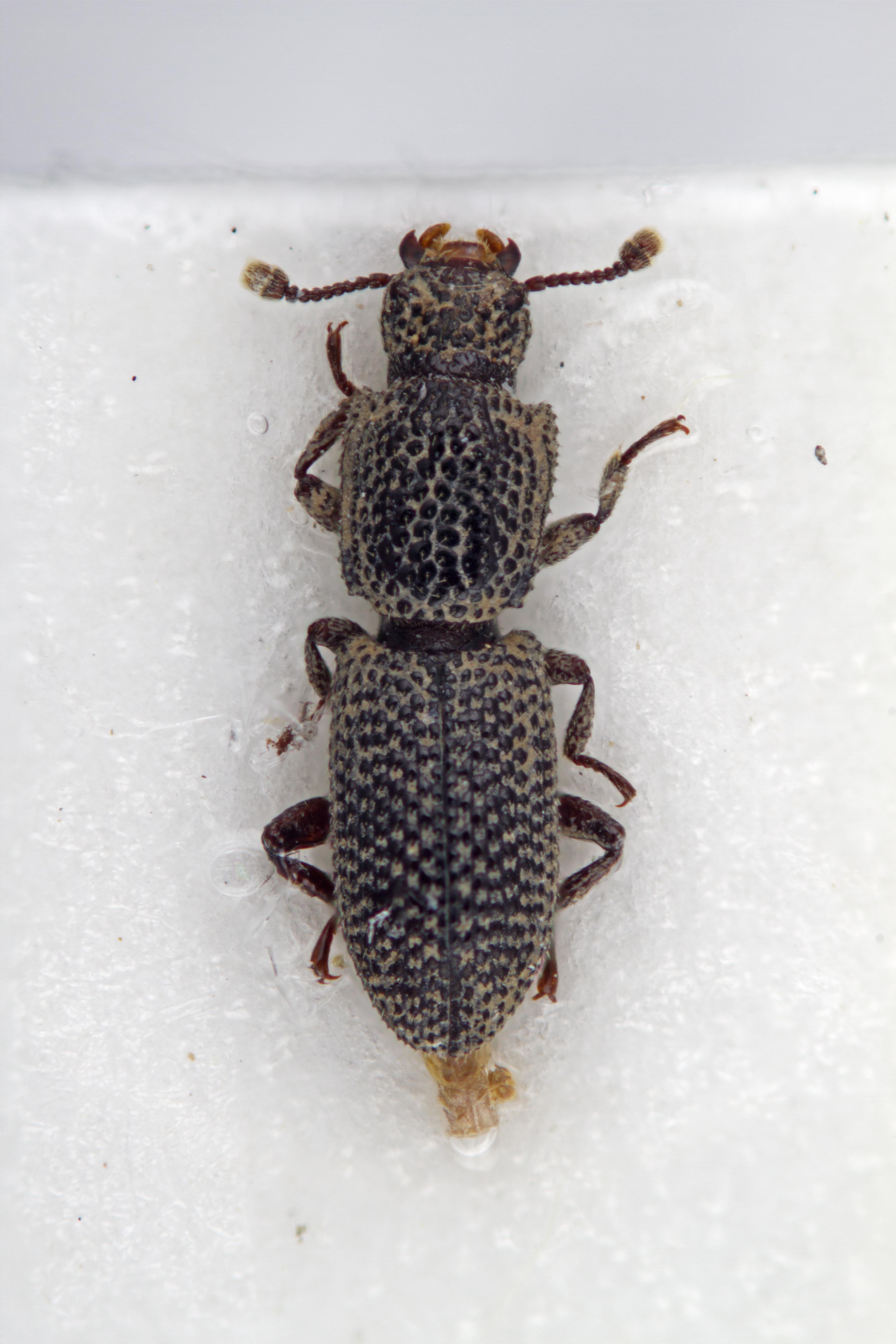
Body extremely small. Antennaeantennae:
paired, segmental appendages, borne one on each side of head, functioning as sense organs and bearing a large number of sensilla.
11-segmented with a distinct, 2-segmented club. Antennal setation sparse, except for club densely setose. Subantennal groovessubantennal groove:
groove or concavity lying below the antennal insertion and housing the base of the antenna. Placed between the eye (if present) and the mandibular articulation, and sometimes extends below or behind the eye.
present, distinct, extending to rear of head. Eyes absent. Pronotal discpronotal disc:
the area of the pronotum which is visible dorsally and usually delimited laterally by the two lateral carinae. Contrasted with the paired pronotal hypomera, which extend onto the ventral surface.
with large, irregular tuberclestubercle:
a small knoblike or rounded protuberance.
, lateral margins weakly serrateserrate:
sawlike, i.e., with notched edges like the teeth of a saw.
. Procoxal cavitiesprocoxal cavities:
external closure: Externally closed when the postcoxal processes of the hypomera meet the prosternal process or meet one another.
narrowly open. Metacoxaemetacoxae:
the coxae of the metathorax.
narrowly separated, separation less than metacoxal length. Elytral smooth, with finely impressed striae. Tarsal formulatarsal formula:
the number of tarsomeres on the fore, mid, and hind tarsi, respectively.
4–4–4. Dorsal surface covered in large, flattened, nearly contiguous tuberclestubercle:
a small knoblike or rounded protuberance.
. Body usually encrusted with dirt or debris.
The genus Lyreus is extremely distinctive and is not readily confused with other zopherid genera.
Lyreus alleni Ivie and Ślipiński, 2001
Southeastern (AL) USA.
Lyreus alleni is known only from a limestone sinkhole in Alabama.
Abundance: Uncommon.
The only other known species of Lyreus is European, creating an odd distribution for the genus.
Ivie (2002a)Ivie (2002a):
Ivie, M.A. 2002a. 127. Colydiidae, pp. 445-453 In: R. H. Arnett, Jr., Jr. and M. C. Thomas (eds.), American Beetles. CRC Press, Gainesville, Florida., Ivie and Ślipiński (2001b)Ivie and Ślipiński (2001b):
Ivie, M.A. and S.A. Ślipiński. 2001b. A new species of Lyreus Aube from Alabama, first report of the genus from the New World (Zopheridae: Colydiinae: Synchitini). Coleopterist Bulletin, 55 (4): 501-505.
Authors: Lord NP, Nearns EH, Miller KB. 2011–2015.
Content updated Apr 2015; taxonomy updated Feb 2026
idtools.org