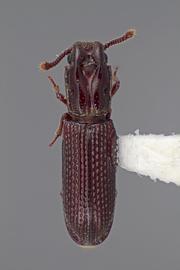
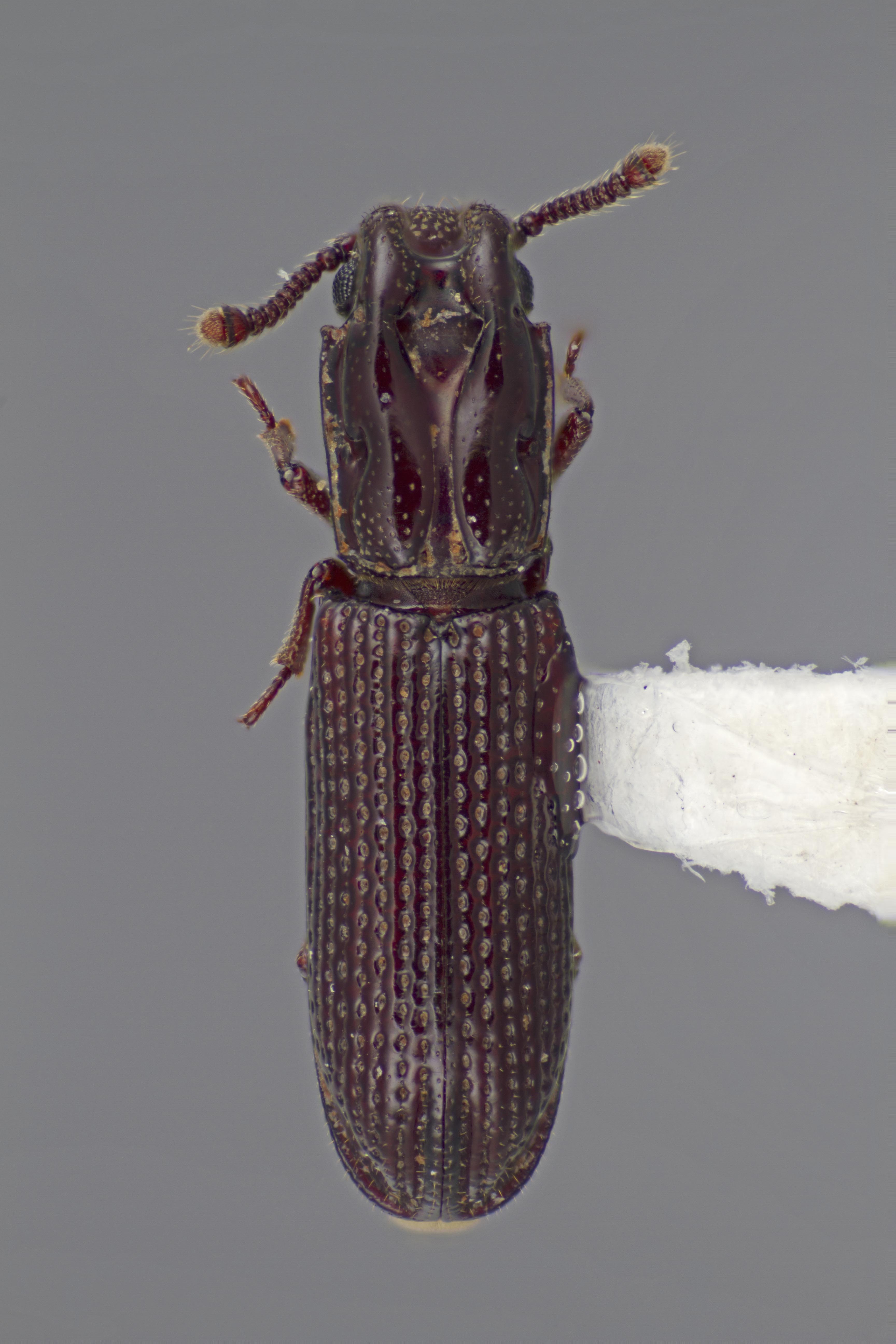
Body cylindrical. Antennaeantennae:
paired, segmental appendages, borne one on each side of head, functioning as sense organs and bearing a large number of sensilla.
11-segmented with a distinct, 2-segmented club. Antennal setation sparse. Subantennal groovessubantennal groove:
groove or concavity lying below the antennal insertion and housing the base of the antenna. Placed between the eye (if present) and the mandibular articulation, and sometimes extends below or behind the eye.
absent. Eyes well-developed, round, finely faceted. Pronotal discpronotal disc:
the area of the pronotum which is visible dorsally and usually delimited laterally by the two lateral carinae. Contrasted with the paired pronotal hypomera, which extend onto the ventral surface.
with pair of large, forward projecting horns. Pronotumpronotum:
dorsal portion of the pronotum, lying above the lateral pronotal carinae when these are present.
longer than wide, lateral margins parallel-sided. Pronotumpronotum:
dorsal portion of the pronotum, lying above the lateral pronotal carinae when these are present.
with a mid-lateral secretory poresecretory pore:
a pore that exudes a glandular secretion.
situated in a lateral, longitudinal channel. Procoxal cavitiesprocoxal cavities:
external closure: Externally closed when the postcoxal processes of the hypomera meet the prosternal process or meet one another.
narrowly open. Metacoxaemetacoxae:
the coxae of the metathorax.
narrowly separated, separation less than metacoxal length. Elytral with 9 rows of evenly spaced, round puncturespuncture:
a small impression on the cuticle, like that made by a needle.
. Abdominal ventritesabdominal ventrite:
visible ventral abdominal sclerite. Ventrite number does not correspond to true sternite number except in rare cases where sternite 1 is visible. Also called ventrite.
1–3 fused, distinctly convexconvex:
the outer curved surface of a segment of a sphere, as opposed to concave.
, ventrite 4 narrow, with transverse groove, ventrite 5 flat. Tarsal formulatarsal formula:
the number of tarsomeres on the fore, mid, and hind tarsi, respectively.
apparently 3–3–3 (actually 4–4–4, tarsomerestarsomere:
one of the divisions of the tarsus.
1 and 2 partially fused). Dorsal surface glabrousglabrous:
without hairs (setae).
.
The genus Lobogestoria is similar to the genus Antilissus in having an apparently 3–3–3 tarsal formulatarsal formula:
the number of tarsomeres on the fore, mid, and hind tarsi, respectively.
and grooved pronotumpronotum:
dorsal portion of the pronotum, lying above the lateral pronotal carinae when these are present.
, but Lobogestoria is easily distinguished by the large, horn-like projections of the pronotumpronotum:
dorsal portion of the pronotum, lying above the lateral pronotal carinae when these are present.
extending well over the head.
Lobogestoria gibbicollis Reitter, 1878Reitter, 1878:
Reitter, E. 1878. Lobogestoria nov. gen. Lathrididarum. Deutsche Entomologische Zeitschrift, 22: 31-32.
Southeastern (AL, FL, GA, SC), South Central (LA) USA.
Likely to occur in South Central (MS) USA.
Nothing is known about the biology of this group.
Abundance: Rare.
This genus is also found in Cuba, parts of South America, and the Australo-Pacific region. It has likely been introduced into the United States.
Ivie (2002a)Ivie (2002a):
Ivie, M.A. 2002a. 127. Colydiidae, pp. 445-453 In: R. H. Arnett, Jr., Jr. and M. C. Thomas (eds.), American Beetles. CRC Press, Gainesville, Florida., Reitter (1878)Reitter (1878):
Reitter, E. 1878. Lobogestoria nov. gen. Lathrididarum. Deutsche Entomologische Zeitschrift, 22: 31-32., Stephan (1989)Stephan (1989):
Stephan, K.H. 1989. The Bothrideridae and Colydiidae of America north of Mexico (Coleoptera: Clavicornia and Heteromera). Occasional Papers of the Florida State Collection of Arthropods, 6: xii + 65 pp.
Authors: Lord NP, Nearns EH, Miller KB. 2011–2015.
Content updated Apr 2015; taxonomy updated Feb 2026
idtools.org