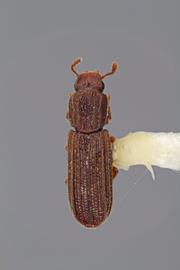
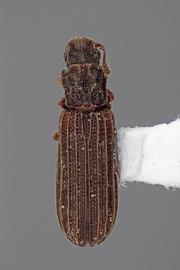
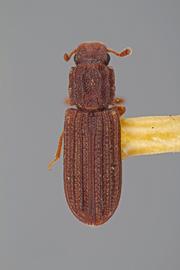
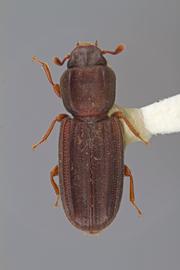
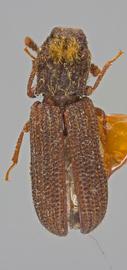
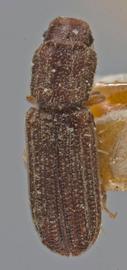
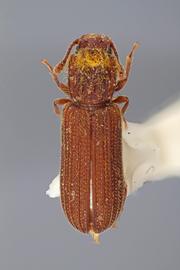
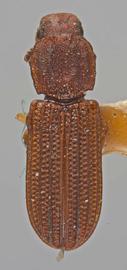
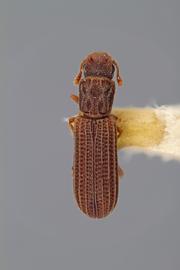
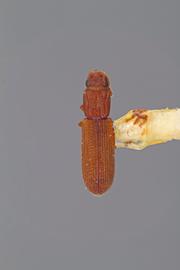
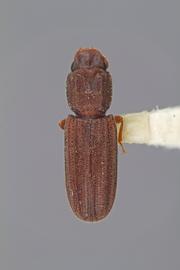
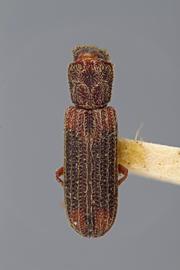
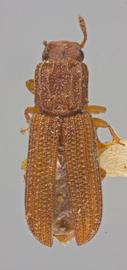
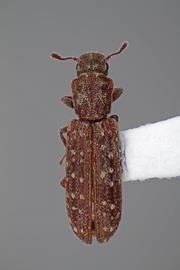
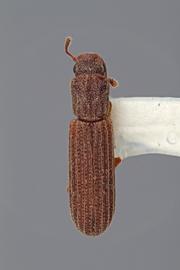
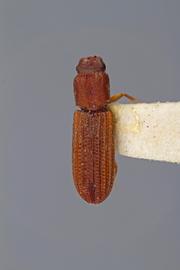
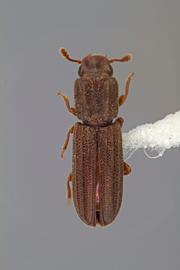
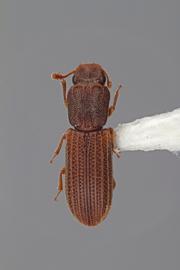
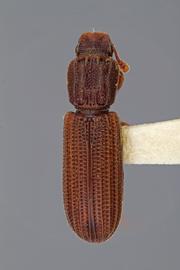
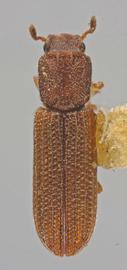
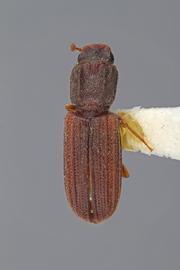
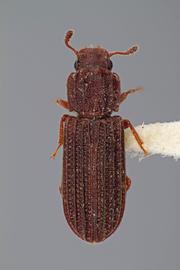
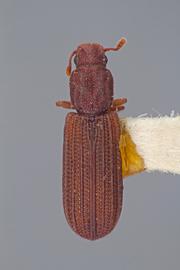
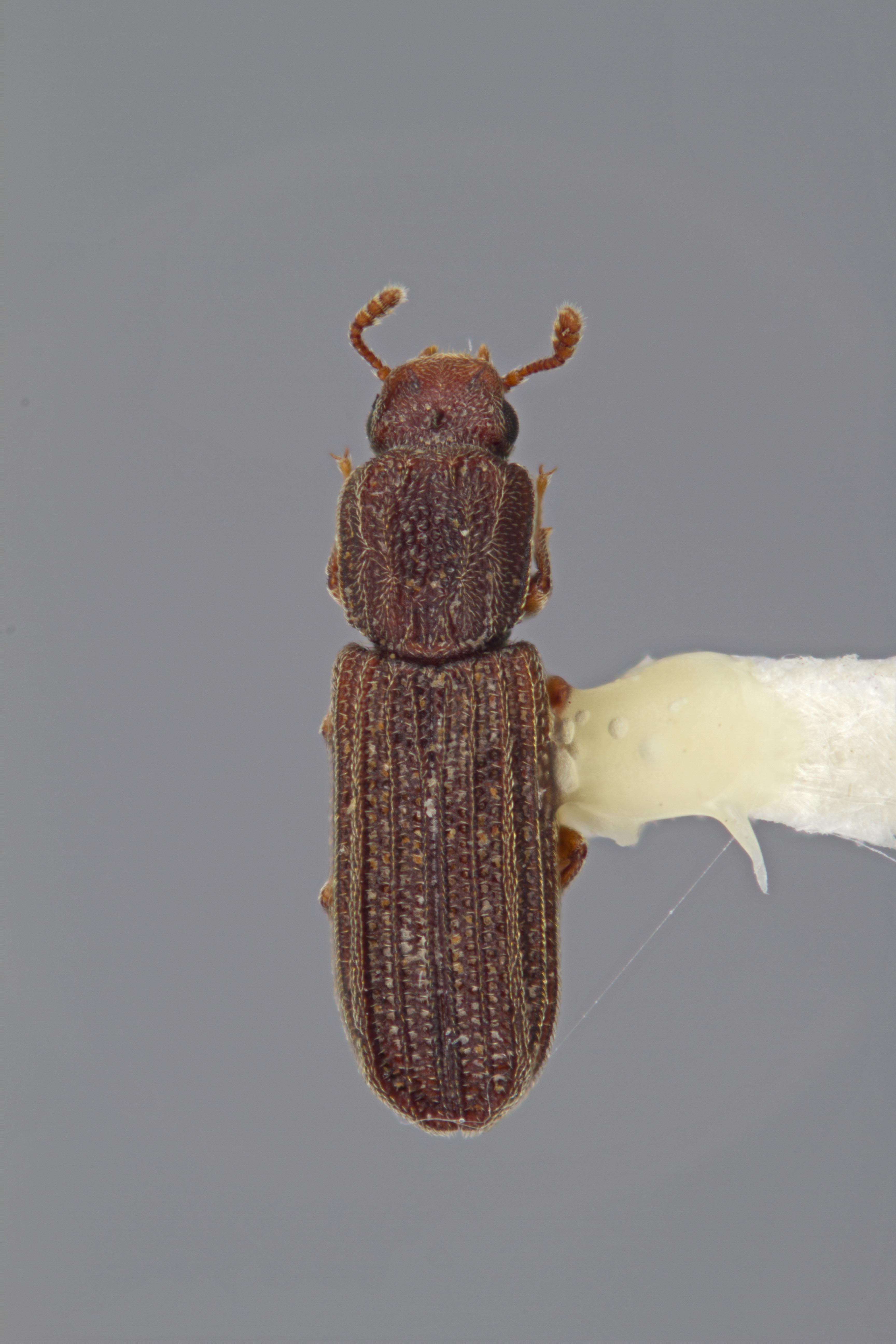
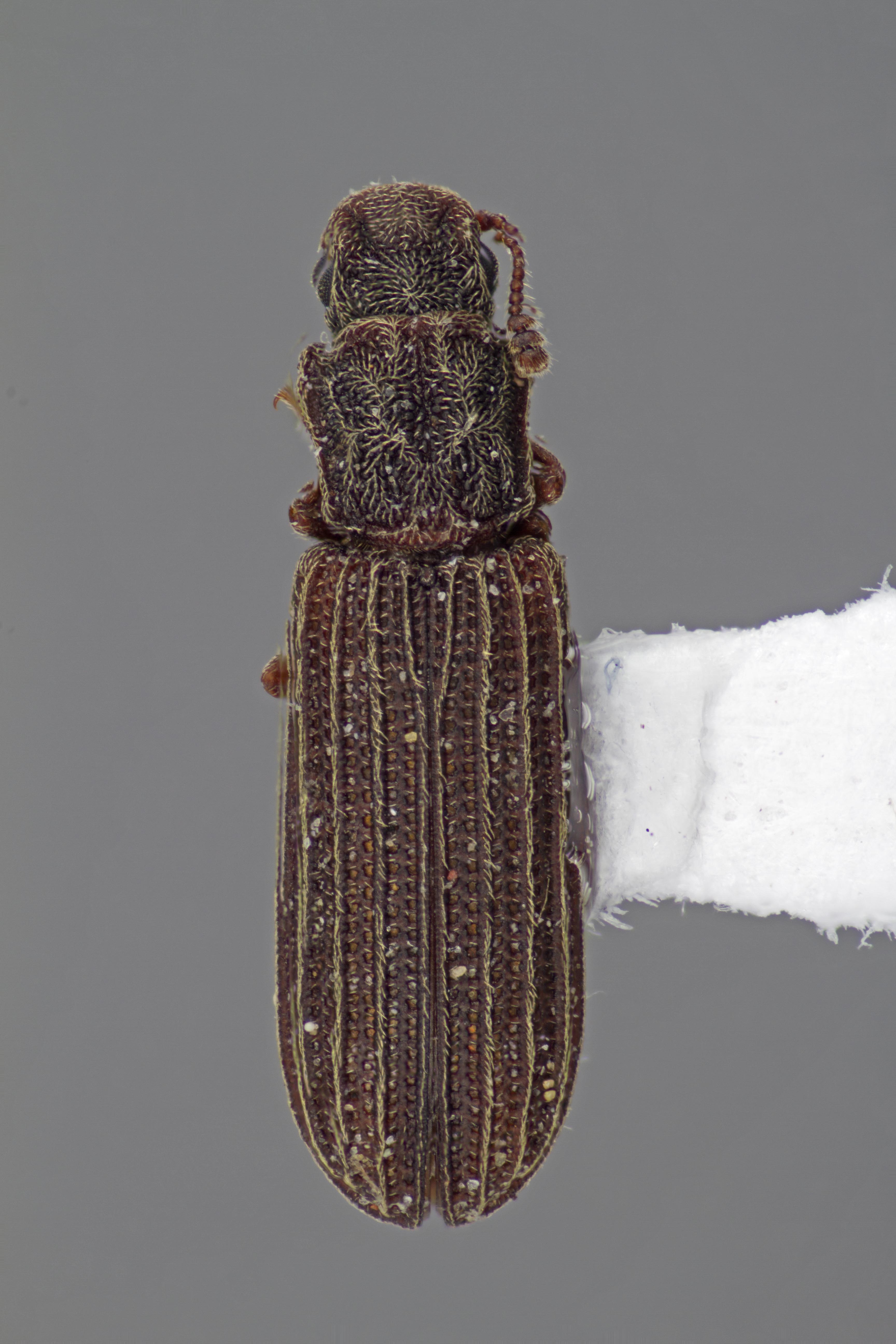
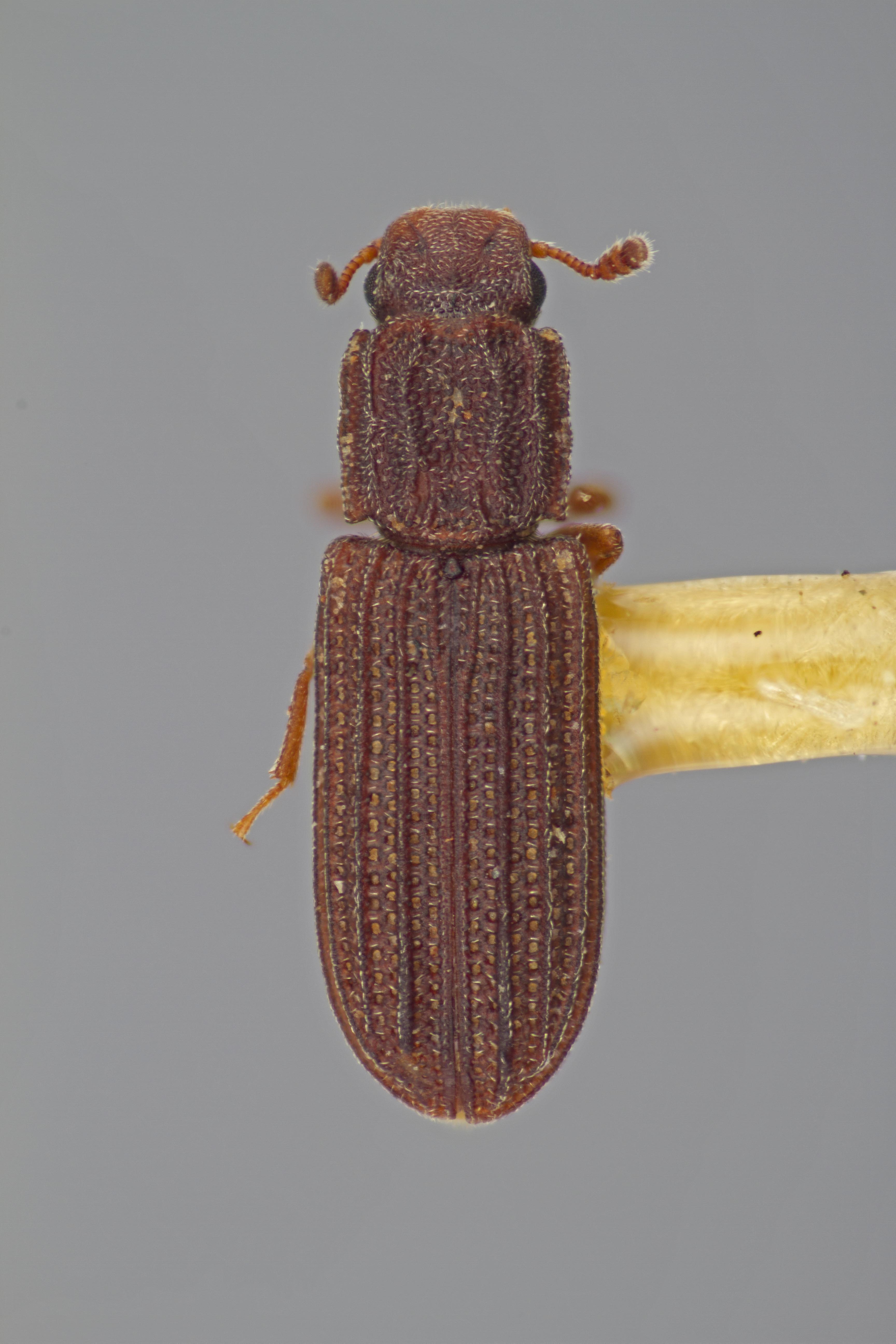
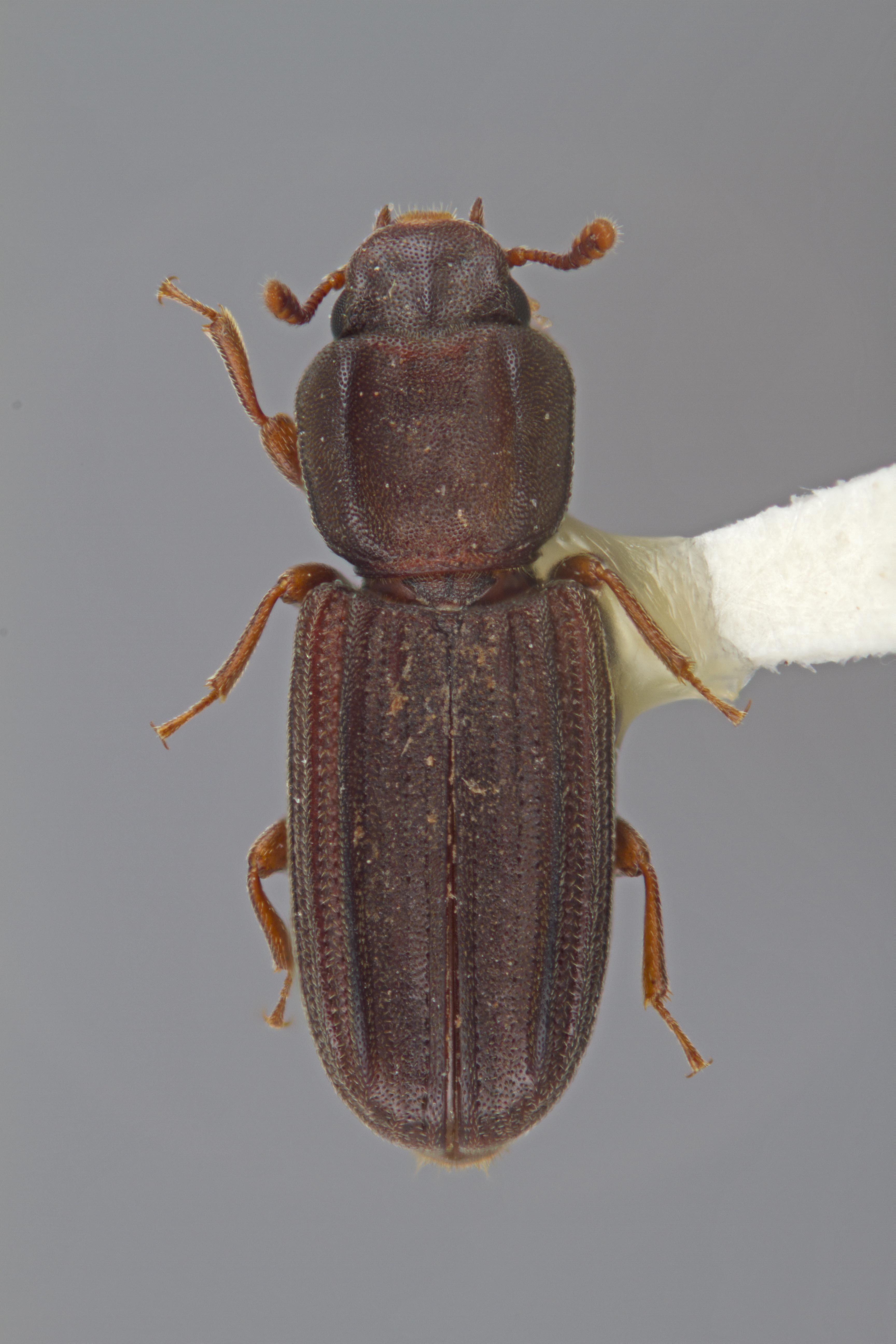
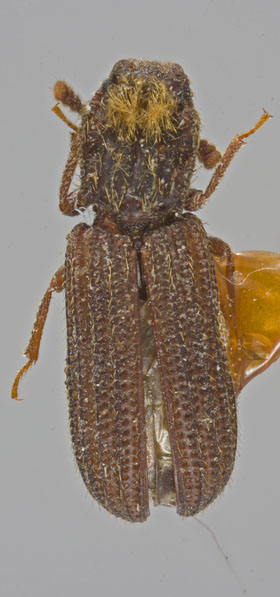
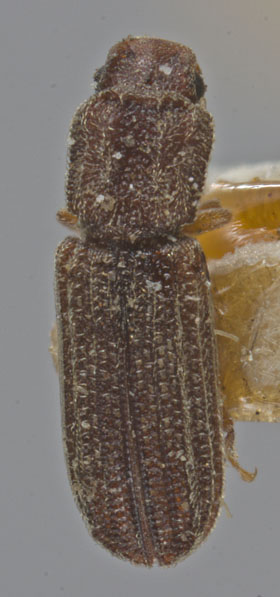
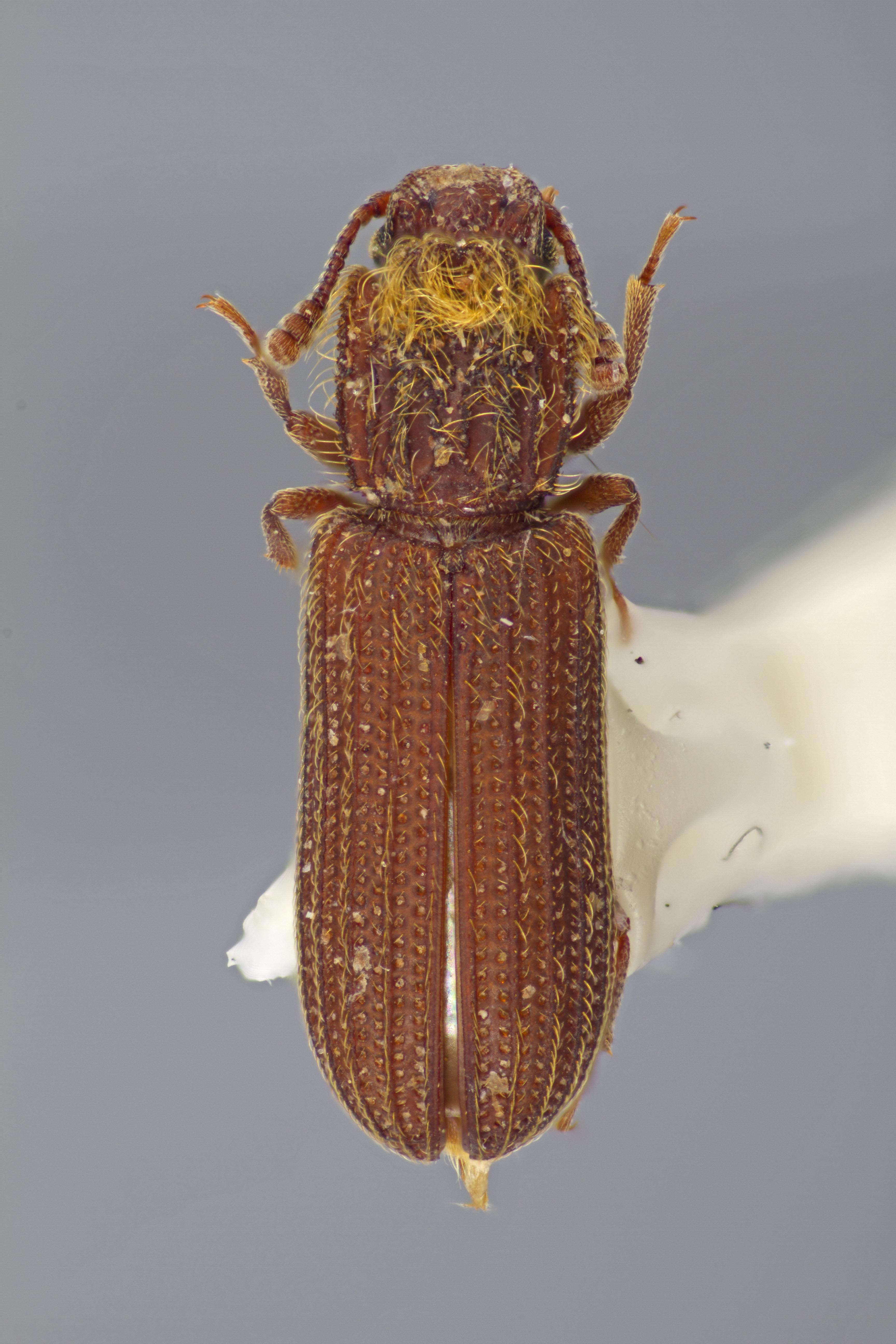
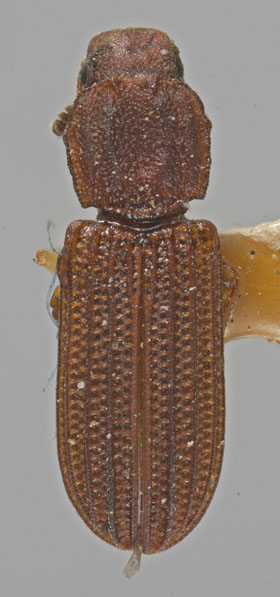
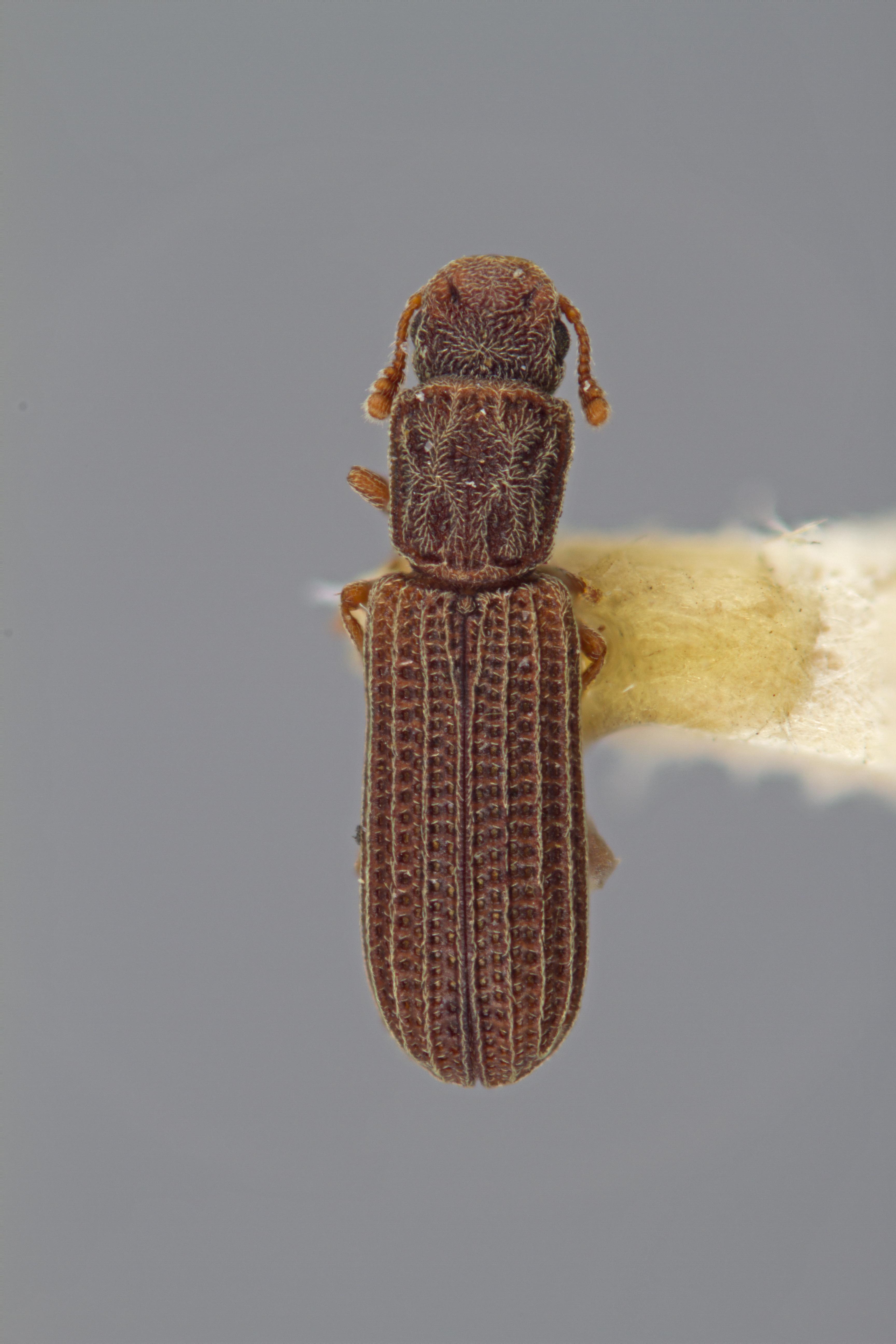
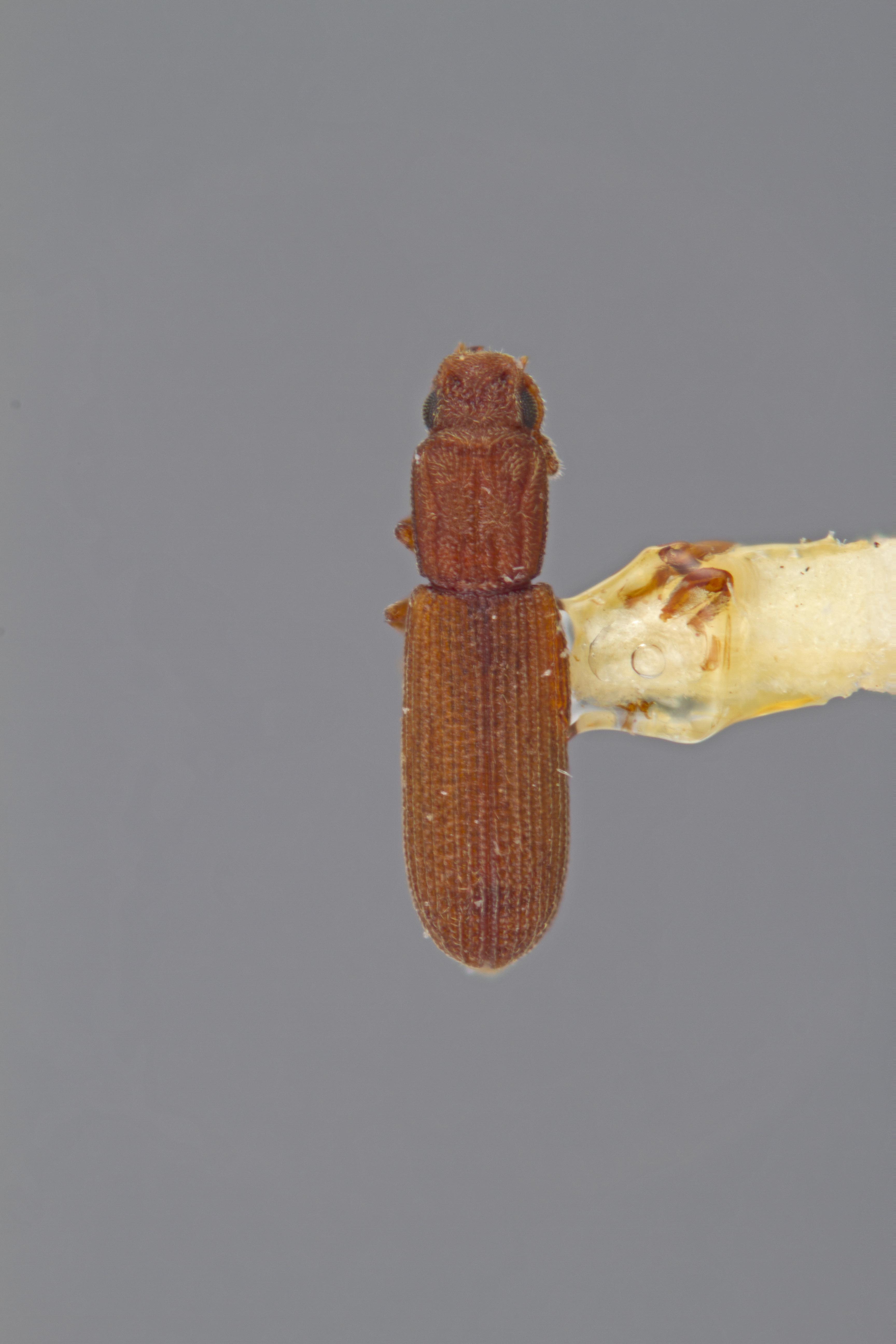
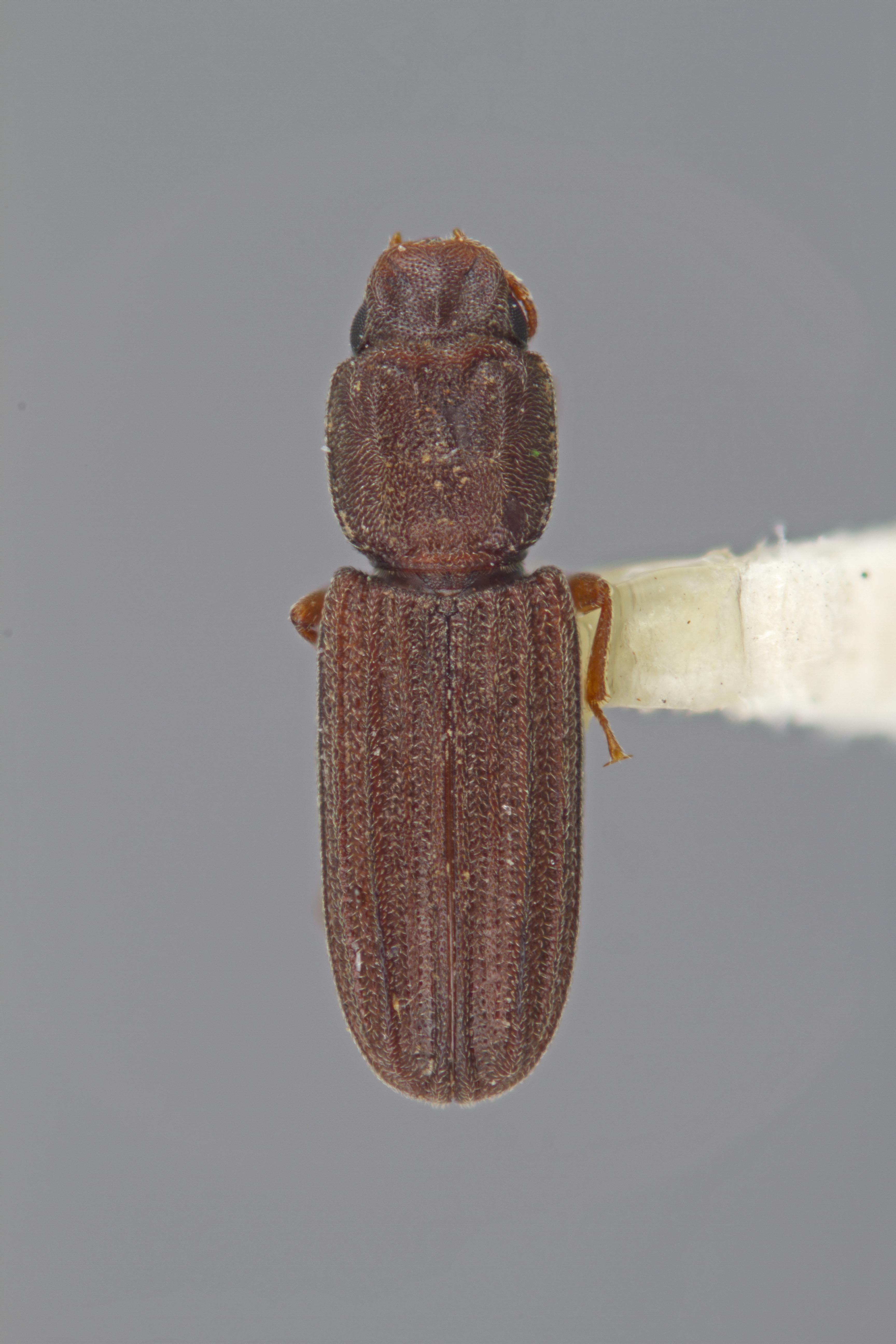
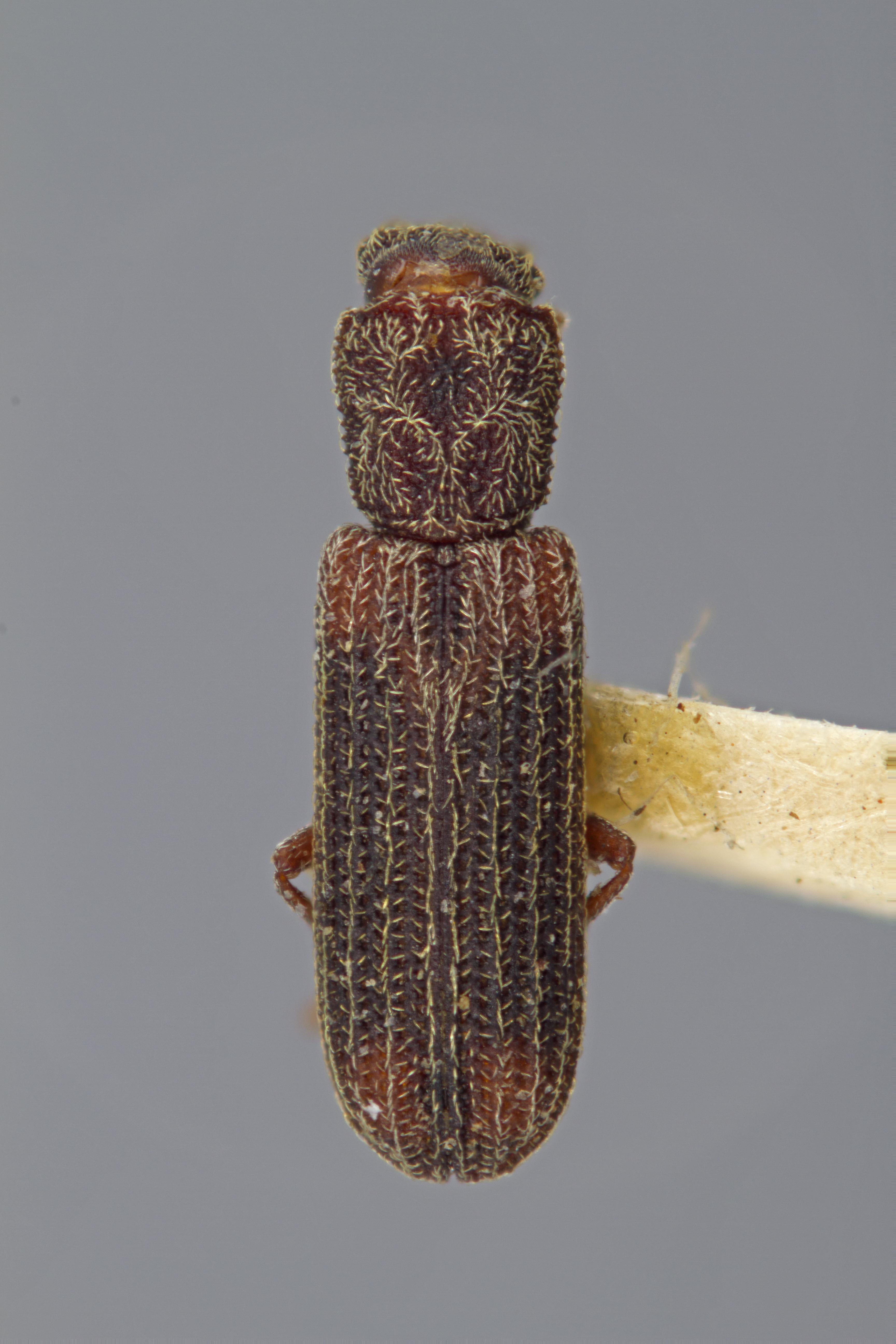
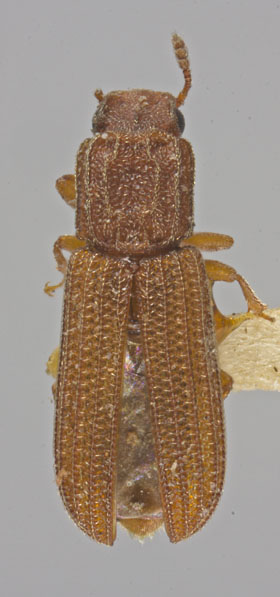
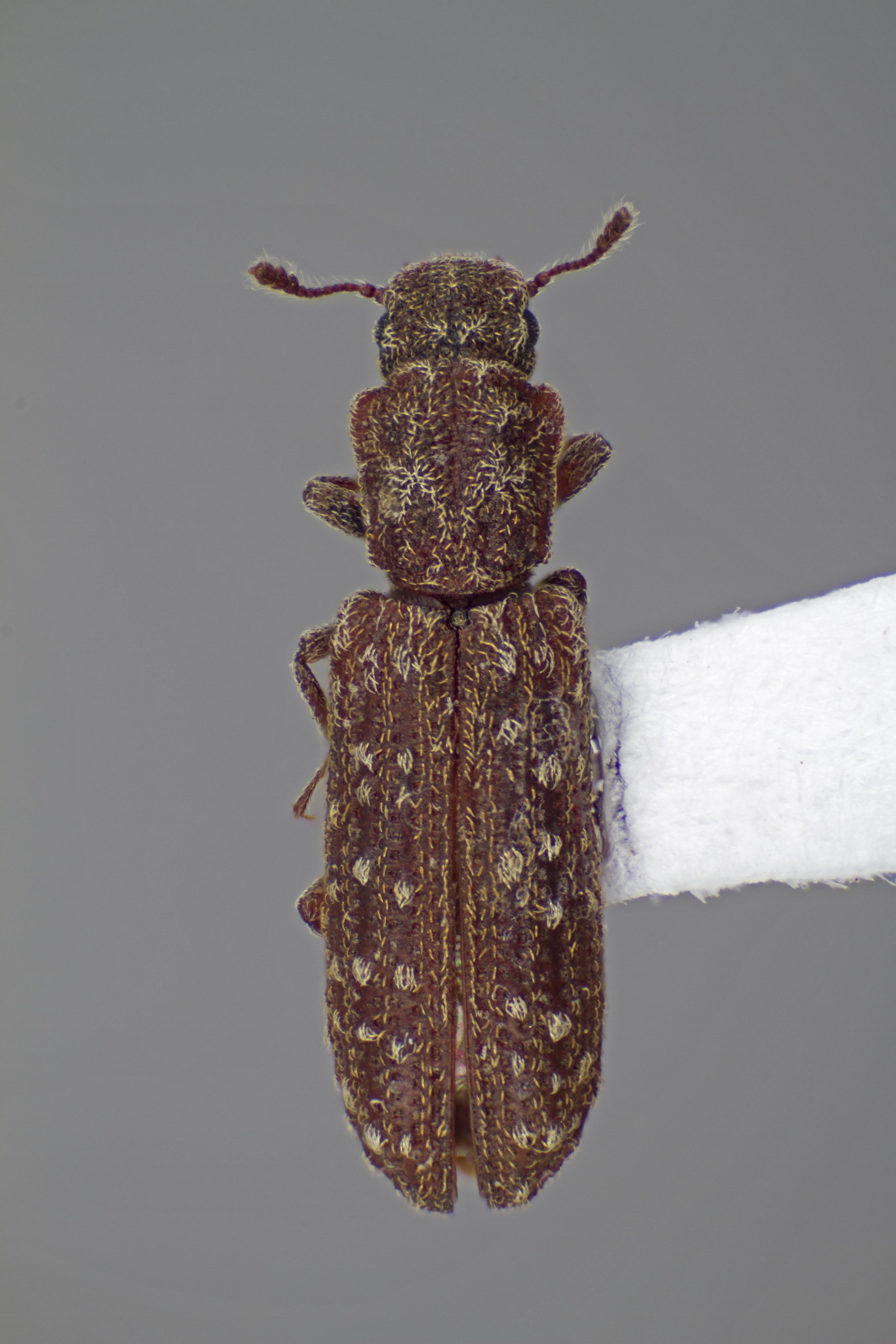
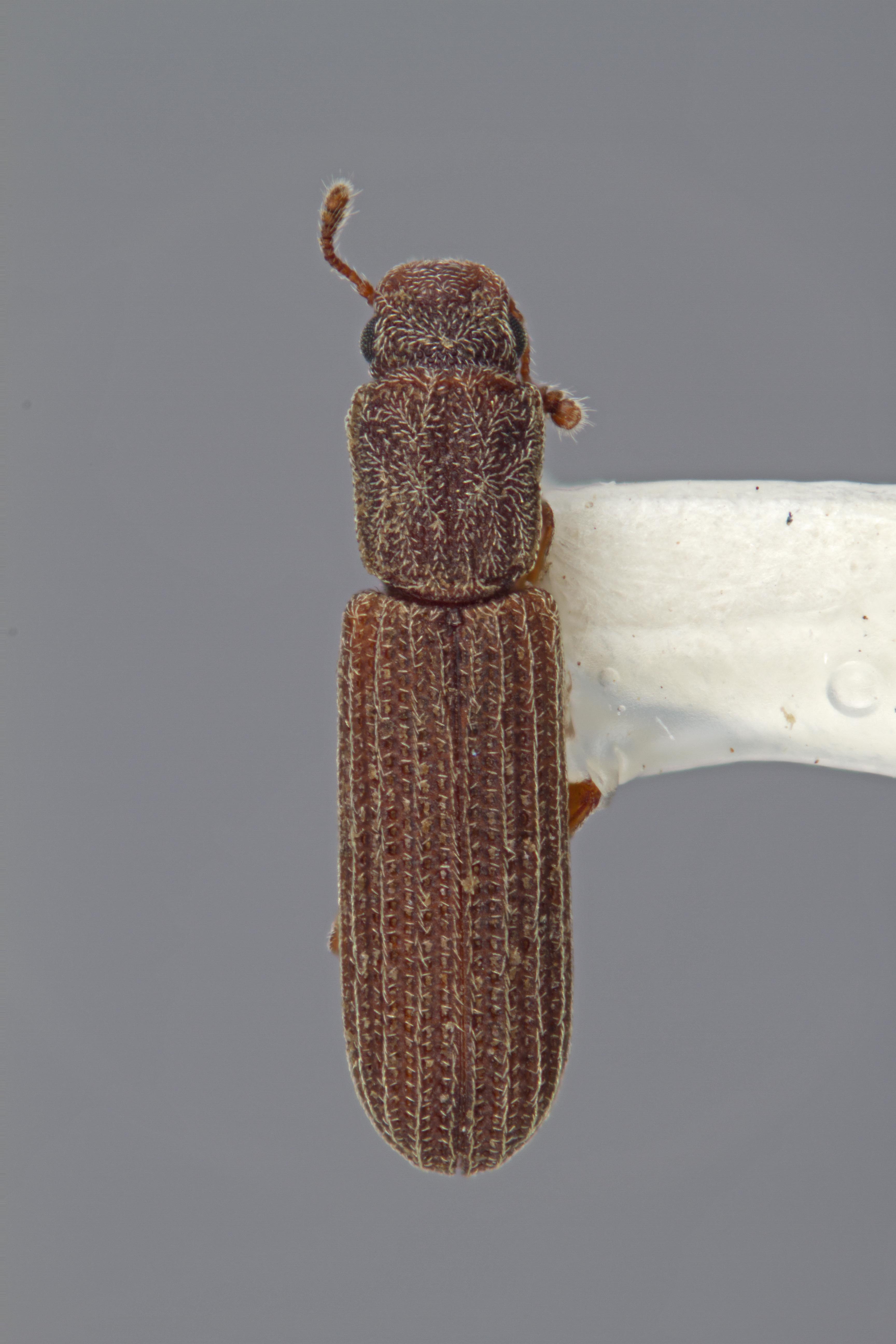
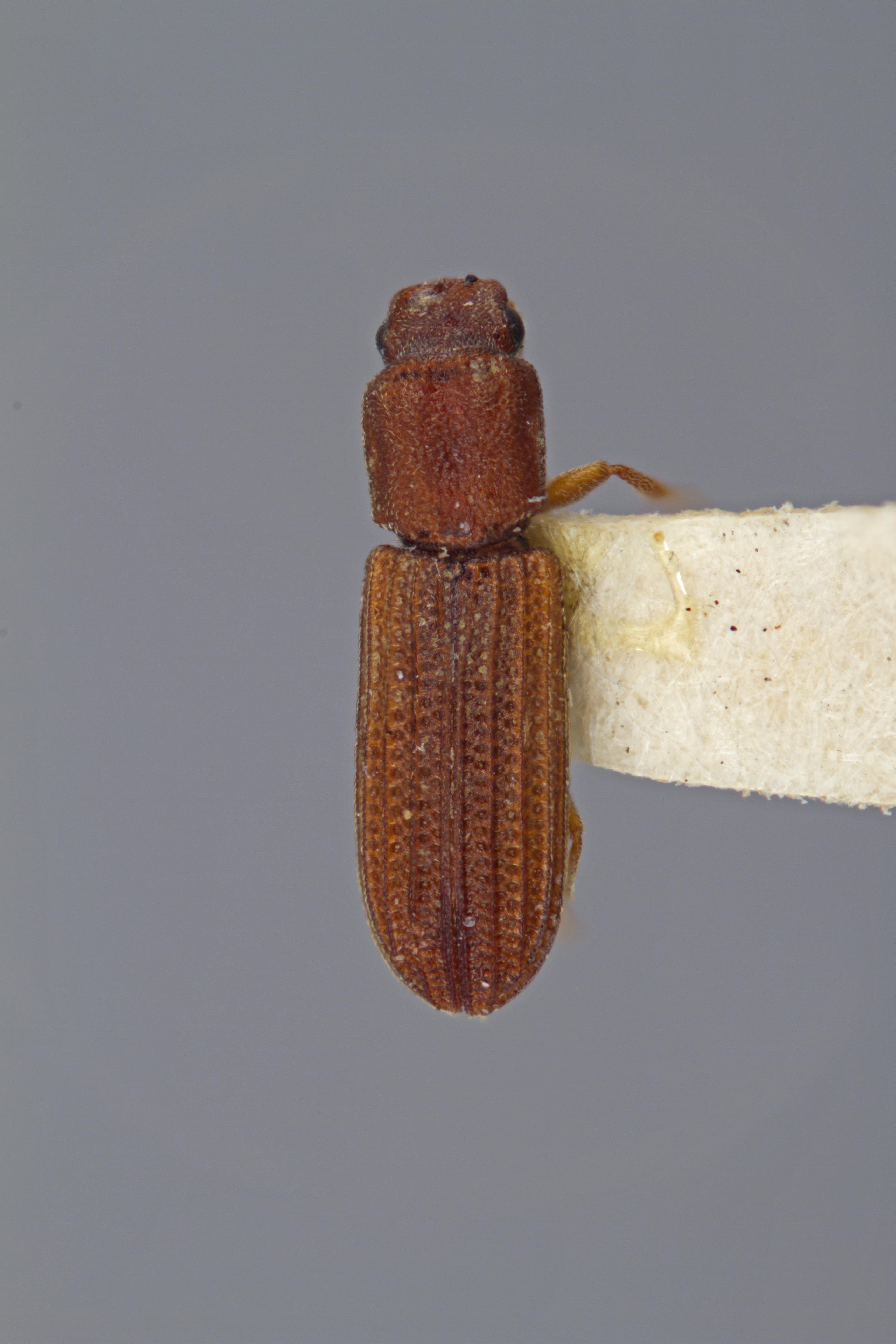
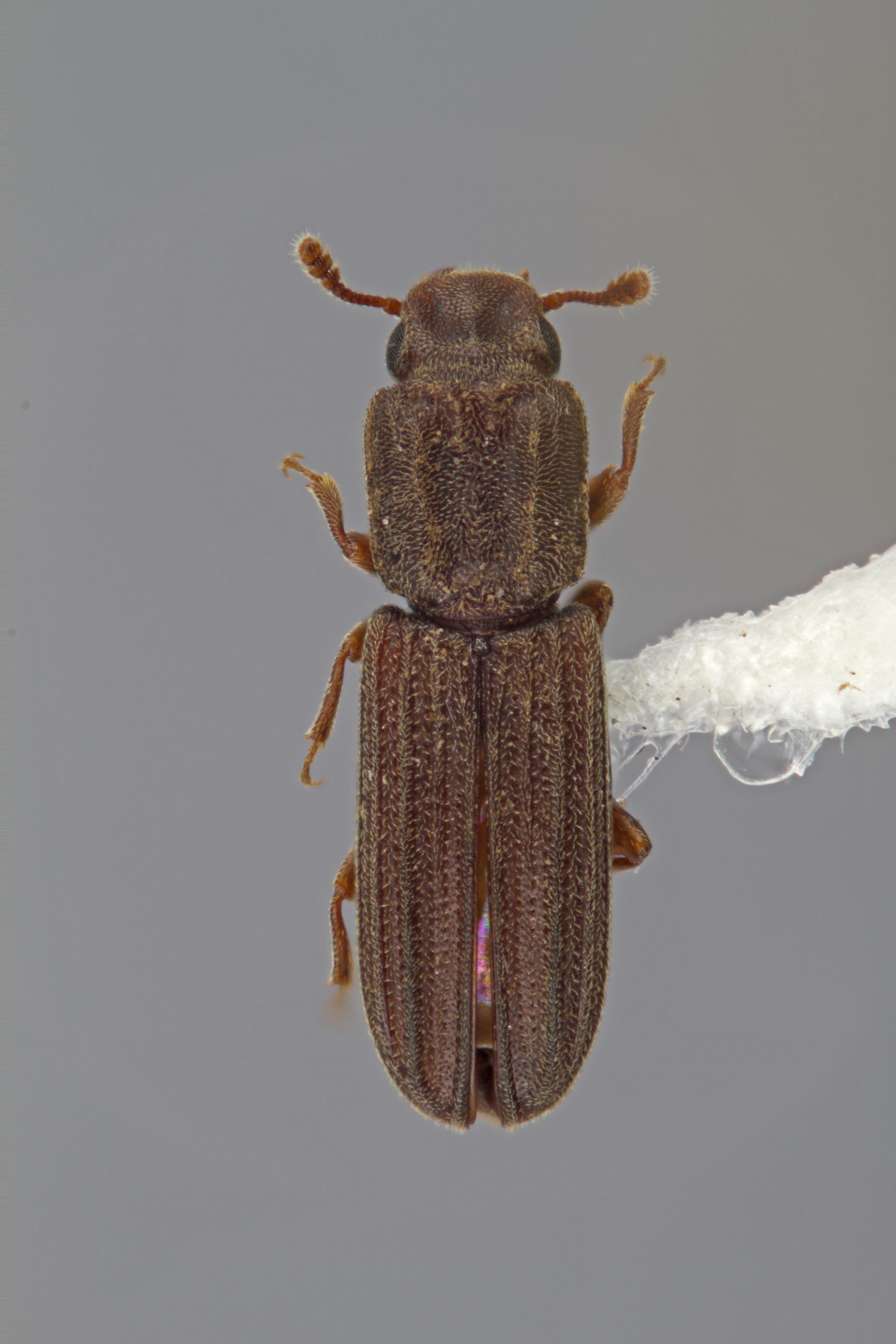
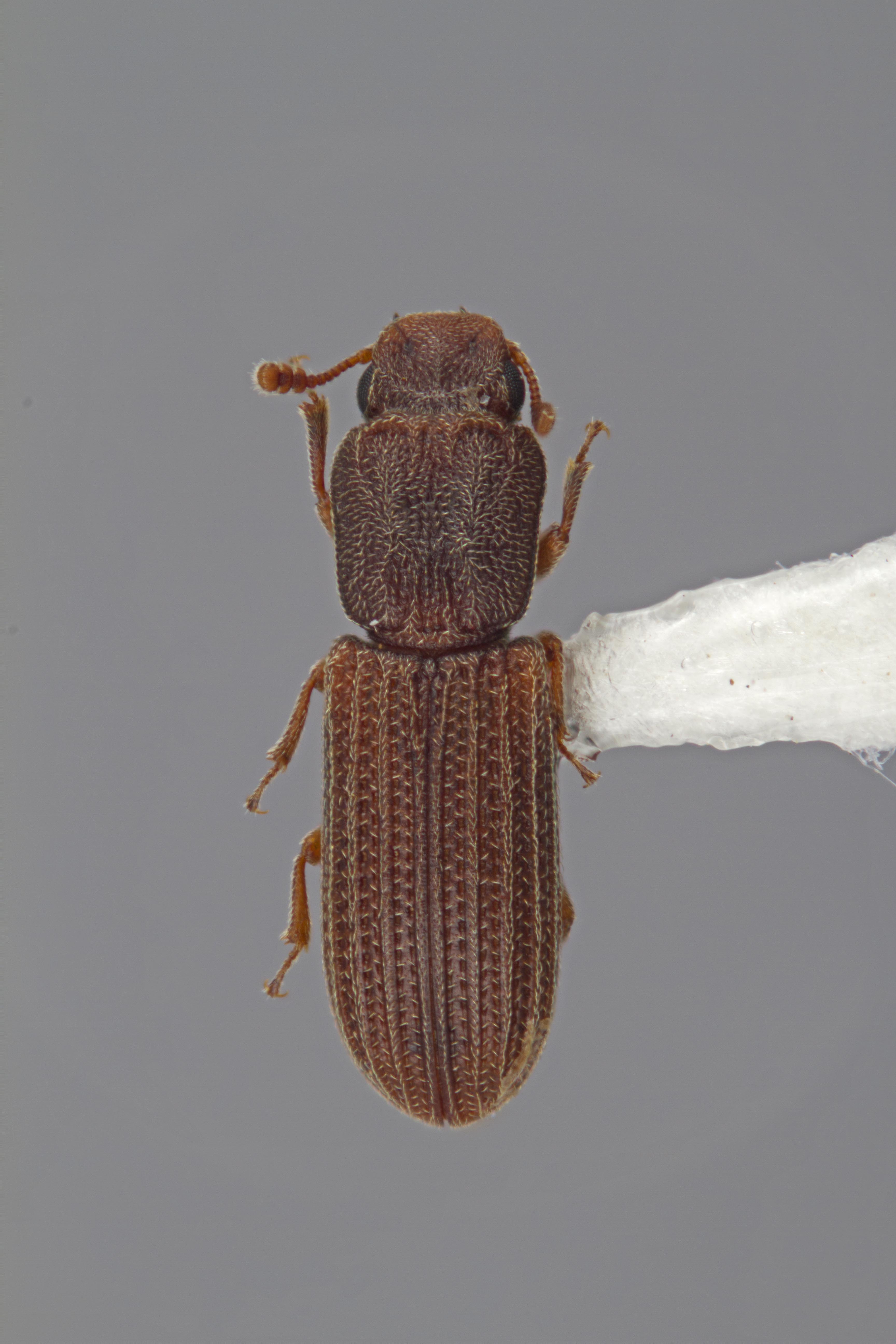
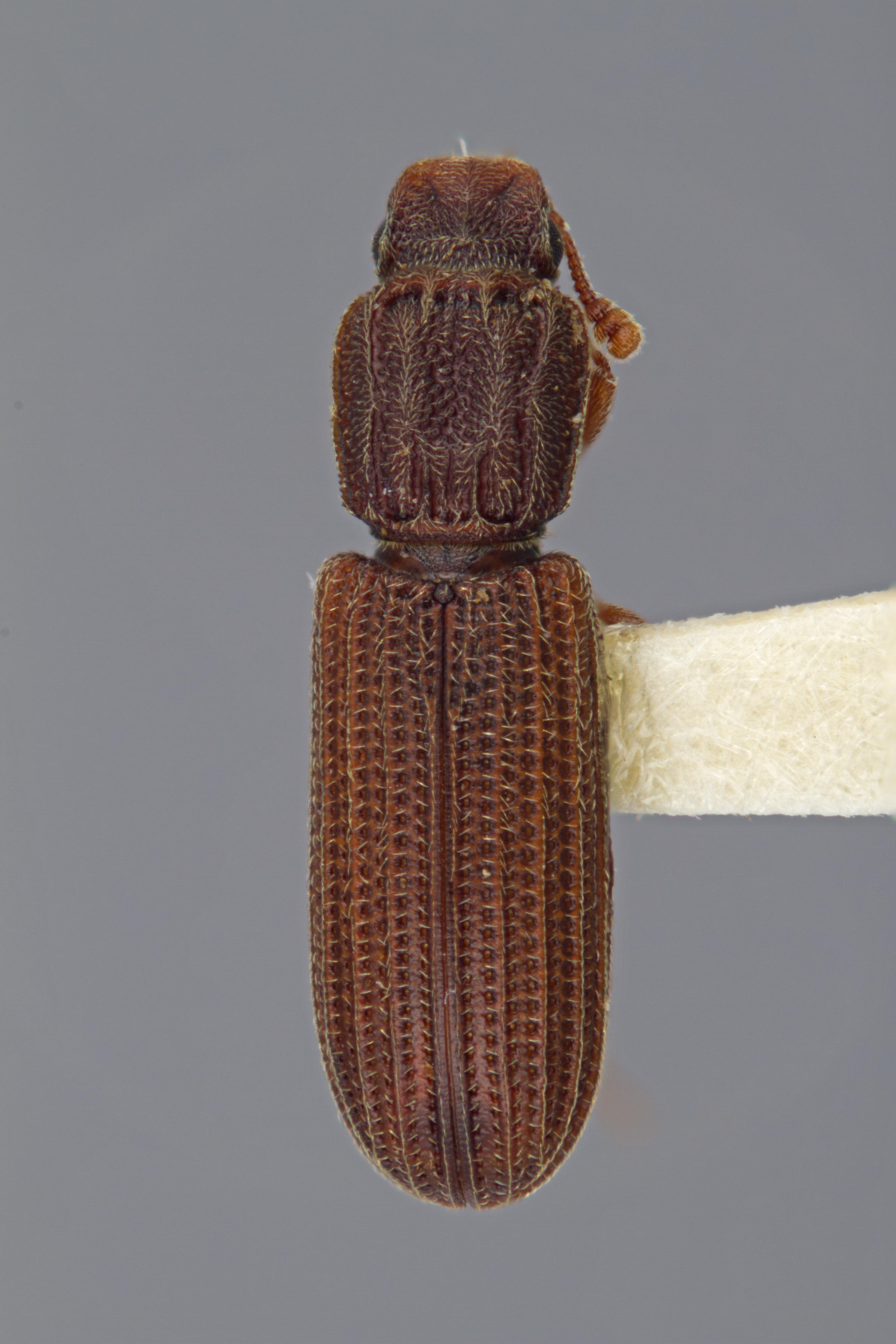
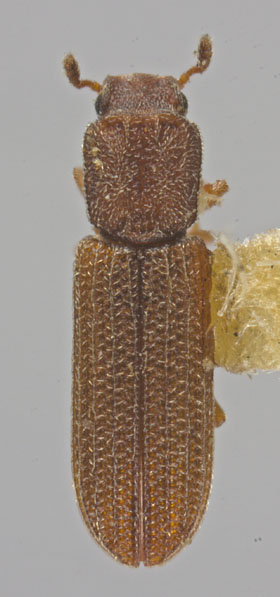
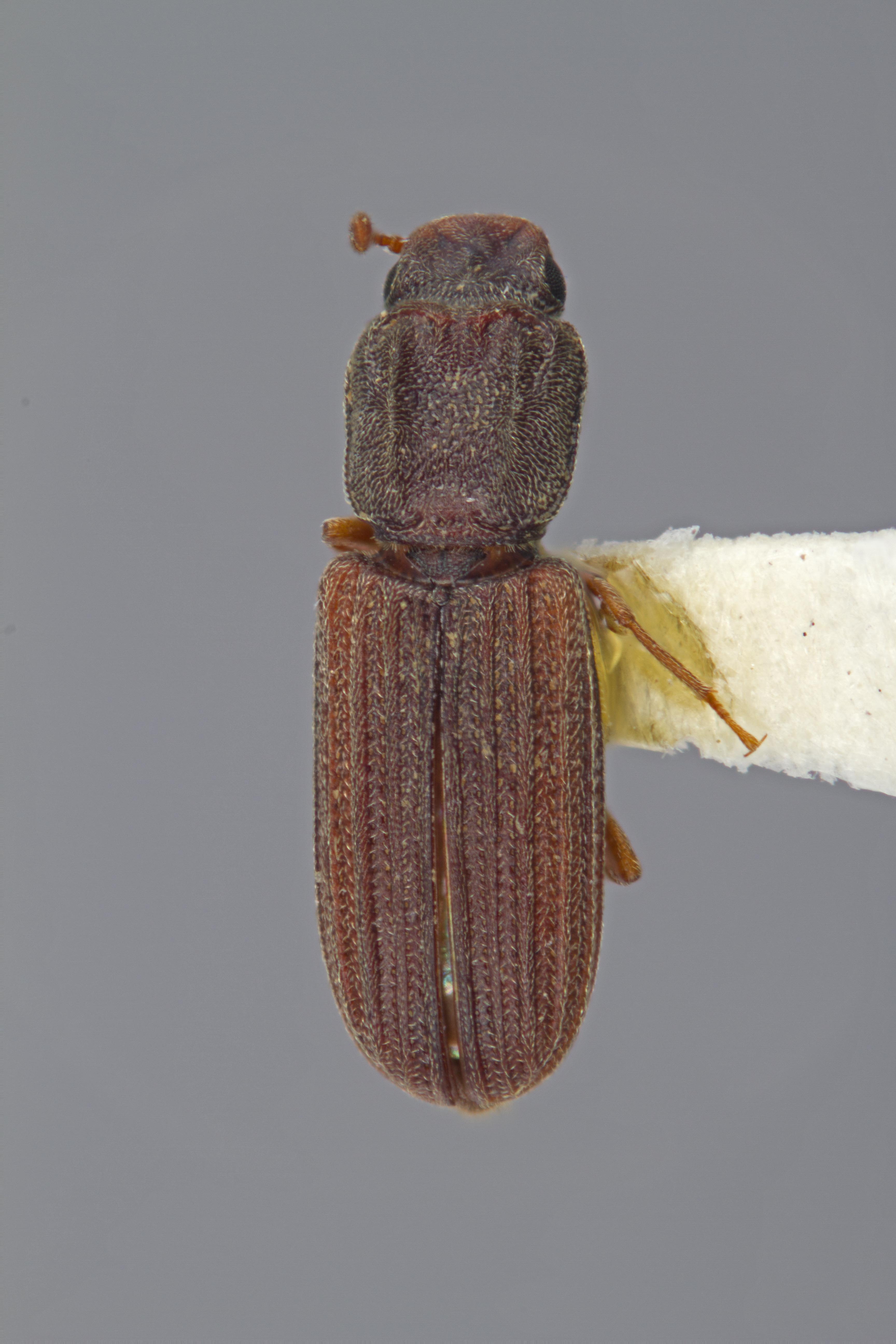
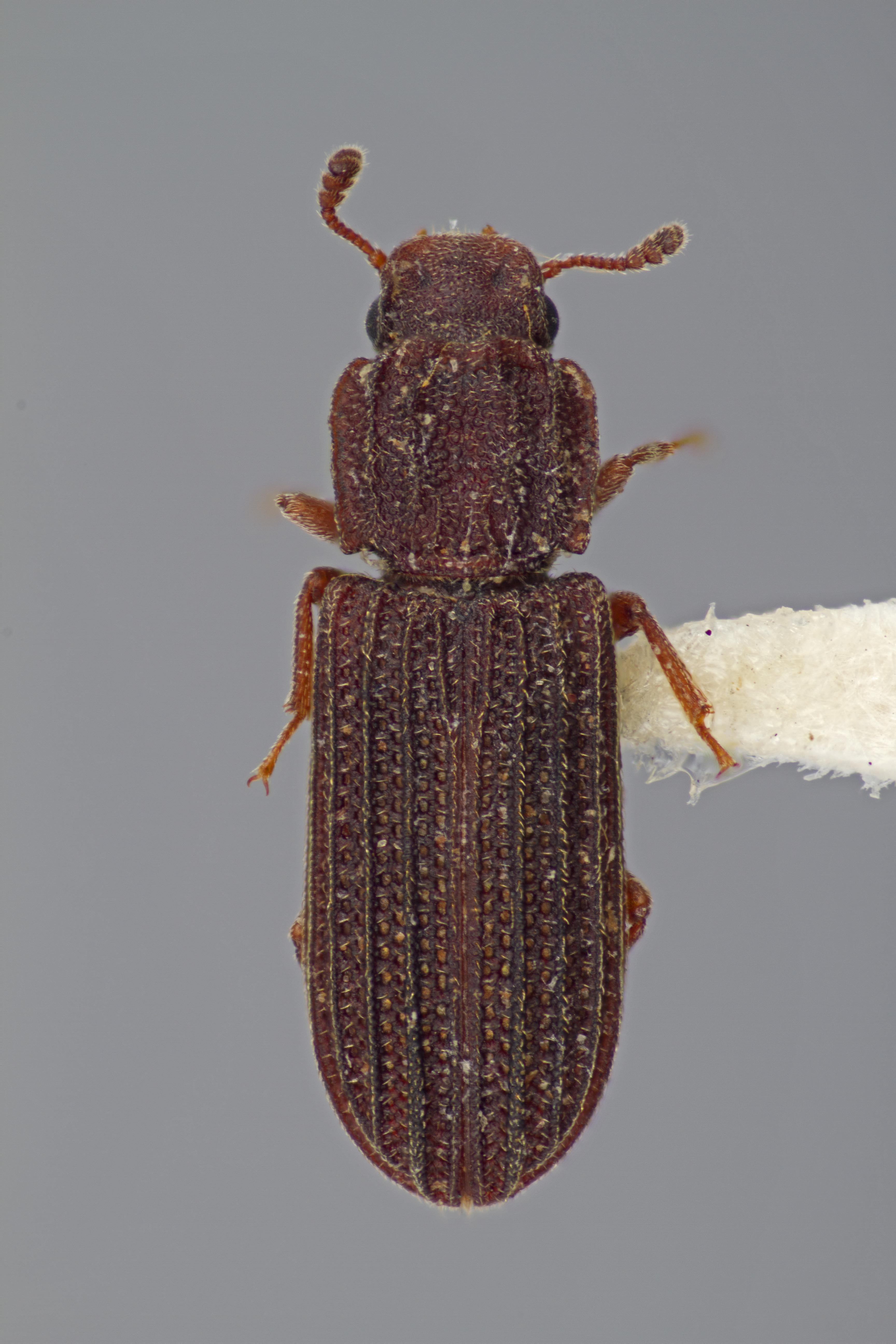
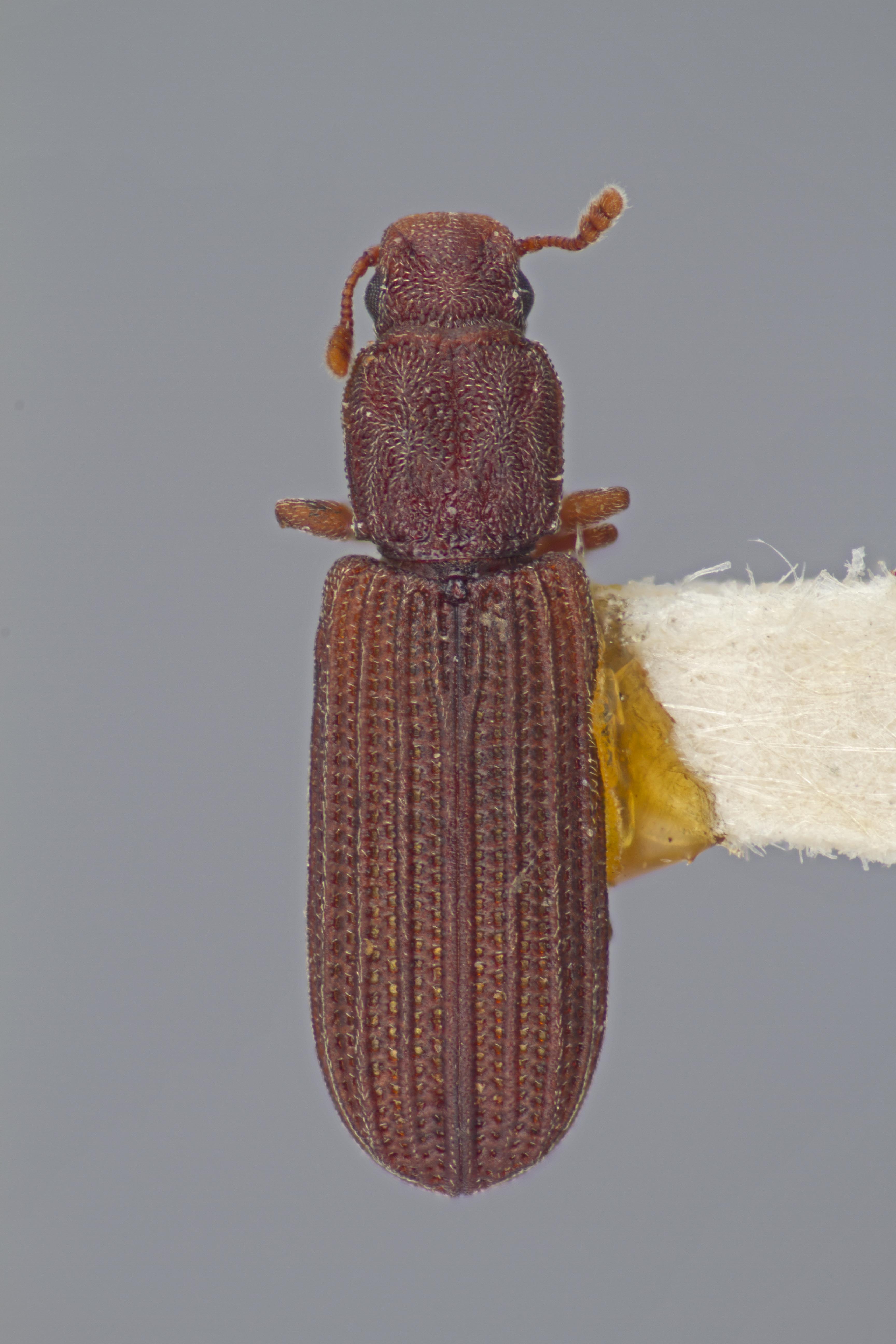
Antennaeantennae:
paired, segmental appendages, borne one on each side of head, functioning as sense organs and bearing a large number of sensilla.
11-segmented with a distinct, 3-segmented club. Antennal setation sparse. Subantennal groovessubantennal groove:
groove or concavity lying below the antennal insertion and housing the base of the antenna. Placed between the eye (if present) and the mandibular articulation, and sometimes extends below or behind the eye.
weakly developed or absent. Eyes large, well-developed, finely faceted. Antennal segment 3 longer than 4, but not as long as 4+5. Pronotal discpronotal disc:
the area of the pronotum which is visible dorsally and usually delimited laterally by the two lateral carinae. Contrasted with the paired pronotal hypomera, which extend onto the ventral surface.
with one or two pairs of longitudinal ridges or carinaecarina:
an elevated ridge or keel, not necessarily high or acute.
, often with depresseddepressed:
flattened down as if pressed.
areas. Lateral pronotal margins variable, subparallel to sinuatesinuate:
wavy, applying specifically to edges and margins.
. Procoxal cavitiesprocoxal cavities:
external closure: Externally closed when the postcoxal processes of the hypomera meet the prosternal process or meet one another.
closed (narrowly open in Lasconotus fitzgibbonae and L. coronatus). Metacoxaemetacoxae:
the coxae of the metathorax.
narrowly separated, separation less than metacoxal length. Elytraelytron:
the fore wing in Coleoptera, which is more or less uniformly sclerotized and in resting position is longitudinally oriented, usually meeting the opposite elytron along the midline.
with distinct carinaecarina:
an elevated ridge or keel, not necessarily high or acute.
. Abdominal ventriteabdominal ventrite:
visible ventral abdominal sclerite. Ventrite number does not correspond to true sternite number except in rare cases where sternite 1 is visible. Also called ventrite.
5 with a deep preapical groove. Tarsal formulatarsal formula:
the number of tarsomeres on the fore, mid, and hind tarsi, respectively.
4–4–4. Apexapex:
end of any structure distad to the base.
of protibia expanded, armed with a stout, apical spinespine:
a multicellular, more or less thornlike process or outgrowth of the cuticle not separated from it by a joint.
and several smaller spinesspine:
a multicellular, more or less thornlike process or outgrowth of the cuticle not separated from it by a joint.
. Dorsal surface consisting of thin, fine, hair-like setaeseta:
a sclerotized, hairlike (or scalelike) projection of cuticula arising from a single trichogen cell and surrounded at the base by a small cuticular ring.
, occasionally with tufts of long, thin, golden setaeseta:
a sclerotized, hairlike (or scalelike) projection of cuticula arising from a single trichogen cell and surrounded at the base by a small cuticular ring.
.
The genus Lasconotus is similar in general appearance to the genera Bitoma and Microprius. Lasconotus can be immediately distinguished with the distinctly 3-segmented antennal clubantennal club:
an enlarged portion of the antennal apex, consisting of a variable number of antennomeres (often 3). In an incrassate, antenna the antennomeres gradually enlarge towards to apex, but if there is an abrupt change in length or width at some point, then the antennomeres beyond this are considered to be part of the club.
, closed procoxal cavities, apically expanded protibia armed with a stout apicalapical:
an adjective (or adverb) denoting position near or movement toward the apex of a body part. The apex of the head or pronotum is at the anterior end while that of the abdomen or an elytron is at the posterior end; on the legs or antennae, apical and distal are synonymous.
spine and several smaller spines, and carinate pronotum and elytra.
Lasconotus bitomoides Kraus, 1912, L. borealis Horn, 1878, L. complex LeConte, 1859, L. concavus Casey, 1890Casey, 1890:
Casey TL. 1890. Coleopterological Notices. II. Annals of the New York Academy of Sciences 5: 307-504, illus., L. coronatus Hinton, 1935, L. fiskei Kraus, 1912, L. fitzgibbonae Kingsolver, Stephan, and Moser, 2006, L. flexuosus Kraus, 1912, L. intricatus Kraus, 1912, L. knulli Stephan, 1989, L. laqueatus LeConte, 1866, L. linearis Crotch, 1874Crotch, 1874:
Crotch GR. 1874. Descriptions of new species of Coleoptera from the Pacific Coast of the United States. Transactions of the American Entomological Society 5: 73-80., L. mexicanus Kraus, 1912, L. nucleatus Casey, 1890Casey, 1890:
Casey TL. 1890. Coleopterological Notices. II. Annals of the New York Academy of Sciences 5: 307-504, illus., L. pertenuis Casey, 1890Casey, 1890:
Casey TL. 1890. Coleopterological Notices. II. Annals of the New York Academy of Sciences 5: 307-504, illus., L. planipennis Kraus, 1912, L. pusillus LeConte, 1863, L. referendarius Zimmermann, 1869, L. servus Horn, 1885, L. simplex LeConte, 1866, L. subcostulatus Kraus, 1912, L. tuberculatus Kraus, 1912, L. vegrandis Horn, 1885
Northeast (DC, MD, NH, NJ, NY, PA, VA), North Central (IN, MI, MO, NK, OH, SD), Southeast (AL, FL, GA, NC, SC), South Central (LA, MS, OK, TX), Southwest (AZ, CA, CO, NM, NV, UT), Northwest (ID, MT, OR, WA, WY), Alaska USA; Ontario, British Columbia, Northwest Territories, Canada.
Lasconotus has been collected by beating vegetation, at MV/UV lights, and from under the bark of dead pines, including the root bark of Pinus edulis and Pinus leiophylla (Lasconotus fitzgibbonae). It has been noted that some Lasconotus are predators of scolytine weevils (Curculionidae), and are therefore possibly beneficial.
Abundance: Some species are moderately common
Lasconotus bitomoides: Western species. This species is in a group of Lasconotus with the elytraelytron:
the fore wing in Coleoptera, which is more or less uniformly sclerotized and in resting position is longitudinally oriented, usually meeting the opposite elytron along the midline.
distinctly concaveconcave:
hollowed out; the interior of a sphere as opposed to the outer or convex surface.
in from elytral interstitial intervals 1 to 5 for nearly entire length on both elytraelytron:
the fore wing in Coleoptera, which is more or less uniformly sclerotized and in resting position is longitudinally oriented, usually meeting the opposite elytron along the midline.
and the carinacarina:
an elevated ridge or keel, not necessarily high or acute.
of elytral interstitial interval 5 markedly more raised than other carinaecarina:
an elevated ridge or keel, not necessarily high or acute.
. Lasconotus bitomoides and L. fiskei each have a long, nearly complete pair of sublateral carinaecarina:
an elevated ridge or keel, not necessarily high or acute.
on the pronotumpronotum:
dorsal portion of the pronotum, lying above the lateral pronotal carinae when these are present.
(between central depression and lateral margin). Lasconotus bitomoides can be separated by the greater elytral concavity, more granulate central depression, and greater distribution from Texas to California. Distribution: Arizona, California, New Mexico, Texas, USA.
Lasconotus borealis: Northern species. This species is in a group of Lasconotus with the elytraelytron:
the fore wing in Coleoptera, which is more or less uniformly sclerotized and in resting position is longitudinally oriented, usually meeting the opposite elytron along the midline.
distinctly convexconvex:
the outer curved surface of a segment of a sphere, as opposed to concave.
to flattened (never concaveconcave:
hollowed out; the interior of a sphere as opposed to the outer or convex surface.
) for entire length, with all elytral carinaecarina:
an elevated ridge or keel, not necessarily high or acute.
similarly raised, pronotumpronotum:
dorsal portion of the pronotum, lying above the lateral pronotal carinae when these are present.
with network of curving carinaecarina:
an elevated ridge or keel, not necessarily high or acute.
crested with setaeseta:
a sclerotized, hairlike (or scalelike) projection of cuticula arising from a single trichogen cell and surrounded at the base by a small cuticular ring.
, and elytral intervals with 2–3 rows of short setaeseta:
a sclerotized, hairlike (or scalelike) projection of cuticula arising from a single trichogen cell and surrounded at the base by a small cuticular ring.
. Lasconotus borealis is most similar to L. intricatus, but can be separated by the piceuspiceus:
black.
color and the pronotumpronotum:
dorsal portion of the pronotum, lying above the lateral pronotal carinae when these are present.
wider than long. Distribution: Alaska, Michigan, New Hampshire, New York, USA; Ontario, Northwest Territories, Canada.
Lasconotus complex: Western species. This species is distinguished by the reflexed lateral margin of the pronotumpronotum:
dorsal portion of the pronotum, lying above the lateral pronotal carinae when these are present.
forming a distinct longitudinal depression between the lateral margin and the 1st pair of pronotal carinacarina:
an elevated ridge or keel, not necessarily high or acute.
and carinacarina:
an elevated ridge or keel, not necessarily high or acute.
of elytral interstitial interval 3 more distinctly raised near apexapex:
end of any structure distad to the base.
than other carinaecarina:
an elevated ridge or keel, not necessarily high or acute.
. Lasconotus complex and L. tuberculatus are readily distinguished by the internal pair of carinaecarina:
an elevated ridge or keel, not necessarily high or acute.
on the prontal disc interrupted into small tuberclestubercle:
a small knoblike or rounded protuberance.
. Lasconotus complex is distinguished from Lasconotus tuberculatus by the more parallel, sinuatesinuate:
wavy, applying specifically to edges and margins.
lateral margins of the pronotumpronotum:
dorsal portion of the pronotum, lying above the lateral pronotal carinae when these are present.
, the inner pair of pronotal carinaecarina:
an elevated ridge or keel, not necessarily high or acute.
less distinctly interrupted into tuberclestubercle:
a small knoblike or rounded protuberance.
, and the posteriorposterior:
hinder or hindmost, opposed to anterior; hind or rear.
angles of the pronotumpronotum:
dorsal portion of the pronotum, lying above the lateral pronotal carinae when these are present.
nearly right angles, not projecting posteriorly. Distribution: California, Idaho, Oregon, Utah, Washington, USA; British Columbia, Canada.
Lasconotus concavus: Western species. This species is in a group of Lasconotus with the pronotumpronotum:
dorsal portion of the pronotum, lying above the lateral pronotal carinae when these are present.
lacking any distinct carinaecarina:
an elevated ridge or keel, not necessarily high or acute.
, instead, two raised ridges laterally bordering a larger central depression, sinuatesinuate:
wavy, applying specifically to edges and margins.
anterior margin of pronotumpronotum:
dorsal portion of the pronotum, lying above the lateral pronotal carinae when these are present.
, and elytraelytron:
the fore wing in Coleoptera, which is more or less uniformly sclerotized and in resting position is longitudinally oriented, usually meeting the opposite elytron along the midline.
distinctly concaveconcave:
hollowed out; the interior of a sphere as opposed to the outer or convex surface.
in from elytral interstitial intervals 1 to 5 for nearly entire length on both elytraelytron:
the fore wing in Coleoptera, which is more or less uniformly sclerotized and in resting position is longitudinally oriented, usually meeting the opposite elytron along the midline.
and the carinacarina:
an elevated ridge or keel, not necessarily high or acute.
of elytral interstitial interval 5 markedly more raised than other carinaecarina:
an elevated ridge or keel, not necessarily high or acute.
. Lasconotus concavus can be separated from the other similar Lasconotus by the more flattened, wider body, absence of a distinctly carinate anterioranterior:
in front; before.
margin of pronotumpronotum:
dorsal portion of the pronotum, lying above the lateral pronotal carinae when these are present.
, and the concaveconcave:
hollowed out; the interior of a sphere as opposed to the outer or convex surface.
portion of the elytraelytron:
the fore wing in Coleoptera, which is more or less uniformly sclerotized and in resting position is longitudinally oriented, usually meeting the opposite elytron along the midline.
without clear striae. Distribution: Arizona, Colorado, Montana, New Mexico, USA.
Lasconotus coronatus: Western species. Lasconotus coronatus is most similar to L. fitzgibbonae and forms a distinct group within Lasconotus. These two species can be separated by the remainder of the genus by the distinctive paired tufts of long golden setaeseta:
a sclerotized, hairlike (or scalelike) projection of cuticula arising from a single trichogen cell and surrounded at the base by a small cuticular ring.
at the anterioranterior:
in front; before.
margin of the pronotumpronotum:
dorsal portion of the pronotum, lying above the lateral pronotal carinae when these are present.
, narrowly open procoxal cavitiesprocoxal cavities:
external closure: Externally closed when the postcoxal processes of the hypomera meet the prosternal process or meet one another.
, and antennal segment 3 longer than either 2 or 4. Lasconotus coronatus differs from L. fitzgibbonae in being slightly larger (~4.5 mm compared to ~3.25 mm in L. fitzgibbonae), the marginal pronotal carinaecarina:
an elevated ridge or keel, not necessarily high or acute.
with a deep depression at midpoint, a more acuteacute:
pointed; terminating in or forming less than a right angle.
pronotal margin and broader anterioranterior:
in front; before.
angles of the pronotumpronotum:
dorsal portion of the pronotum, lying above the lateral pronotal carinae when these are present.
. Distribution: Colorado, USA.
Lasconotus fiskei: Southcentral species. This species is in a group of Lasconotus with the elytraelytron:
the fore wing in Coleoptera, which is more or less uniformly sclerotized and in resting position is longitudinally oriented, usually meeting the opposite elytron along the midline.
distinctly concaveconcave:
hollowed out; the interior of a sphere as opposed to the outer or convex surface.
in from elytral interstitial intervals 1 to 5 for nearly entire length on both elytraelytron:
the fore wing in Coleoptera, which is more or less uniformly sclerotized and in resting position is longitudinally oriented, usually meeting the opposite elytron along the midline.
and the carinacarina:
an elevated ridge or keel, not necessarily high or acute.
of elytral interstitial interval 5 markedly more raised than other carinaecarina:
an elevated ridge or keel, not necessarily high or acute.
. Lasconotus fiskei and L. bitomoides each have a long, nearly complete pair of sublateral carinaecarina:
an elevated ridge or keel, not necessarily high or acute.
on the pronotumpronotum:
dorsal portion of the pronotum, lying above the lateral pronotal carinae when these are present.
(between central depression and lateral margin). Lasconotus fiskei can be separated by the slighter elytral concavity, less granulate central depression, and distribution restricted to Texas. Distribution: Texas, USA.
Lasconotus fitzgibbonae: Western species. L. fitzgibbonae is most similar to L. coronatus and forms a distinct group within Lasconotus. These two species can be separated by the remainder of the genus by the distinctive paired tufts of long golden setaeseta:
a sclerotized, hairlike (or scalelike) projection of cuticula arising from a single trichogen cell and surrounded at the base by a small cuticular ring.
at the anterioranterior:
in front; before.
margin of the pronotumpronotum:
dorsal portion of the pronotum, lying above the lateral pronotal carinae when these are present.
, narrowly open procoxal cavitiesprocoxal cavities:
external closure: Externally closed when the postcoxal processes of the hypomera meet the prosternal process or meet one another.
, and antennal segment 3 longer than either 2 or 4. Lasconotus fitzgibbonae differs from L. coronatus in being slightly smaller (~3.25 mm compared to ~4. 5 mm in L. coronatus), the lateral pronotal carinaelateral pronotal carina:
a sharp lateral edge on the prothorax separating the pronotal disc above and the hypomeron below.
with a shallow depression at midpoint, a more straight pronotal margin and narrower anterioranterior:
in front; before.
angles of the pronotumpronotum:
dorsal portion of the pronotum, lying above the lateral pronotal carinae when these are present.
. Distribution: Arizona, South Dakota, USA.
Lasconotus flexuosus: Western species. This species is distinguished by the reflexed lateral margin of the pronotumpronotum:
dorsal portion of the pronotum, lying above the lateral pronotal carinae when these are present.
forming a distinct longitudinal depression between the lateral margin and the 1st pair of pronotal carinacarina:
an elevated ridge or keel, not necessarily high or acute.
, the carinacarina:
an elevated ridge or keel, not necessarily high or acute.
of elytral interstitial interval 3 more distinctly raised near apexapex:
end of any structure distad to the base.
than other carinaecarina:
an elevated ridge or keel, not necessarily high or acute.
, and the presence of a strong flexure or bend in the pronotumpronotum:
dorsal portion of the pronotum, lying above the lateral pronotal carinae when these are present.
slightly ahead of midline (only when viewed laterally). Distribution: Washington, USA.
Lasconotus intricatus: Western species. This species is in a group of Lasconotus with the elytraelytron:
the fore wing in Coleoptera, which is more or less uniformly sclerotized and in resting position is longitudinally oriented, usually meeting the opposite elytron along the midline.
distinctly convexconvex:
the outer curved surface of a segment of a sphere, as opposed to concave.
to flattened (never concaveconcave:
hollowed out; the interior of a sphere as opposed to the outer or convex surface.
) for entire length, with all elytral carinaecarina:
an elevated ridge or keel, not necessarily high or acute.
similarly raised, pronotumpronotum:
dorsal portion of the pronotum, lying above the lateral pronotal carinae when these are present.
with network of curving carinaecarina:
an elevated ridge or keel, not necessarily high or acute.
crested with setaeseta:
a sclerotized, hairlike (or scalelike) projection of cuticula arising from a single trichogen cell and surrounded at the base by a small cuticular ring.
, and elytral intervals with 2-3 rows of short setaeseta:
a sclerotized, hairlike (or scalelike) projection of cuticula arising from a single trichogen cell and surrounded at the base by a small cuticular ring.
. Lasconotus intricatus is most similar to L. borealis, but can be separated by the ferrugineus color and the pronotumpronotum:
dorsal portion of the pronotum, lying above the lateral pronotal carinae when these are present.
longer than wide. Distribution: Idaho, Oregon, Washington, USA; British Columbia, Northwest Territories, Canada.
Lasconotus knulli: Western species. This species is in a group of Lasconotus with the elytraelytron:
the fore wing in Coleoptera, which is more or less uniformly sclerotized and in resting position is longitudinally oriented, usually meeting the opposite elytron along the midline.
distinctly convexconvex:
the outer curved surface of a segment of a sphere, as opposed to concave.
to flattened (never concaveconcave:
hollowed out; the interior of a sphere as opposed to the outer or convex surface.
) for entire length and with all elytral carinaecarina:
an elevated ridge or keel, not necessarily high or acute.
similarly raised. Lasconotus knulli can be distinguished by the restricted distribution, extremely small size, elytraelytron:
the fore wing in Coleoptera, which is more or less uniformly sclerotized and in resting position is longitudinally oriented, usually meeting the opposite elytron along the midline.
with no distinct carinacarina:
an elevated ridge or keel, not necessarily high or acute.
, pronotumpronotum:
dorsal portion of the pronotum, lying above the lateral pronotal carinae when these are present.
longer than wide with only a hint of paired carinaecarina:
an elevated ridge or keel, not necessarily high or acute.
. Distribution: Arizona, USA.
Lasconotus laqueatus: Western species. This species is in a group of Lasconotus with the pronotumpronotum:
dorsal portion of the pronotum, lying above the lateral pronotal carinae when these are present.
lacking any distinct carinaecarina:
an elevated ridge or keel, not necessarily high or acute.
, instead, two raised ridges laterally bordering a larger central depression, sinuatesinuate:
wavy, applying specifically to edges and margins.
anterior margin of pronotumpronotum:
dorsal portion of the pronotum, lying above the lateral pronotal carinae when these are present.
, and elytraelytron:
the fore wing in Coleoptera, which is more or less uniformly sclerotized and in resting position is longitudinally oriented, usually meeting the opposite elytron along the midline.
distinctly concaveconcave:
hollowed out; the interior of a sphere as opposed to the outer or convex surface.
in from elytral interstitial intervals 1 to 5 for nearly entire length on both elytraelytron:
the fore wing in Coleoptera, which is more or less uniformly sclerotized and in resting position is longitudinally oriented, usually meeting the opposite elytron along the midline.
and the carinacarina:
an elevated ridge or keel, not necessarily high or acute.
of elytral interstitial interval 5 markedly more raised than other carinaecarina:
an elevated ridge or keel, not necessarily high or acute.
. Lasconotus laqueatus can be separated from the other similar Lasconotus by the presence of a distinctly carinate, double "U" shaped anterioranterior:
in front; before.
margin of pronotumpronotum:
dorsal portion of the pronotum, lying above the lateral pronotal carinae when these are present.
, the width of the central pronotal depression greater than 1/2 the total width of pronotumpronotum:
dorsal portion of the pronotum, lying above the lateral pronotal carinae when these are present.
, and the concaveconcave:
hollowed out; the interior of a sphere as opposed to the outer or convex surface.
portion of the elytraelytron:
the fore wing in Coleoptera, which is more or less uniformly sclerotized and in resting position is longitudinally oriented, usually meeting the opposite elytron along the midline.
for majority of elytral length. Lasconotus laqueatus differs from L. pusillus by its western distribution. Distribution: Arizona, California, Montana, Nevada, New Mexico, South Dakota, Texas, Wyoming, USA.
Lasconotus linearis: Western species. This species is in a group of Lasconotus with the elytraelytron:
the fore wing in Coleoptera, which is more or less uniformly sclerotized and in resting position is longitudinally oriented, usually meeting the opposite elytron along the midline.
distinctly convexconvex:
the outer curved surface of a segment of a sphere, as opposed to concave.
to flattened (never concaveconcave:
hollowed out; the interior of a sphere as opposed to the outer or convex surface.
) for entire length, with all elytral carinaecarina:
an elevated ridge or keel, not necessarily high or acute.
similarly raised, pronotumpronotum:
dorsal portion of the pronotum, lying above the lateral pronotal carinae when these are present.
with network of curving carinaecarina:
an elevated ridge or keel, not necessarily high or acute.
crested with setaeseta:
a sclerotized, hairlike (or scalelike) projection of cuticula arising from a single trichogen cell and surrounded at the base by a small cuticular ring.
, and elytral intervals with a single row of recumbent setaeseta:
a sclerotized, hairlike (or scalelike) projection of cuticula arising from a single trichogen cell and surrounded at the base by a small cuticular ring.
. Lasconotus linearis is most similar to L. pertenuis, but can be separated by the usually bicolored elytraelytron:
the fore wing in Coleoptera, which is more or less uniformly sclerotized and in resting position is longitudinally oriented, usually meeting the opposite elytron along the midline.
and antennomereantennomere:
antennal segment; including scape, pedicel and flagellomeres. NOTE: the flagellum is composed of all antennal segments proceeding the scape and pedicel. Any individual antennal segment is commonly called an antennomere.
9 as long as 10. Distribution: California, USA.
Lasconotus mexicanus: This species is distinguished by the reflexed lateral margin of the pronotumpronotum:
dorsal portion of the pronotum, lying above the lateral pronotal carinae when these are present.
forming a distinct longitudinal depression between the lateral margin and the 1st pair of pronotal carinacarina:
an elevated ridge or keel, not necessarily high or acute.
and elytral carinaecarina:
an elevated ridge or keel, not necessarily high or acute.
all equally elevated. To date, L. mexicanus does not occur in North America north of Mexico, but is included because it is likely this species will be discovered in the Southwest USA. Distribution: Mexico.
Lasconotus nucleatus: Western species. This species is in a group of Lasconotus with the elytraelytron:
the fore wing in Coleoptera, which is more or less uniformly sclerotized and in resting position is longitudinally oriented, usually meeting the opposite elytron along the midline.
distinctly convexconvex:
the outer curved surface of a segment of a sphere, as opposed to concave.
to flattened (never concaveconcave:
hollowed out; the interior of a sphere as opposed to the outer or convex surface.
) for entire length and with all elytral carinaecarina:
an elevated ridge or keel, not necessarily high or acute.
similarly raised. Lasconotus nucleatus is readily distinguished by the rounded anterioranterior:
in front; before.
angles of the pronotumpronotum:
dorsal portion of the pronotum, lying above the lateral pronotal carinae when these are present.
, dorsal vestiturevestiture:
the general surface covering comprised of cuticular projections, e.g., setae, scales, or spicules.
consisting of short, recurved setaeseta:
a sclerotized, hairlike (or scalelike) projection of cuticula arising from a single trichogen cell and surrounded at the base by a small cuticular ring.
, and elytraelytron:
the fore wing in Coleoptera, which is more or less uniformly sclerotized and in resting position is longitudinally oriented, usually meeting the opposite elytron along the midline.
with numerous small tufts of round, silver-white setaeseta:
a sclerotized, hairlike (or scalelike) projection of cuticula arising from a single trichogen cell and surrounded at the base by a small cuticular ring.
. Distribution: California, Oregon, Washington, USA.
Lasconotus pertenuis: Western species. This species is in a group of Lasconotus with the elytraelytron:
the fore wing in Coleoptera, which is more or less uniformly sclerotized and in resting position is longitudinally oriented, usually meeting the opposite elytron along the midline.
distinctly convexconvex:
the outer curved surface of a segment of a sphere, as opposed to concave.
to flattened (never concaveconcave:
hollowed out; the interior of a sphere as opposed to the outer or convex surface.
) for entire length, with all elytral carinaecarina:
an elevated ridge or keel, not necessarily high or acute.
similarly raised, pronotumpronotum:
dorsal portion of the pronotum, lying above the lateral pronotal carinae when these are present.
with network of curving carinaecarina:
an elevated ridge or keel, not necessarily high or acute.
crested with setaeseta:
a sclerotized, hairlike (or scalelike) projection of cuticula arising from a single trichogen cell and surrounded at the base by a small cuticular ring.
, and elytral intervals with a single row of recumbent setaeseta:
a sclerotized, hairlike (or scalelike) projection of cuticula arising from a single trichogen cell and surrounded at the base by a small cuticular ring.
. Lasconotus pertenuis is most similar to L.linearis, but can be separated by the unicolored elytraelytron:
the fore wing in Coleoptera, which is more or less uniformly sclerotized and in resting position is longitudinally oriented, usually meeting the opposite elytron along the midline.
and antennomereantennomere:
antennal segment; including scape, pedicel and flagellomeres. NOTE: the flagellum is composed of all antennal segments proceeding the scape and pedicel. Any individual antennal segment is commonly called an antennomere.
9 distinctly shorter and narrower than 10. Distribution: California, USA.
Lasconotus planipennis: Western species. This species is in a group of Lasconotus with the elytraelytron:
the fore wing in Coleoptera, which is more or less uniformly sclerotized and in resting position is longitudinally oriented, usually meeting the opposite elytron along the midline.
distinctly convexconvex:
the outer curved surface of a segment of a sphere, as opposed to concave.
to flattened (never concaveconcave:
hollowed out; the interior of a sphere as opposed to the outer or convex surface.
) for entire length, with all elytral carinaecarina:
an elevated ridge or keel, not necessarily high or acute.
similarly raised, and pronotumpronotum:
dorsal portion of the pronotum, lying above the lateral pronotal carinae when these are present.
with indistinct carinaecarina:
an elevated ridge or keel, not necessarily high or acute.
(never with network of curved carinaecarina:
an elevated ridge or keel, not necessarily high or acute.
crested with setaeseta:
a sclerotized, hairlike (or scalelike) projection of cuticula arising from a single trichogen cell and surrounded at the base by a small cuticular ring.
). Lasconotus planipennis can be separated from similar species by the western distribution, smaller size (2.5 mm or less), absence of a distinct pair of sublateral pronotal carinaesublateral pronotal carina:
applied to various longitudinal carinae lying mesad of the lateral carinae. These may extend the length of the pronotal disc or be restricted to the posterior angles.
, and elytraelytron:
the fore wing in Coleoptera, which is more or less uniformly sclerotized and in resting position is longitudinally oriented, usually meeting the opposite elytron along the midline.
distinctly convexconvex:
the outer curved surface of a segment of a sphere, as opposed to concave.
. Distribution: Arizona, California, Idaho, Montana, New Mexico, South Dakota, Washington, Wyoming, USA; British Columbia, Canada.
Lasconotus pusillus: Eastern species. This species is in a group of Lasconotus with the pronotumpronotum:
dorsal portion of the pronotum, lying above the lateral pronotal carinae when these are present.
lacking any distinct carinaecarina:
an elevated ridge or keel, not necessarily high or acute.
, instead, two raised ridges laterally bordering a larger central depression, sinuatesinuate:
wavy, applying specifically to edges and margins.
anterior margin of pronotumpronotum:
dorsal portion of the pronotum, lying above the lateral pronotal carinae when these are present.
, and elytraelytron:
the fore wing in Coleoptera, which is more or less uniformly sclerotized and in resting position is longitudinally oriented, usually meeting the opposite elytron along the midline.
distinctly concaveconcave:
hollowed out; the interior of a sphere as opposed to the outer or convex surface.
in from elytral interstitial intervals 1 to 5 for nearly entire length on both elytraelytron:
the fore wing in Coleoptera, which is more or less uniformly sclerotized and in resting position is longitudinally oriented, usually meeting the opposite elytron along the midline.
and the carinacarina:
an elevated ridge or keel, not necessarily high or acute.
of elytral interstitial interval 5 markedly more raised than other carinaecarina:
an elevated ridge or keel, not necessarily high or acute.
. Lasconotus pusillus can be separated from the other similar Lasconotus by the presence of a distinctly carinate, double "U" shaped anterioranterior:
in front; before.
margin of pronotumpronotum:
dorsal portion of the pronotum, lying above the lateral pronotal carinae when these are present.
, the width of the central pronotal depression greater than 1/2 the total width of pronotumpronotum:
dorsal portion of the pronotum, lying above the lateral pronotal carinae when these are present.
, and the concaveconcave:
hollowed out; the interior of a sphere as opposed to the outer or convex surface.
portion of the elytraelytron:
the fore wing in Coleoptera, which is more or less uniformly sclerotized and in resting position is longitudinally oriented, usually meeting the opposite elytron along the midline.
for majority of elytral length. Lasconotus pusillus differs from L. laqueatus by its eastern distribution. Distribution: Alabama, Florida, Georgia, Louisiana, Mississippi, North Carolina, South Carolina, Ohio, Oklahoma, Texas, USA.
Lasconotus referendarius: Eastern species. This species is in a group of Lasconotus with the elytraelytron:
the fore wing in Coleoptera, which is more or less uniformly sclerotized and in resting position is longitudinally oriented, usually meeting the opposite elytron along the midline.
distinctly convexconvex:
the outer curved surface of a segment of a sphere, as opposed to concave.
to flattened (never concaveconcave:
hollowed out; the interior of a sphere as opposed to the outer or convex surface.
) for entire length, with all elytral carinaecarina:
an elevated ridge or keel, not necessarily high or acute.
similarly raised, and pronotumpronotum:
dorsal portion of the pronotum, lying above the lateral pronotal carinae when these are present.
with indistinct carinaecarina:
an elevated ridge or keel, not necessarily high or acute.
(never with network of curved carinaecarina:
an elevated ridge or keel, not necessarily high or acute.
crested with setaeseta:
a sclerotized, hairlike (or scalelike) projection of cuticula arising from a single trichogen cell and surrounded at the base by a small cuticular ring.
). Lasconotus referendarius can be separated from similar species by the eastern distribution, smaller length to width ratio, and lack of distinct pronotal carinaecarina:
an elevated ridge or keel, not necessarily high or acute.
. Distribution: Washington D.C., Indiana, Maryland, New Jersey, Pennsylvania, Alabama, Florida, Georgia, North Carolina, South Carolina, Virginia, Oklahoma, Texas, USA.
Lasconotus servus: Western species. This species is in a group of Lasconotus with the elytraelytron:
the fore wing in Coleoptera, which is more or less uniformly sclerotized and in resting position is longitudinally oriented, usually meeting the opposite elytron along the midline.
distinctly convexconvex:
the outer curved surface of a segment of a sphere, as opposed to concave.
to flattened (never concaveconcave:
hollowed out; the interior of a sphere as opposed to the outer or convex surface.
) for entire length, with all elytral carinaecarina:
an elevated ridge or keel, not necessarily high or acute.
similarly raised, and pronotumpronotum:
dorsal portion of the pronotum, lying above the lateral pronotal carinae when these are present.
with indistinct carinaecarina:
an elevated ridge or keel, not necessarily high or acute.
(never with network of curved carinaecarina:
an elevated ridge or keel, not necessarily high or acute.
crested with setaeseta:
a sclerotized, hairlike (or scalelike) projection of cuticula arising from a single trichogen cell and surrounded at the base by a small cuticular ring.
). Lasconotus servus can be separated from similar species by the western distribution, larger size (3mm +), and presence of a distinct pair of sublateral pronotal carinaesublateral pronotal carina:
applied to various longitudinal carinae lying mesad of the lateral carinae. These may extend the length of the pronotal disc or be restricted to the posterior angles.
. Distribution: Arizona, California, New Mexico, USA.
Lasconotus simplex: Western species. This species is in a group of Lasconotus with the elytraelytron:
the fore wing in Coleoptera, which is more or less uniformly sclerotized and in resting position is longitudinally oriented, usually meeting the opposite elytron along the midline.
distinctly convexconvex:
the outer curved surface of a segment of a sphere, as opposed to concave.
to flattened (never concaveconcave:
hollowed out; the interior of a sphere as opposed to the outer or convex surface.
) for entire length, with all elytral carinaecarina:
an elevated ridge or keel, not necessarily high or acute.
similarly raised, and pronotumpronotum:
dorsal portion of the pronotum, lying above the lateral pronotal carinae when these are present.
with indistinct carinaecarina:
an elevated ridge or keel, not necessarily high or acute.
(never with network of curved carinaecarina:
an elevated ridge or keel, not necessarily high or acute.
crested with setaeseta:
a sclerotized, hairlike (or scalelike) projection of cuticula arising from a single trichogen cell and surrounded at the base by a small cuticular ring.
). Lasconotus simplex can be separated from similar species by the western distribution, smaller size (2.5 mm or less), absence of a distinct pair of sublateral pronotal carinaesublateral pronotal carina:
applied to various longitudinal carinae lying mesad of the lateral carinae. These may extend the length of the pronotal disc or be restricted to the posterior angles.
, and elytraelytron:
the fore wing in Coleoptera, which is more or less uniformly sclerotized and in resting position is longitudinally oriented, usually meeting the opposite elytron along the midline.
distinctly flattened. Distribution: Arizona, California, New Mexico, USA.
Lasconotus subcostulatus: Western species. This species is in a group of Lasconotus with the pronotumpronotum:
dorsal portion of the pronotum, lying above the lateral pronotal carinae when these are present.
lacking any distinct carinaecarina:
an elevated ridge or keel, not necessarily high or acute.
, instead, two raised ridges laterally bordering a larger central depression, sinuatesinuate:
wavy, applying specifically to edges and margins.
anterior margin of pronotumpronotum:
dorsal portion of the pronotum, lying above the lateral pronotal carinae when these are present.
, and elytraelytron:
the fore wing in Coleoptera, which is more or less uniformly sclerotized and in resting position is longitudinally oriented, usually meeting the opposite elytron along the midline.
distinctly concaveconcave:
hollowed out; the interior of a sphere as opposed to the outer or convex surface.
in from elytral interstitial intervals 1 to 5 for nearly entire length on both elytraelytron:
the fore wing in Coleoptera, which is more or less uniformly sclerotized and in resting position is longitudinally oriented, usually meeting the opposite elytron along the midline.
and the carinacarina:
an elevated ridge or keel, not necessarily high or acute.
of elytral interstitial interval 5 markedly more raised than other carinaecarina:
an elevated ridge or keel, not necessarily high or acute.
. Lasconotus subcostulatus can be separated from the other similar Lasconotus by the presence of a distinctly carinate, double "U" shaped anterioranterior:
in front; before.
margin of pronotumpronotum:
dorsal portion of the pronotum, lying above the lateral pronotal carinae when these are present.
, the width of the central pronotal depression 1/3 to 1/2 total width of pronotumpronotum:
dorsal portion of the pronotum, lying above the lateral pronotal carinae when these are present.
, and the concaveconcave:
hollowed out; the interior of a sphere as opposed to the outer or convex surface.
portion of the elytraelytron:
the fore wing in Coleoptera, which is more or less uniformly sclerotized and in resting position is longitudinally oriented, usually meeting the opposite elytron along the midline.
for posteriorposterior:
hinder or hindmost, opposed to anterior; hind or rear.
half only. Distribution: California, Idaho, Nevada, Oregon, Washington, South Dakota, Montana, Nebraska, USA.
Lasconotus tuberculatus: Western species. This species is distinguished by the reflexed lateral margin of the pronotumpronotum:
dorsal portion of the pronotum, lying above the lateral pronotal carinae when these are present.
forming a distinct longitudinal depression between the lateral margin and the 1st pair of pronotal carinacarina:
an elevated ridge or keel, not necessarily high or acute.
and carinacarina:
an elevated ridge or keel, not necessarily high or acute.
of elytral interstitial interval 3 more distinctly raised near apexapex:
end of any structure distad to the base.
than other carinaecarina:
an elevated ridge or keel, not necessarily high or acute.
. Lasconotus tuberculatus and L. complex are readily distinguished by the internal pair of carinaecarina:
an elevated ridge or keel, not necessarily high or acute.
on the prontal disc interrupted into small tuberclestubercle:
a small knoblike or rounded protuberance.
. Lasconotus tuberculatus differs from L. complex by the more arcuatearcuate:
arched or bowlike.
, sinuatesinuate:
wavy, applying specifically to edges and margins.
lateral margins of the pronotumpronotum:
dorsal portion of the pronotum, lying above the lateral pronotal carinae when these are present.
, the inner pair of pronotal carinaecarina:
an elevated ridge or keel, not necessarily high or acute.
more distinctly interrupted into tuberclestubercle:
a small knoblike or rounded protuberance.
, and the posteriorposterior:
hinder or hindmost, opposed to anterior; hind or rear.
angles of the pronotumpronotum:
dorsal portion of the pronotum, lying above the lateral pronotal carinae when these are present.
distinctly angulate, projecting posteriorly. Distribution: Arizona, California, New Mexico, Oregon, Washington, Utah, South Dakota, Wyoming, USA; British Columbia, Canada.
Lasconotus vegrandis: Western species. This species is in a group of Lasconotus with the elytraelytron:
the fore wing in Coleoptera, which is more or less uniformly sclerotized and in resting position is longitudinally oriented, usually meeting the opposite elytron along the midline.
distinctly convexconvex:
the outer curved surface of a segment of a sphere, as opposed to concave.
to flattened (never concaveconcave:
hollowed out; the interior of a sphere as opposed to the outer or convex surface.
) for entire length, with all elytral carinaecarina:
an elevated ridge or keel, not necessarily high or acute.
similarly raised, and pronotumpronotum:
dorsal portion of the pronotum, lying above the lateral pronotal carinae when these are present.
with indistinct carinaecarina:
an elevated ridge or keel, not necessarily high or acute.
(never with network of curved carinaecarina:
an elevated ridge or keel, not necessarily high or acute.
crested with setaeseta:
a sclerotized, hairlike (or scalelike) projection of cuticula arising from a single trichogen cell and surrounded at the base by a small cuticular ring.
). Lasconotus vegrandis can be separated from similar species by the pronotal width distinctly narrower than the elytral width. Distribution: California, Idaho, Oregon, Washington, USA; British Columbia, Canada.
Due to a unique combination of morphological characters, the placement of Lasconotus within the tribe Synchitini remains in question.
Ivie (2002a)Ivie (2002a):
Ivie, M.A. 2002a. 127. Colydiidae, pp. 445-453 In: R. H. Arnett, Jr., Jr. and M. C. Thomas (eds.), American Beetles. CRC Press, Gainesville, Florida., Kingslover et al. (2006)Kingslover et al. (2006):
Kingsolver, J.M., K. Stephan, and J.C. Moser. 2006. A new species of Lasconotus (Coleoptera: Colydiidae) from Arizona and South Dakota, U.S.A. Entomological News 117(1): 53-56., Stephan (1989)Stephan (1989):
Stephan, K.H. 1989. The Bothrideridae and Colydiidae of America north of Mexico (Coleoptera: Clavicornia and Heteromera). Occasional Papers of the Florida State Collection of Arthropods, 6: xii + 65 pp.
Authors: Lord NP, Nearns EH, Miller KB. 2011–2015.
Content updated Apr 2015; taxonomy updated Feb 2026
idtools.org