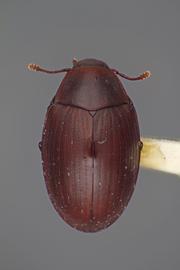
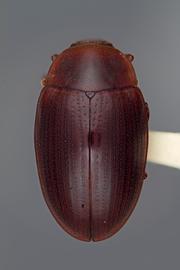
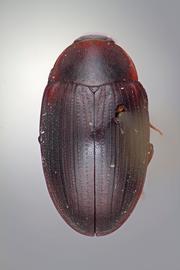
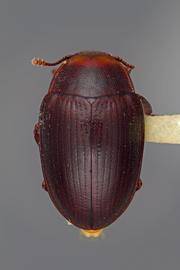
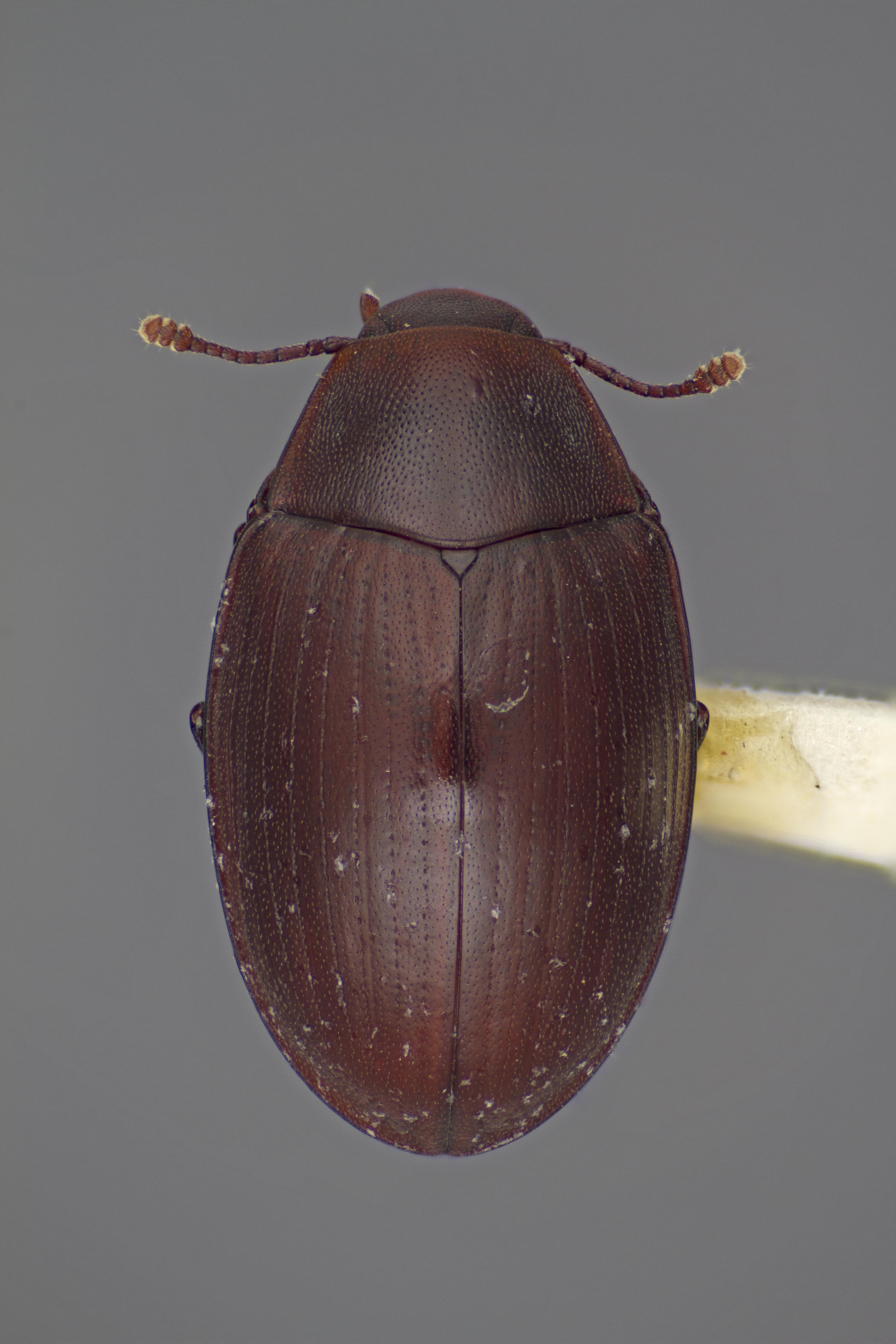
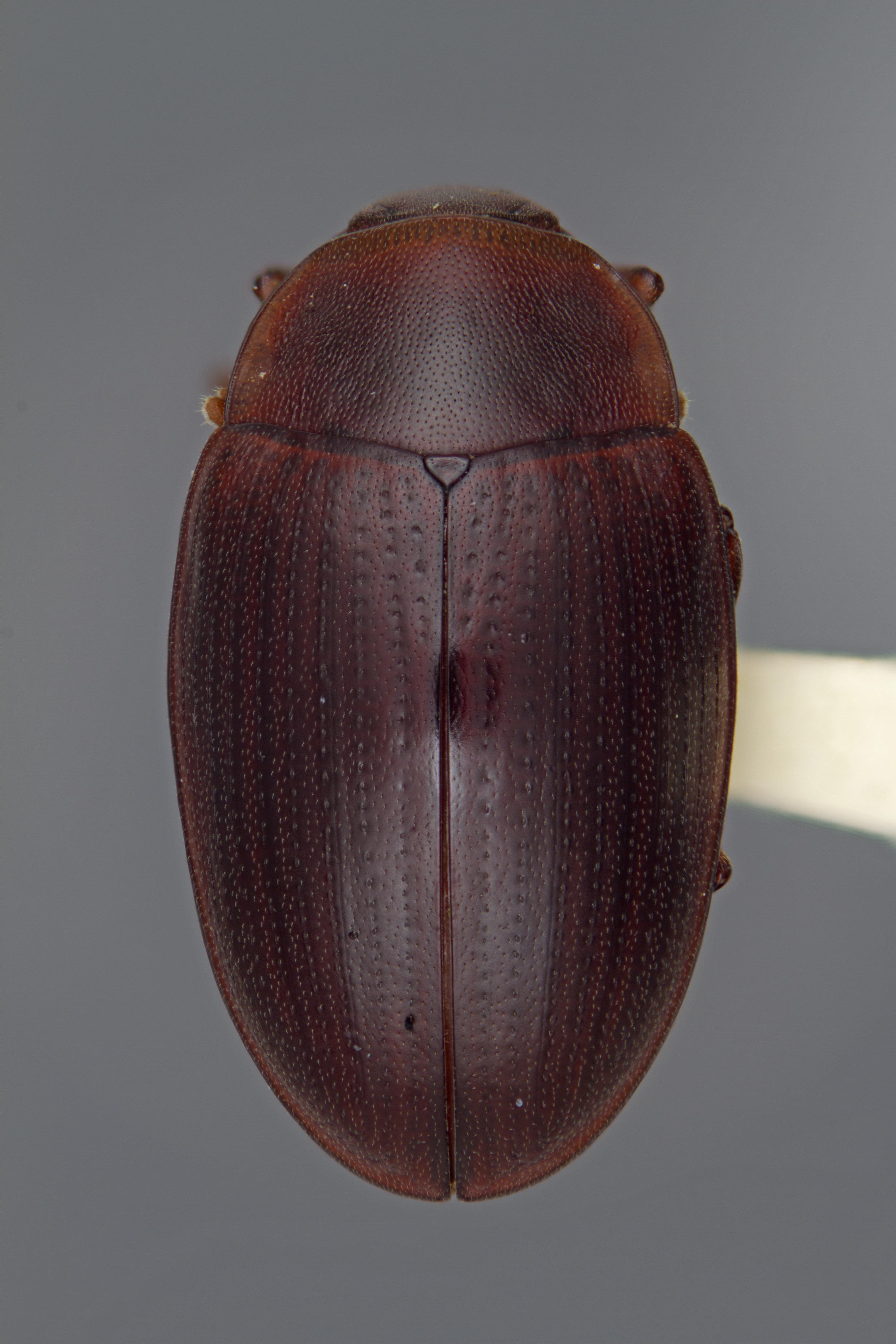
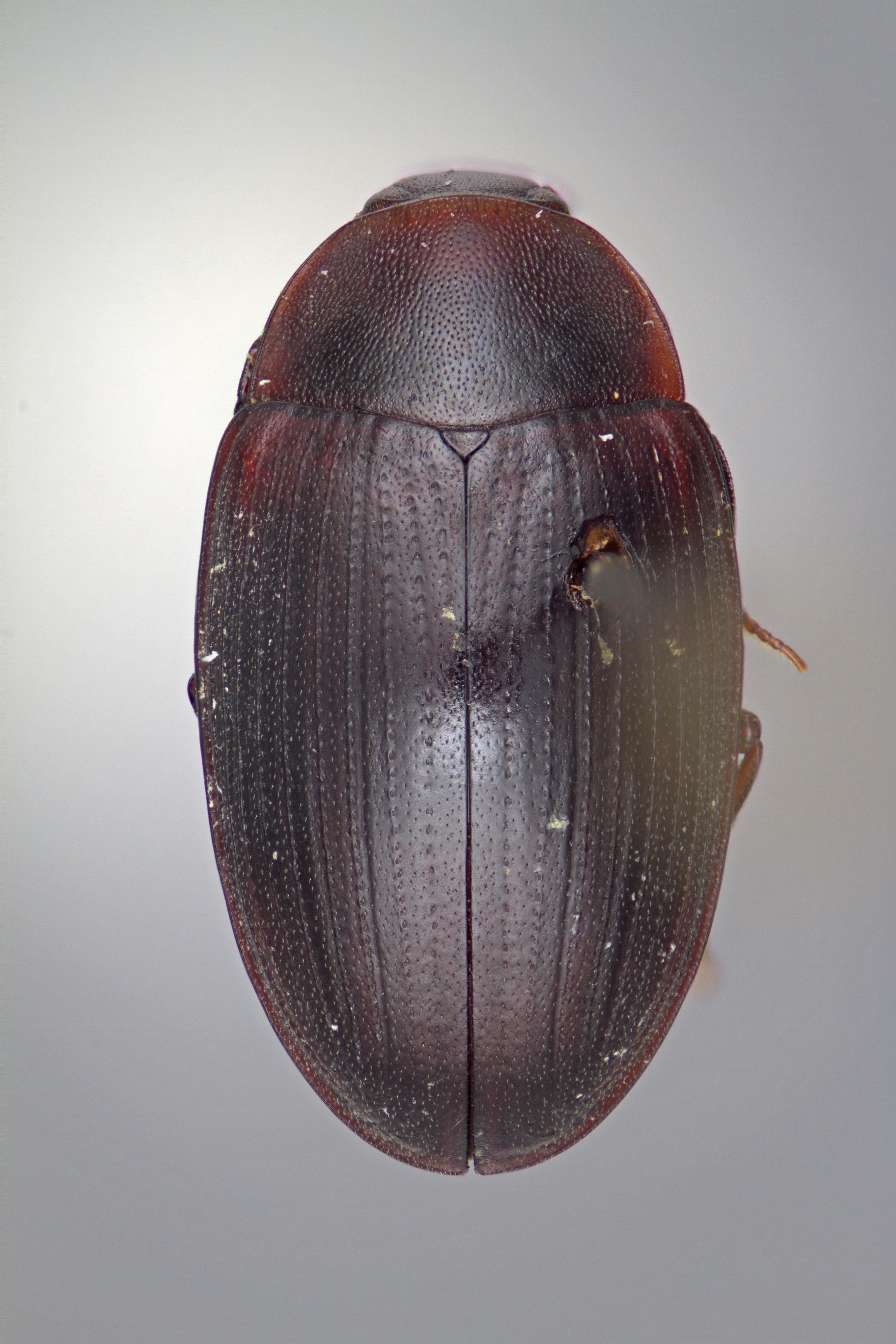
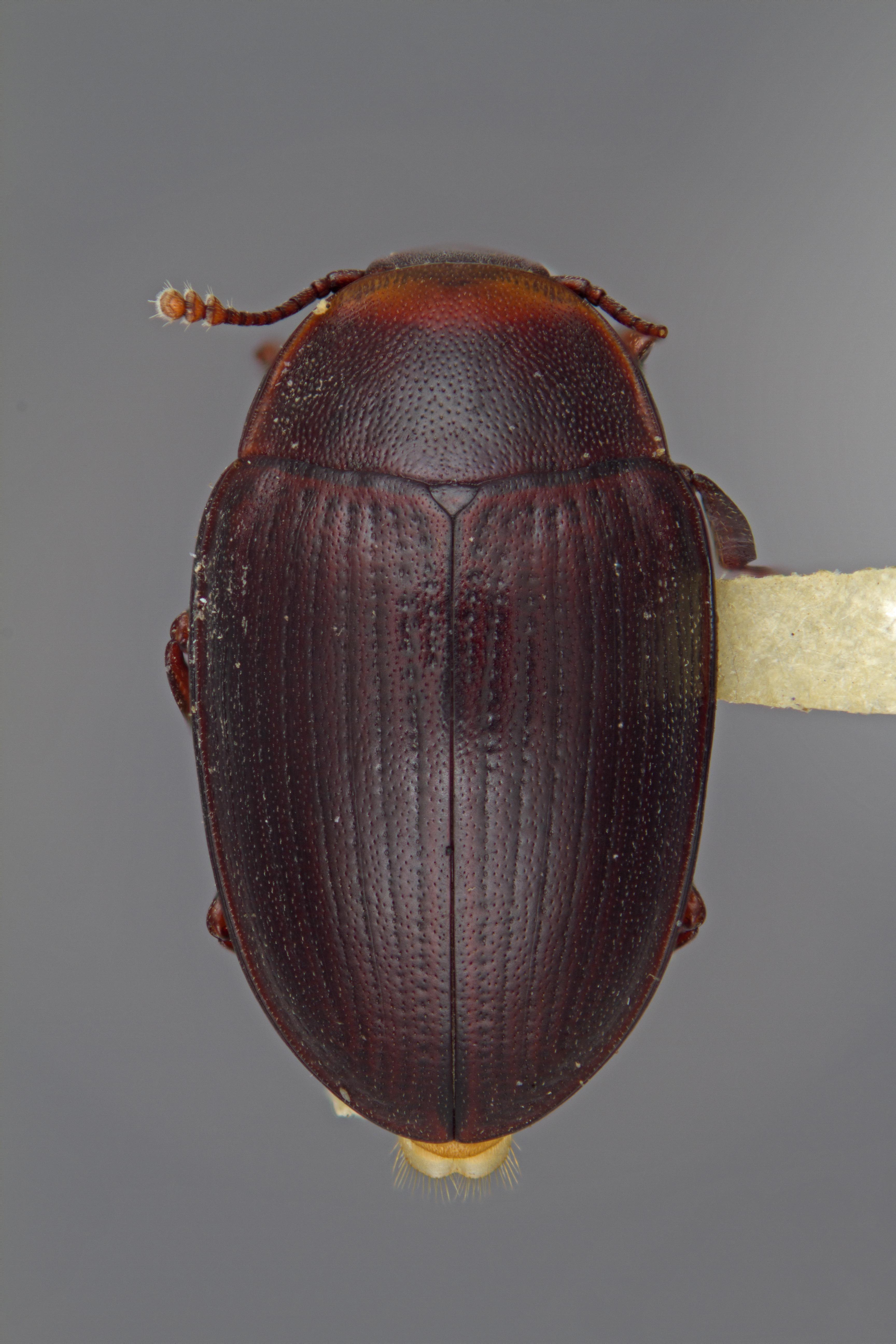
Body larger, convexconvex:
the outer curved surface of a segment of a sphere, as opposed to concave.
, elongate-oval, size over 3.5 mm. Antennaeantennae:
paired, segmental appendages, borne one on each side of head, functioning as sense organs and bearing a large number of sensilla.
11-segmented with a 3-segmented club. Antennal setation sparse. Eyes well-developed, elongate-oval, somewhat reniformreniform:
kidney-shaped.
, coarsely faceted, extending well onto dorsal portion of head. Groove around dorsal edge of eye paralleling eye facetseye facet:
individual parts of the external surface of the compound eye; often convex but sometimes more or less flattened.
for entire length. Lateral margins of pronotumpronotum:
dorsal portion of the pronotum, lying above the lateral pronotal carinae when these are present.
arcuate. Pronotal discpronotal disc:
the area of the pronotum which is visible dorsally and usually delimited laterally by the two lateral carinae. Contrasted with the paired pronotal hypomera, which extend onto the ventral surface.
simple. Hypomeronhypomeron:
that portion of the pronotum which is visible from the ventral side; when there is a lateral pronotal carina, this is the portion below that carina (the pronotal disc being above it).
with deep antennal cavitiesantennal cavity:
a prothoracic cavity for housing the whole antenna or a portion of the antenna (usually the club).
. Antennal groove and cavity slightly curved (not recurved dorsally), ending before lateral margin of hypomeronhypomeron:
that portion of the pronotum which is visible from the ventral side; when there is a lateral pronotal carina, this is the portion below that carina (the pronotal disc being above it).
. Antennal cavityantennal cavity:
a prothoracic cavity for housing the whole antenna or a portion of the antenna (usually the club).
concealed by prothoracic leg when retracted. Procoxal cavitiesprocoxal cavities:
external closure: Externally closed when the postcoxal processes of the hypomera meet the prosternal process or meet one another.
open. Metacoxaemetacoxae:
the coxae of the metathorax.
widely separated, separation as wide or wider than metacoxal length. Scutellumscutellum:
posterior portion of mesotergum. Often referring only to that portion of the scutellum which is visible between the bases of the elytra (see Scutellar Shield).
small, triangular, visible. Abdominal ventriteabdominal ventrite:
visible ventral abdominal sclerite. Ventrite number does not correspond to true sternite number except in rare cases where sternite 1 is visible. Also called ventrite.
5 with deep, curved preapical groove. Tarsal formulatarsal formula:
the number of tarsomeres on the fore, mid, and hind tarsi, respectively.
5–5–4 Dorsal surface punctate, glabrousglabrous:
without hairs (setae).
, shiny.
The genus Hyporhagus is most similar to the other monommatine genera Aspathines and Spinhyporhagus. Hyporhagus can be separated from Aspathines by the larger size, 3-segmented anntennal club, antennal groove and cavity not strongly recurved dorsally and not ending near lateral margin of hypomeron, and antennal cavityantennal cavity:
a prothoracic cavity for housing the whole antenna or a portion of the antenna (usually the club).
concealed by the prothoracic leg when retracted. Hyporhagus can be separated from Spinhyporhagus by the lack of a thin cuticular process on the dorsal margin of the eye.
Hyporhagus gilensis Horn, 1872, H. opaculus LeConte, 1866. H. pseudogilensis Freude, 1955. H. Thomson, 1860
Southwest (AZ, CA, NM, NV, UT), Southcentral (LA, OK, TX), Southeast (FL) USA.
Members of the Monommatini are associated with rotting vegetable matter and are suspected to feed on fungus (Ivie 2002bIvie 2002b:
Ivie, M.A. 2002b. 128. Monommatidae, pp. 454-456 In: R. H. Arnett, Jr., Jr. and M. C. Thomas (eds.), American Beetles. CRC Press, Gainesville, Florida.). Hyporhagus gilensis was found in Yucca stems (Lawrence 1991bLawrence 1991b:
Lawrence, J.F. 1991b. Monommidae (Tenebrionoidea), pp. 514-515. In: F. W. Stehr (ed.), Immature Insects. Vol. 2. Kendall/Hunt Publishing Co., Dubuque, Iowa.).
Abundance: Rare.
Hyporhagus gilensis: Western species. Body sub-opaque. DORSAL: Lateral margins of pronotumpronotum:
dorsal portion of the pronotum, lying above the lateral pronotal carinae when these are present.
nearly straight, with a distinct angle separating lateral from anterioranterior:
in front; before.
margins. Anterioranterior:
in front; before.
pronotal margin nearly straight, distinctly shorter than basal margin. Posteriorposterior:
hinder or hindmost, opposed to anterior; hind or rear.
pronotal angles obtuse, posteriorposterior:
hinder or hindmost, opposed to anterior; hind or rear.
pronotal margin more sharply angled, distinctly convexconvex:
the outer curved surface of a segment of a sphere, as opposed to concave.
. VENTRAL: maxillary palpi not distinctly swollen, terminal palpomerepalpomere:
palp segment
subcylindrical, widest at apexapex:
end of any structure distad to the base.
, not distinctly wider than preceding palpomerespalpomere:
palp segment
, apexapex:
end of any structure distad to the base.
distinctly truncatetruncate:
cut off squarely at the tip.
. Strip of cuticle between eye and mouthparts wide, expanding towards base of eye. Eye at base mostly concealed, not distinctly expanded. Intercoxal process of abdominal ventriteabdominal ventrite:
visible ventral abdominal sclerite. Ventrite number does not correspond to true sternite number except in rare cases where sternite 1 is visible. Also called ventrite.
I shallower, abdominal ventriteabdominal ventrite:
visible ventral abdominal sclerite. Ventrite number does not correspond to true sternite number except in rare cases where sternite 1 is visible. Also called ventrite.
I shorter or nearly as long as ventrites 2–4. Male protarsus with 2 tarsomerestarsomere:
one of the divisions of the tarsus.
dilated and pubescentpubescent:
downy; clothed with soft, short, fine, loosely set hair.
. Distribution: Arizona, California, New Mexico, Nevada, Oklahoma, Texas, Utah, USA.
Hyporhagus opaculus: Western species. Body sub-opaque. DORSAL: Lateral margins of pronotumpronotum:
dorsal portion of the pronotum, lying above the lateral pronotal carinae when these are present.
arcuate, curvature smoothly continuing to anterioranterior:
in front; before.
margin. Anterioranterior:
in front; before.
pronotal margin nearly straight, slightly shorter than basal margin. Posteriorposterior:
hinder or hindmost, opposed to anterior; hind or rear.
pronotal angles acuteacute:
pointed; terminating in or forming less than a right angle.
, posteriorposterior:
hinder or hindmost, opposed to anterior; hind or rear.
pronotal margin more subtly convexconvex:
the outer curved surface of a segment of a sphere, as opposed to concave.
. VENTRAL: maxillary palpi swollen, terminal palpomerepalpomere:
palp segment
bulbous, widest at middle, distinctly wider than preceding palpomerespalpomere:
palp segment
. Strip of cuticle between eye and mouthparts wide, expanding towards base of eye. Eye at base mostly concealed, not distinctly expanded. Intercoxal process of abdominal ventriteabdominal ventrite:
visible ventral abdominal sclerite. Ventrite number does not correspond to true sternite number except in rare cases where sternite 1 is visible. Also called ventrite.
I shallower, abdominal ventriteabdominal ventrite:
visible ventral abdominal sclerite. Ventrite number does not correspond to true sternite number except in rare cases where sternite 1 is visible. Also called ventrite.
I about at long as ventrites 2–4. Male protarsus with 3 tarsomerestarsomere:
one of the divisions of the tarsus.
dilated and pubescentpubescent:
downy; clothed with soft, short, fine, loosely set hair.
. Distribution: Arizona, California, New Mexico, Texas, USA.
Hyporhagus pseudogilensis: Western species. Body sub-opaque. DORSAL: Lateral margins of pronotumpronotum:
dorsal portion of the pronotum, lying above the lateral pronotal carinae when these are present.
arcuate, with a slight angle separating lateral from anterioranterior:
in front; before.
margins (curvature into anterioranterior:
in front; before.
margin not seamless. Anterioranterior:
in front; before.
pronotal margin slightly sinuatesinuate:
wavy, applying specifically to edges and margins.
, distinctly shorter than basal margin. Posteriorposterior:
hinder or hindmost, opposed to anterior; hind or rear.
pronotal angles obtuse, posteriorposterior:
hinder or hindmost, opposed to anterior; hind or rear.
pronotal margin more sharply angled, distinctly convexconvex:
the outer curved surface of a segment of a sphere, as opposed to concave.
. VENTRAL: maxillary palpi slightly swollen, terminal palpomerepalpomere:
palp segment
subcylindrical, widest at middle, narrowing slightly towards apexapex:
end of any structure distad to the base.
, only slightly wider than preceding palpomerespalpomere:
palp segment
, apexapex:
end of any structure distad to the base.
distinctly truncatetruncate:
cut off squarely at the tip.
. Strip of cuticle between eye and mouthparts wide, expanding towards base of eye. Eye at base mostly concealed, not distinctly expanded. Intercoxal process of abdominal ventriteabdominal ventrite:
visible ventral abdominal sclerite. Ventrite number does not correspond to true sternite number except in rare cases where sternite 1 is visible. Also called ventrite.
I shallower, abdominal ventriteabdominal ventrite:
visible ventral abdominal sclerite. Ventrite number does not correspond to true sternite number except in rare cases where sternite 1 is visible. Also called ventrite.
I shorter or nearly as long as ventrites 2–4. Male protarsus with 2 tarsomerestarsomere:
one of the divisions of the tarsus.
dilated and pubescentpubescent:
downy; clothed with soft, short, fine, loosely set hair.
. Distribution: Arizona, Texas, USA.
Hyporhagus punctulatus: Eastern species. Body shining. DORSAL: Lateral margins of pronotumpronotum:
dorsal portion of the pronotum, lying above the lateral pronotal carinae when these are present.
arcuate, curvature smoothly continuing to anterioranterior:
in front; before.
margin. Anterioranterior:
in front; before.
pronotal margin nearly straight, slightly shorter than basal margin. VENTRAL: maxillary palpi swollen, terminal palpomerepalpomere:
palp segment
bulbous, widest at middle, distinctly wider than preceding palpomerespalpomere:
palp segment
. Strip of cuticle between eye and mouthparts narrower, nearly parallel sided towards base of eye. Eye at base exposed, distinctly expanded inward. Intercoxal process of abdominal ventriteabdominal ventrite:
visible ventral abdominal sclerite. Ventrite number does not correspond to true sternite number except in rare cases where sternite 1 is visible. Also called ventrite.
I more acuteacute:
pointed; terminating in or forming less than a right angle.
, abdominal ventriteabdominal ventrite:
visible ventral abdominal sclerite. Ventrite number does not correspond to true sternite number except in rare cases where sternite 1 is visible. Also called ventrite.
I longer than ventrites 2–4. Male protarsus with 3 tarsomerestarsomere:
one of the divisions of the tarsus.
dilated and pubescentpubescent:
downy; clothed with soft, short, fine, loosely set hair.
. Distribution: Florida, Louisiana, USA.
NOTE: Several subspecies are recognized for H. gilensis, H. punctulatus, and H. opaculus, but due to the need of revisionary work on the genus, only the nominal species for each will be referred to in this resource.
Members of this genus are extremely difficult to identify without representatives of each species at hand. The group requires extensive revision.
Freude (1955b)Freude (1955b):
Freude H. 1955b. Die Monommiden der Welt: II. Teil: Die Monommiden der amerikanischen Region. Entomologische Arbeiten aus dem Museum G. Frey 6: 684-763., Freude (1993)Freude (1993):
Freude H. 1993. Neue Monommidae und Epitragini (Tenebrioidae) des British Museum und eine Tabell der amerikanishen Monommidae. Spixiana 16: 213-225., Horn (1872)Horn (1872):
Horn, G.H. 1872. Descriptions of some new North American Coleoptera. Transactions of the American Entomological Society, 4: 143-152., Ivie (2002b)Ivie (2002b):
Ivie, M.A. 2002b. 128. Monommatidae, pp. 454-456 In: R. H. Arnett, Jr., Jr. and M. C. Thomas (eds.), American Beetles. CRC Press, Gainesville, Florida., Lawrence (1991b)Lawrence (1991b):
Lawrence, J.F. 1991b. Monommidae (Tenebrionoidea), pp. 514-515. In: F. W. Stehr (ed.), Immature Insects. Vol. 2. Kendall/Hunt Publishing Co., Dubuque, Iowa., LeConte (1866)LeConte (1866):
LeConte, J.L. 1866. Additions to the coleopterous fauna of the United States, No. 1. Proceedings of the Academy of National Science of Philadelphia, 1866: 361-394., Thomson (1860)Thomson (1860):
Thomson, J. 1860. Monographie de la famille des monommides. Annales de la Societe Entomologique de France, ser 3, 8: 5-38, pls 1-3.
Authors: Lord NP, Nearns EH, Miller KB. 2011–2015.
Content updated Apr 2015; taxonomy updated Feb 2026
idtools.org