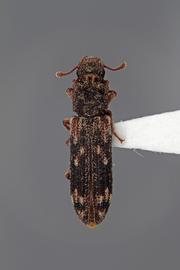
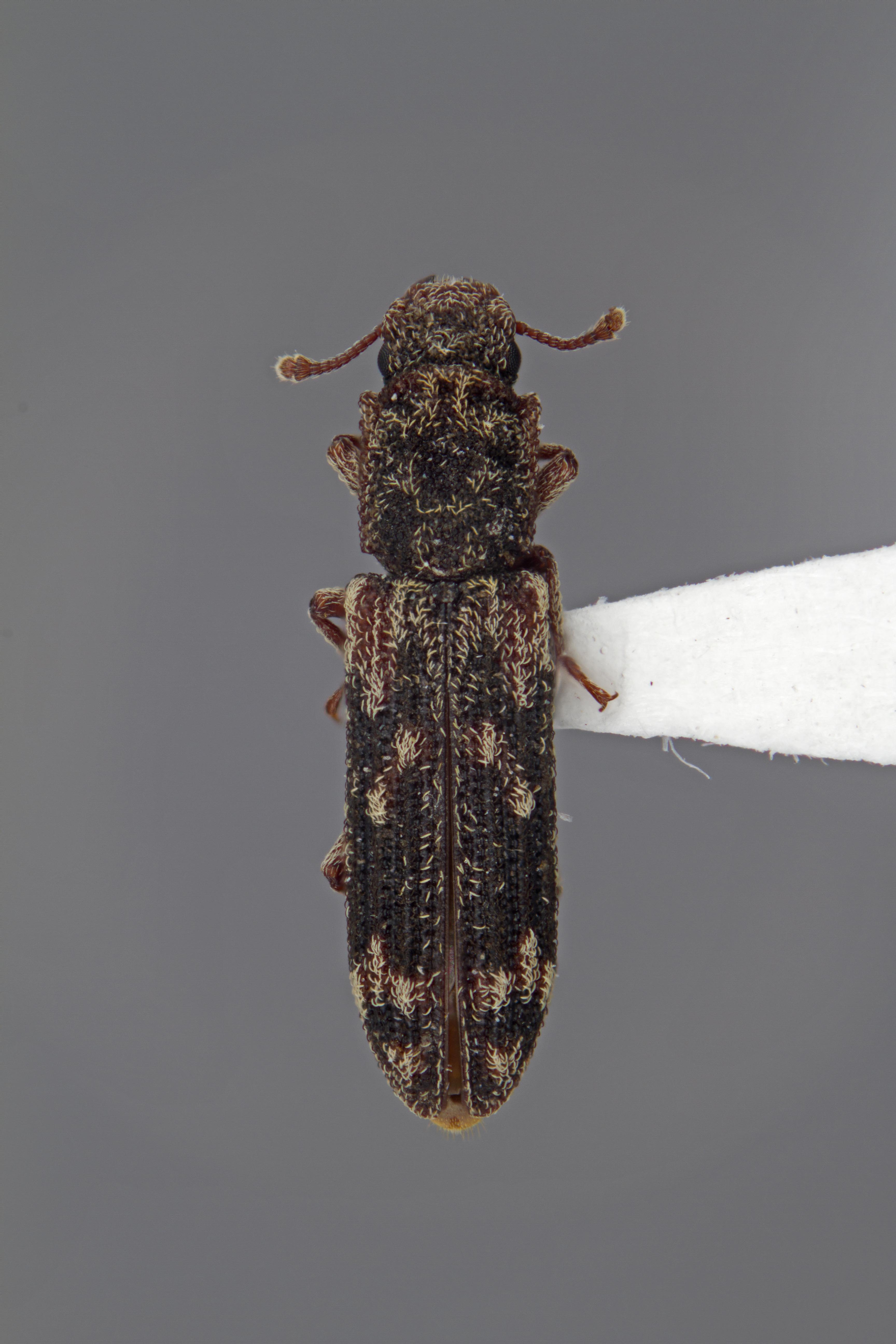
Body cylindrical, elongate. Antennaeantennae:
paired, segmental appendages, borne one on each side of head, functioning as sense organs and bearing a large number of sensilla.
11-segmented with a distinct, 2-segmented club. Antennal setation sparse. Subantennal groovessubantennal groove:
groove or concavity lying below the antennal insertion and housing the base of the antenna. Placed between the eye (if present) and the mandibular articulation, and sometimes extends below or behind the eye.
present, as long as eyes. Eyes large, well-developed, facets fine. Pronotumpronotum:
dorsal portion of the pronotum, lying above the lateral pronotal carinae when these are present.
subquadrate, with several raised areas and depressions. Lateral pronotal margins finely serrateserrate:
sawlike, i.e., with notched edges like the teeth of a saw.
. Procoxal cavitiesprocoxal cavities:
external closure: Externally closed when the postcoxal processes of the hypomera meet the prosternal process or meet one another.
open. Metacoxaemetacoxae:
the coxae of the metathorax.
narrowly separated, separation less than metacoxal length. Elytraelytron:
the fore wing in Coleoptera, which is more or less uniformly sclerotized and in resting position is longitudinally oriented, usually meeting the opposite elytron along the midline.
weakly carinate, with two rows of large, nearly contiguous puncturespuncture:
a small impression on the cuticle, like that made by a needle.
between carinaecarina:
an elevated ridge or keel, not necessarily high or acute.
. Tarsal formulatarsal formula:
the number of tarsomeres on the fore, mid, and hind tarsi, respectively.
4–4–4. Dorsal surface bi-colored, vestiturevestiture:
the general surface covering comprised of cuticular projections, e.g., setae, scales, or spicules.
consisting of patches of pale setaeseta:
a sclerotized, hairlike (or scalelike) projection of cuticula arising from a single trichogen cell and surrounded at the base by a small cuticular ring.
.
The genus Eudesma is extremely distinctive and is not readily confused with other zopherid genera.
Eudesma undulata (Melsheimer, 1846)
Northeast (PA, VA), North Central (IL, IN, OH) USA.
Eudesma undulata has been collected from under the bark of dead trees, including buckeye (Aesculus glabra) and oak (Quercus).
Abundance: Rare.
Cockerell (1906)Cockerell (1906):
Cockerell TDA. 1906. Preoccupied generic names in Coleoptera. Entomological News 17: 240-244., Ivie (2002a)Ivie (2002a):
Ivie, M.A. 2002a. 127. Colydiidae, pp. 445-453 In: R. H. Arnett, Jr., Jr. and M. C. Thomas (eds.), American Beetles. CRC Press, Gainesville, Florida., Melsheimer (1846)Melsheimer (1846):
Melsheimer, F.E. 1846. Descriptions of new species of Coleoptera of the United States. Proceedings of the Academy of National Science of Philadelphia, 2: 98-118., Stephan (1989)Stephan (1989):
Stephan, K.H. 1989. The Bothrideridae and Colydiidae of America north of Mexico (Coleoptera: Clavicornia and Heteromera). Occasional Papers of the Florida State Collection of Arthropods, 6: xii + 65 pp.
Authors: Lord NP, Nearns EH, Miller KB. 2011–2015.
Content updated Apr 2015; taxonomy updated Feb 2026
idtools.org