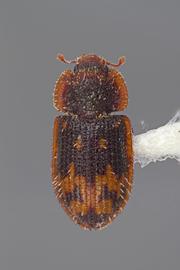
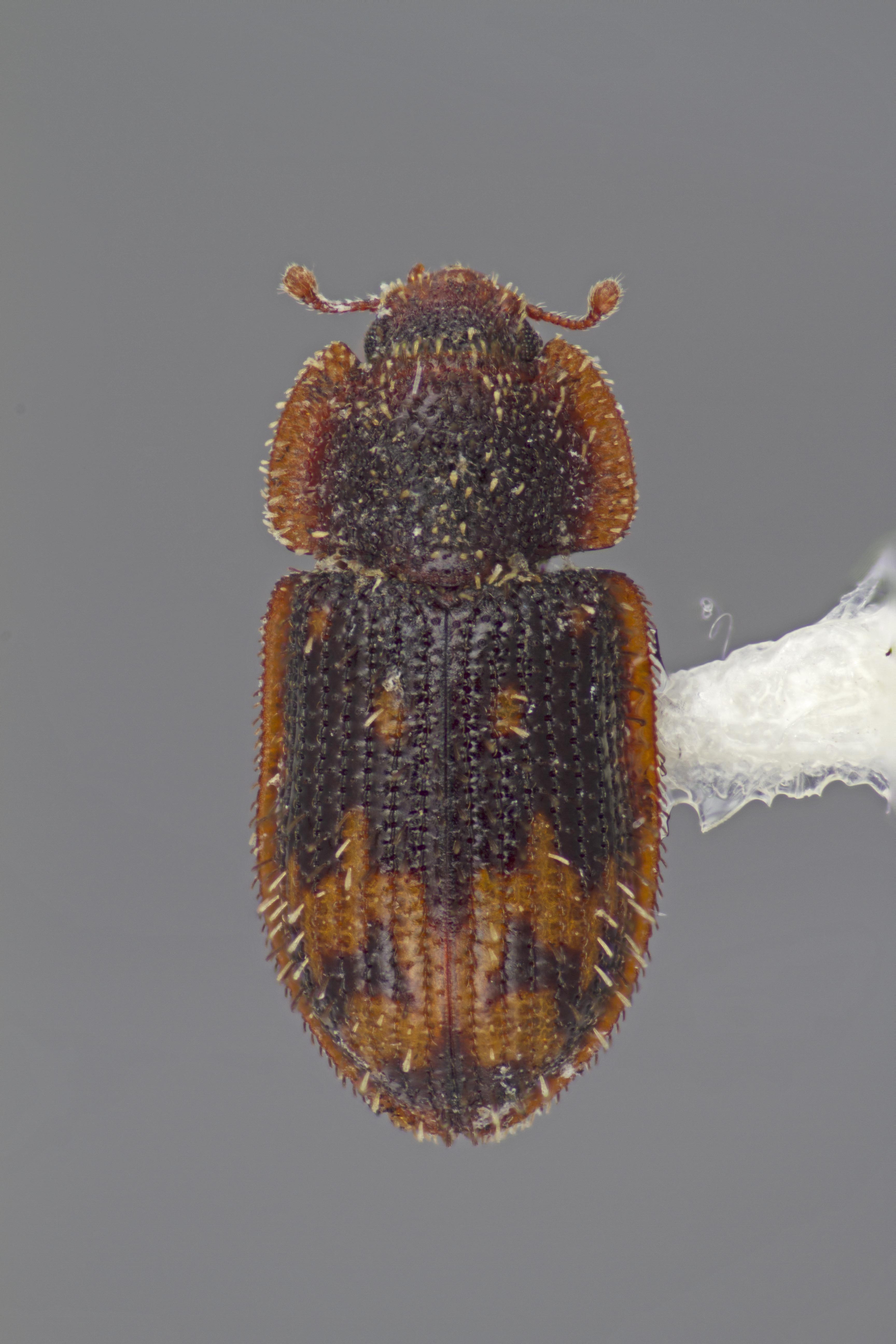
Antennaeantennae:
paired, segmental appendages, borne one on each side of head, functioning as sense organs and bearing a large number of sensilla.
10-segmented with a distinct, 1-segmented club. Antennal setation sparse. Subantennal groovessubantennal groove:
groove or concavity lying below the antennal insertion and housing the base of the antenna. Placed between the eye (if present) and the mandibular articulation, and sometimes extends below or behind the eye.
present, as long as eyes. Eyes large, well-developed, facets moderately coarse. Pronotal discpronotal disc:
the area of the pronotum which is visible dorsally and usually delimited laterally by the two lateral carinae. Contrasted with the paired pronotal hypomera, which extend onto the ventral surface.
convex, simple. Lateral pronotal margins widest posteriorly, distinctly explanateexplanate:
spread out and flattened; applied to a margin.
. Procoxal cavitiesprocoxal cavities:
external closure: Externally closed when the postcoxal processes of the hypomera meet the prosternal process or meet one another.
open. Metacoxaemetacoxae:
the coxae of the metathorax.
narrowly separated, separation less than metacoxal length. Elytraelytron:
the fore wing in Coleoptera, which is more or less uniformly sclerotized and in resting position is longitudinally oriented, usually meeting the opposite elytron along the midline.
variegated, multi-colored. Elytral margins slightly explanateexplanate:
spread out and flattened; applied to a margin.
. Tarsal formulatarsal formula:
the number of tarsomeres on the fore, mid, and hind tarsi, respectively.
4–4–4. Dorsum with short, thick, flattened, club-shaped setaeseta:
a sclerotized, hairlike (or scalelike) projection of cuticula arising from a single trichogen cell and surrounded at the base by a small cuticular ring.
.
The genus Eucicones is similar in general appearance to the genus Acolobicus. The presence of faint carinae on the pronotal disc, lack of thick, flattened, club-shaped setae and unicolored dorsal surface serve to distinguish Acolobicus.
Eucicones marginalis (Melsheimer, 1846)
Northeast (DC, NJ, PA), North Central (IL, IN, KS, MO), Southeast (AL, FL, TN), South Central (OK, TX) USA; Ontario, Canada.
Eucicones marginalis has been collected from under the bark of dead oaks and elms.
Abundance: Uncommon.
Ivie (2002a)Ivie (2002a):
Ivie, M.A. 2002a. 127. Colydiidae, pp. 445-453 In: R. H. Arnett, Jr., Jr. and M. C. Thomas (eds.), American Beetles. CRC Press, Gainesville, Florida., Melsheimer (1846)Melsheimer (1846):
Melsheimer, F.E. 1846. Descriptions of new species of Coleoptera of the United States. Proceedings of the Academy of National Science of Philadelphia, 2: 98-118., Stephan (1989)Stephan (1989):
Stephan, K.H. 1989. The Bothrideridae and Colydiidae of America north of Mexico (Coleoptera: Clavicornia and Heteromera). Occasional Papers of the Florida State Collection of Arthropods, 6: xii + 65 pp.
Authors: Lord NP, Nearns EH, Miller KB. 2011–2015.
Content updated Apr 2015; taxonomy updated Feb 2026
idtools.org