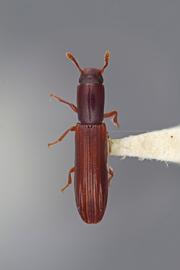
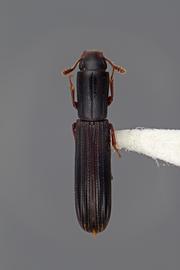
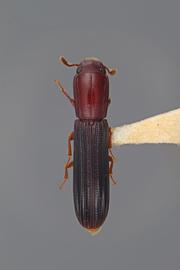
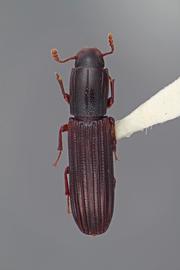
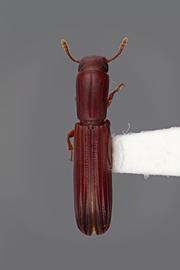
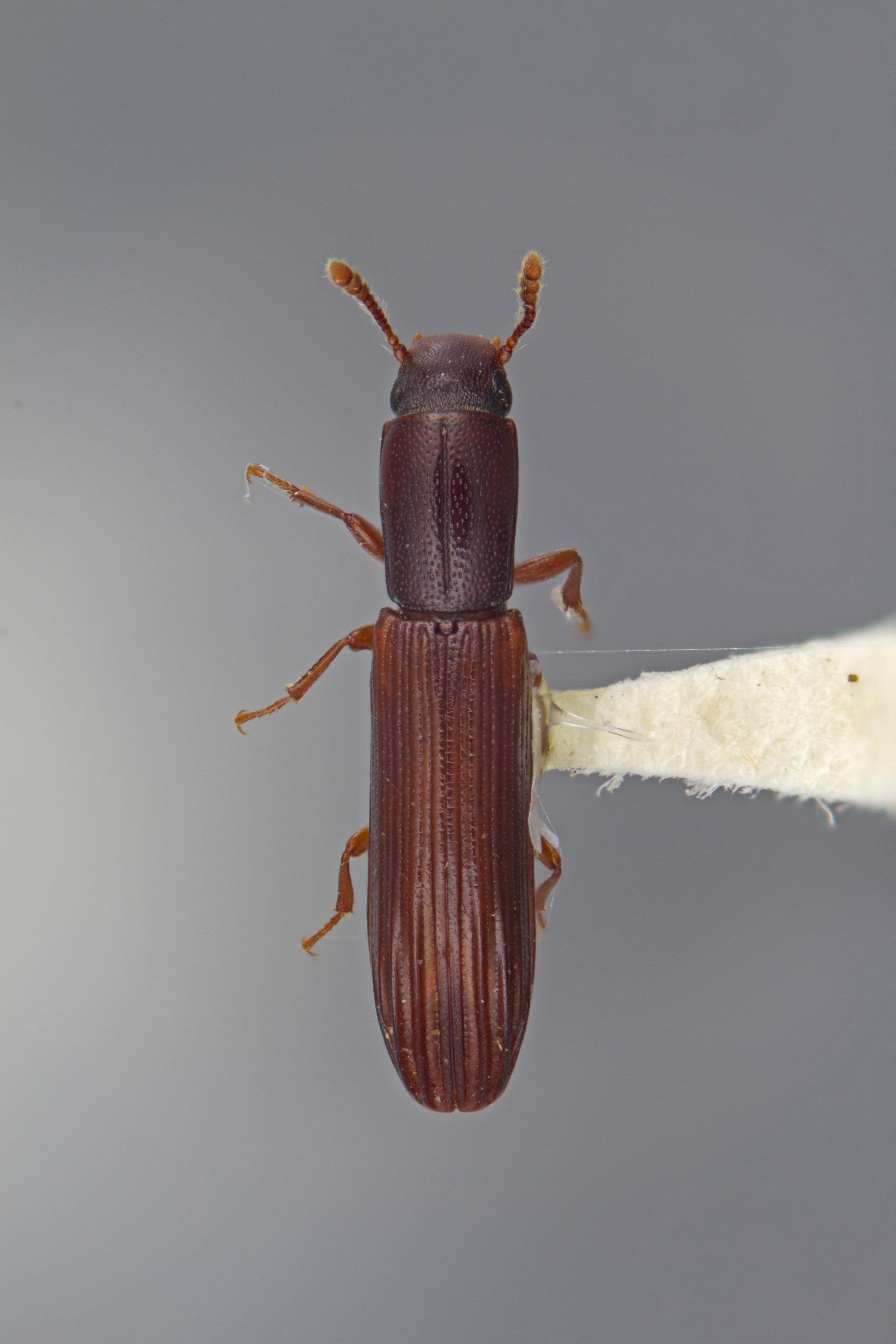
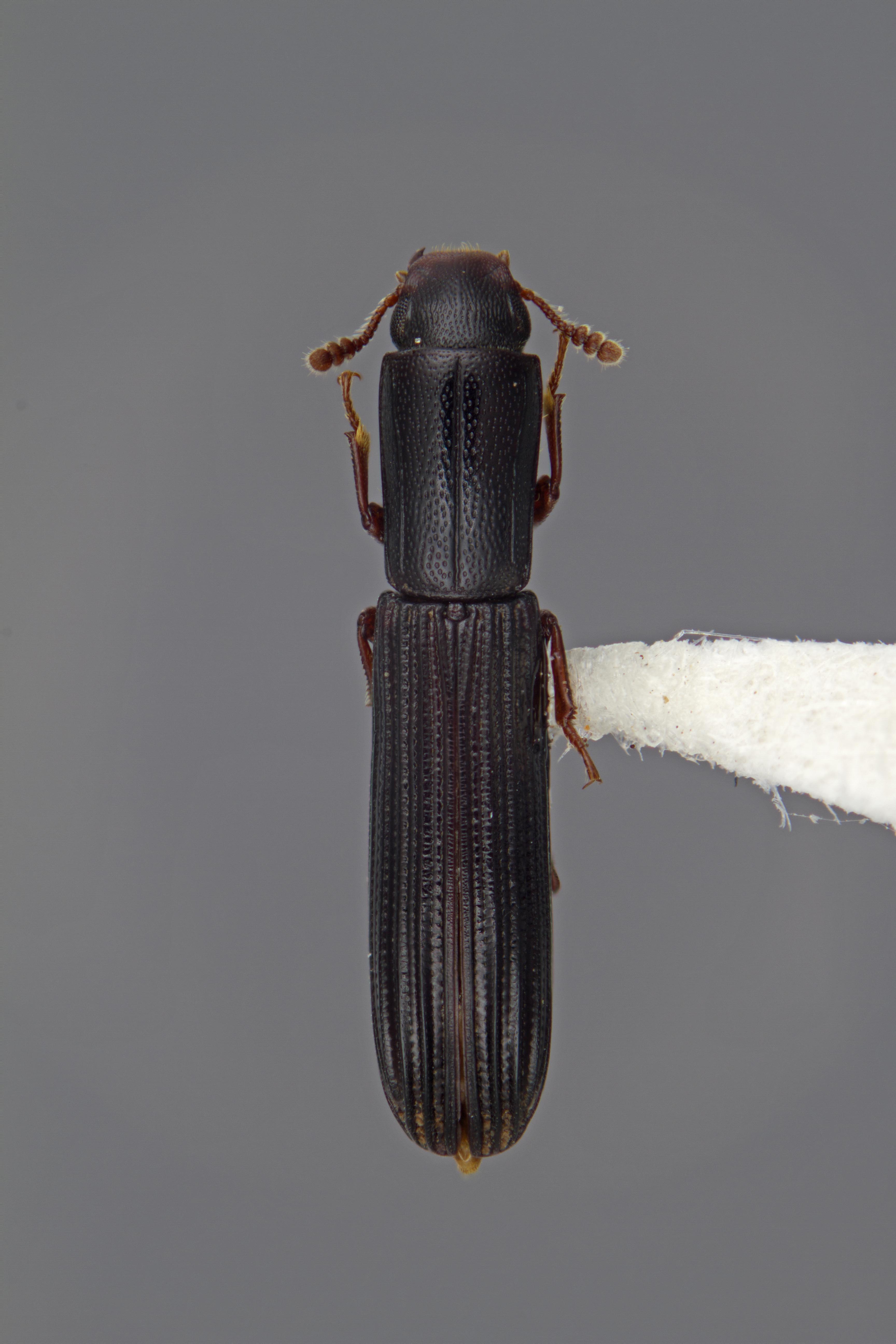
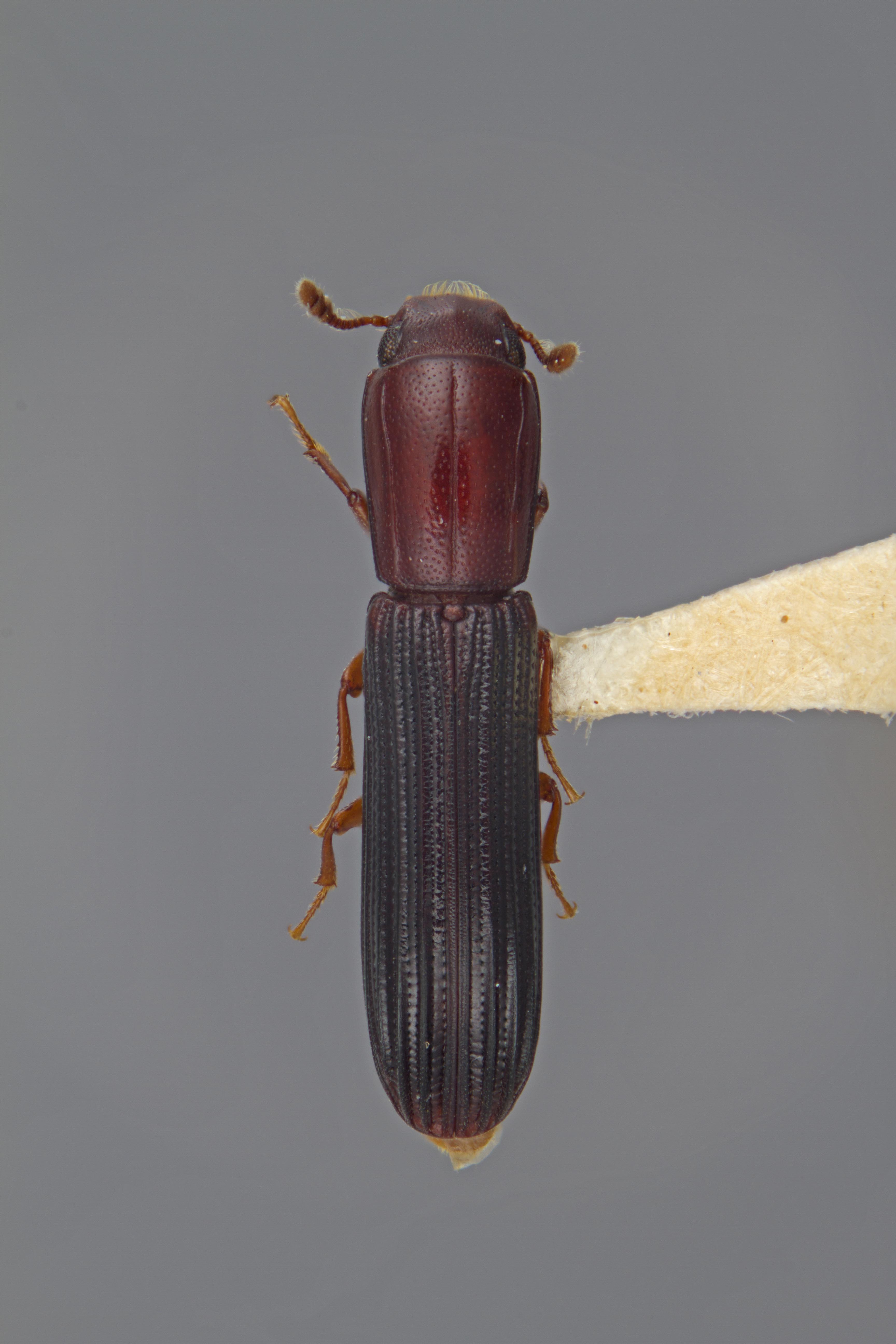
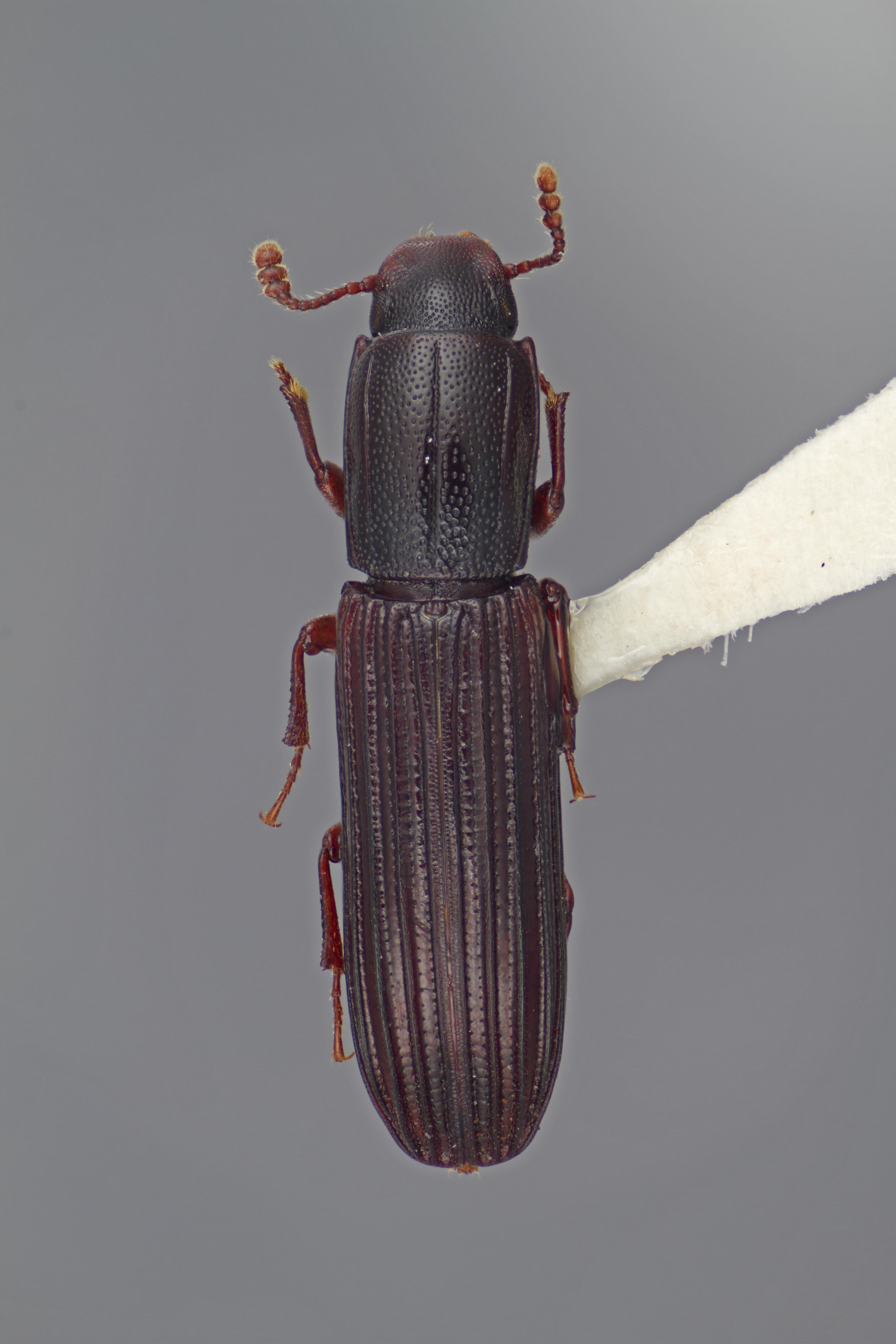
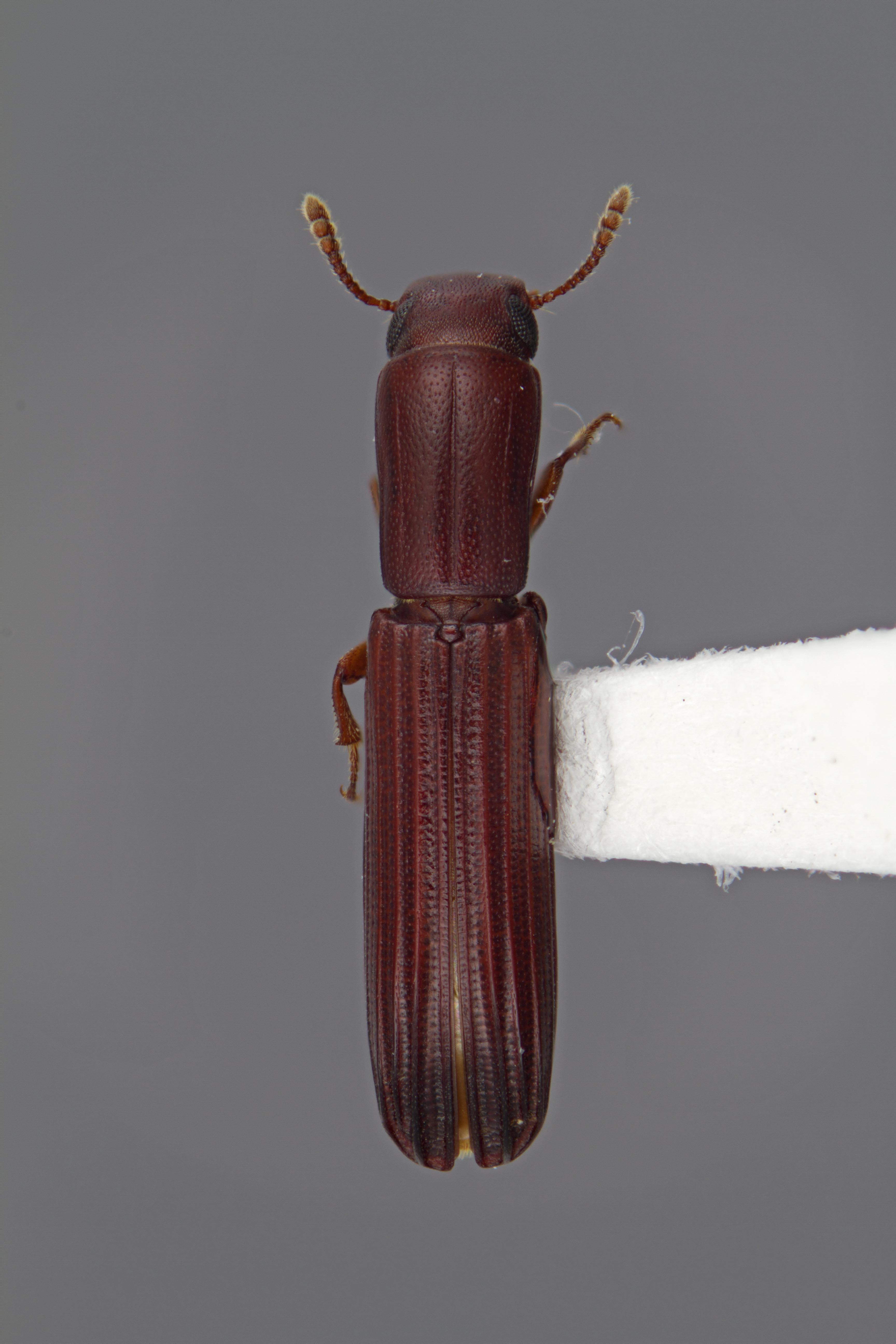
Body elongate, subcylindrical. Antennaeantennae:
paired, segmental appendages, borne one on each side of head, functioning as sense organs and bearing a large number of sensilla.
11-segmented with a 3-segmented club. Antennal setation sparse. Subantennal groovessubantennal groove:
groove or concavity lying below the antennal insertion and housing the base of the antenna. Placed between the eye (if present) and the mandibular articulation, and sometimes extends below or behind the eye.
absent. Eyes ovate, well-developed, coarsely faceted. Eyes weakly to distinctly emarginateemarginate:
notched at the margin.
anteriorly by projection of fronsfrons:
the area between the eyes and just behind the frontoclypeal suture. In Coleoptera it is not or only rarely separated from the vertex posteriorly.
, forming a distinct canthuscanthus:
a sclerotized bar encroaching on the eye.
. Pronotumpronotum:
dorsal portion of the pronotum, lying above the lateral pronotal carinae when these are present.
subquadrate to elongate. Pronotal discpronotal disc:
the area of the pronotum which is visible dorsally and usually delimited laterally by the two lateral carinae. Contrasted with the paired pronotal hypomera, which extend onto the ventral surface.
often with pair of sublateralsublateral:
just inside the lateral margin.
sulci and single medial sulcus. Procoxal cavitiesprocoxal cavities:
external closure: Externally closed when the postcoxal processes of the hypomera meet the prosternal process or meet one another.
narrowly closed. Metacoxaemetacoxae:
the coxae of the metathorax.
narrowly separated, separation less than metacoxal length. Tarsal formulatarsal formula:
the number of tarsomeres on the fore, mid, and hind tarsi, respectively.
4–4–4. Apexapex:
end of any structure distad to the base.
of protibia expanded, armed with a stout, apical spinespine:
a multicellular, more or less thornlike process or outgrowth of the cuticle not separated from it by a joint.
. Dorsal surface glabrousglabrous:
without hairs (setae).
, moderately shiny.
The genus Colydium is superficially similar in general appearance to Aulonium. The non-carinate elytral declivity and absence of a pair of long setae near the apicalapical:
an adjective (or adverb) denoting position near or movement toward the apex of a body part. The apex of the head or pronotum is at the anterior end while that of the abdomen or an elytron is at the posterior end; on the legs or antennae, apical and distal are synonymous.
margin of the last abdominal ventriteabdominal ventrite:
visible ventral abdominal sclerite. Ventrite number does not correspond to true sternite number except in rare cases where sternite 1 is visible. Also called ventrite.
serve to distinguish Aulonium. The genus Phloeonemus also has emarginated eyes formed by a projection of the frons, but is readily distinguished from Colydium and Aulonium by the 2-segmented antennal clubantennal club:
an enlarged portion of the antennal apex, consisting of a variable number of antennomeres (often 3). In an incrassate, antenna the antennomeres gradually enlarge towards to apex, but if there is an abrupt change in length or width at some point, then the antennomeres beyond this are considered to be part of the club.
, lack of a stout apicalapical:
an adjective (or adverb) denoting position near or movement toward the apex of a body part. The apex of the head or pronotum is at the anterior end while that of the abdomen or an elytron is at the posterior end; on the legs or antennae, apical and distal are synonymous.
spine on the protibia, explanate lateral pronotal margins, very different sculpturing of the pronotal disc.
Colydium glabriculum Stephan, 1989, C. lineola Say, 1826, C. nigripenne LeConte, 1863, C. robustum Stephan, 1989, C. thomasi Stephan, 1989
Northwest (ID, MT, OR, WA), Southwest (AZ, CA, CO, NM, NV, UT), North Central (SD, IL, IN, MI, OH), Northeast (DC, DE, NJ, NY, MA, MD, PA, WV, VA), Southeast (AL, FL, GA, KY, NC, SC, TN), South Central (AR, LA, MS, OK, TX) USA; British Columbia, Canada.
Colydium has been collected at MV/UV lights and from under the bark of various dead hardwoods and conifers. Adults and larvae of Colydium have been found in the galleries of scolytine weevils (Curculionidae), and they are suspected to feed on the larvae of those beetles within the galleries (Ivie 2002aIvie 2002a:
Ivie, M.A. 2002a. 127. Colydiidae, pp. 445-453 In: R. H. Arnett, Jr., Jr. and M. C. Thomas (eds.), American Beetles. CRC Press, Gainesville, Florida., Lawrence 1991aLawrence 1991a:
Lawrence, J.F. 1991a. Colydiidae (Tenebrionoidea), pp. 512-514. In: F. W. Stehr (ed.), Immature Insects. Vol. 2. Kendall/Hunt Publishing Co., Dubuque, Iowa., Wegrzynowicz 1999Wegrzynowicz 1999:
Wegrzynowicz, P. 1999. A revision of the genus Colydium Fabricius, 1792 (Coleoptera: Zopheridae: Colydiinae). Annales Zoologici, 49: 265-328.). It is unclear whether or not this genus can be considered beneficial, as the feeding on wood boring beetles may be circumstantial.
Abundance: Moderately common.
Colydium glabriculum: Apexapex:
end of any structure distad to the base.
of clypeus glabrousglabrous:
without hairs (setae).
, labrum distinctly setose. Anterioranterior:
in front; before.
angles of pronotumpronotum:
dorsal portion of the pronotum, lying above the lateral pronotal carinae when these are present.
rounded, not projecting forward. Lateral margins of pronotumpronotum:
dorsal portion of the pronotum, lying above the lateral pronotal carinae when these are present.
narrowing basally. Sublateralsublateral:
just inside the lateral margin.
sulci of pronotal discpronotal disc:
the area of the pronotum which is visible dorsally and usually delimited laterally by the two lateral carinae. Contrasted with the paired pronotal hypomera, which extend onto the ventral surface.
distinct. Elytral carinaecarina:
an elevated ridge or keel, not necessarily high or acute.
distinctly raised basally and for apicalapical:
an adjective (or adverb) denoting position near or movement toward the apex of a body part. The apex of the head or pronotum is at the anterior end while that of the abdomen or an elytron is at the posterior end; on the legs or antennae, apical and distal are synonymous.
half, indistinctly raised medially. Body reddish, apexapex:
end of any structure distad to the base.
of elytraelytron:
the fore wing in Coleoptera, which is more or less uniformly sclerotized and in resting position is longitudinally oriented, usually meeting the opposite elytron along the midline.
darker. Distribution: Arizona and New Mexico, USA.
Colydium lineola: Body 5x longer than wide. Apexapex:
end of any structure distad to the base.
of clypeusclypeus:
the area of the beetle head between the frontoclypeal suture and the labrum, or in the absence of a frontoclypeal suture, the area just behind the labrum and in front of the eyes. Also called the epistoma.
and labrum both distinctly setose. Anterioranterior:
in front; before.
angles of pronotumpronotum:
dorsal portion of the pronotum, lying above the lateral pronotal carinae when these are present.
rounded, not projecting forward. Lateral margins of pronotumpronotum:
dorsal portion of the pronotum, lying above the lateral pronotal carinae when these are present.
narrowing basally. Sublateralsublateral:
just inside the lateral margin.
sulci of pronotal discpronotal disc:
the area of the pronotum which is visible dorsally and usually delimited laterally by the two lateral carinae. Contrasted with the paired pronotal hypomera, which extend onto the ventral surface.
faint to absent. Elytral carinaecarina:
an elevated ridge or keel, not necessarily high or acute.
distinctly raised for entire length. Body dark red to black. Distribution: Alabama, Arkansas, Arizona, California, Delaware, Florida, Georgia, Illinois, Indiana, Louisiana, Maryland, Mississippi, Missouri, New Jersey, New York, Oklahoma, Oregon, Pennsylvania, South Carolina, Tennessee, Texas, Washington, Washington D.C., USA; British Columbia, Ontario, Canada.
Colydium nigripenne: Apexapex:
end of any structure distad to the base.
of clypeusclypeus:
the area of the beetle head between the frontoclypeal suture and the labrum, or in the absence of a frontoclypeal suture, the area just behind the labrum and in front of the eyes. Also called the epistoma.
and labrum both distinctly setose. Anterioranterior:
in front; before.
angles of pronotumpronotum:
dorsal portion of the pronotum, lying above the lateral pronotal carinae when these are present.
rounded, not projecting forward. Lateral margins of pronotumpronotum:
dorsal portion of the pronotum, lying above the lateral pronotal carinae when these are present.
narrowing basally. Sublateralsublateral:
just inside the lateral margin.
sulci of pronotal discpronotal disc:
the area of the pronotum which is visible dorsally and usually delimited laterally by the two lateral carinae. Contrasted with the paired pronotal hypomera, which extend onto the ventral surface.
distinct. Elytral carinaecarina:
an elevated ridge or keel, not necessarily high or acute.
distinctly raised for entire length. Head and pronotumpronotum:
dorsal portion of the pronotum, lying above the lateral pronotal carinae when these are present.
reddish, elytraelytron:
the fore wing in Coleoptera, which is more or less uniformly sclerotized and in resting position is longitudinally oriented, usually meeting the opposite elytron along the midline.
black. Distribution: Alabama, Arkansas, Florida, Georgia, Illinois, Maryland, Mississippi, New Jersey, North Carolina, Oklahoma, South Carolina, Tennessee, Texas, Washington D.C., USA.
Colydium robustum: Body 4x longer than wide. Apexapex:
end of any structure distad to the base.
of clypeusclypeus:
the area of the beetle head between the frontoclypeal suture and the labrum, or in the absence of a frontoclypeal suture, the area just behind the labrum and in front of the eyes. Also called the epistoma.
and labrum both distinctly setose. Anterioranterior:
in front; before.
angles of pronotumpronotum:
dorsal portion of the pronotum, lying above the lateral pronotal carinae when these are present.
angulate, distinctly projecting forward. Lateral margins of pronotumpronotum:
dorsal portion of the pronotum, lying above the lateral pronotal carinae when these are present.
evenly curved. Sublateralsublateral:
just inside the lateral margin.
sulci of pronotal discpronotal disc:
the area of the pronotum which is visible dorsally and usually delimited laterally by the two lateral carinae. Contrasted with the paired pronotal hypomera, which extend onto the ventral surface.
distinct. Elytral carinaecarina:
an elevated ridge or keel, not necessarily high or acute.
distinctly raised for entire length. Body dark red to black. Distribution: Arizona, USA.
Colydium thomasi: Apexapex:
end of any structure distad to the base.
of clypeus glabrousglabrous:
without hairs (setae).
, labrum distinctly setose. Anterioranterior:
in front; before.
angles of pronotumpronotum:
dorsal portion of the pronotum, lying above the lateral pronotal carinae when these are present.
rounded, not projecting forward. Lateral margins of pronotumpronotum:
dorsal portion of the pronotum, lying above the lateral pronotal carinae when these are present.
narrowing basally. Sublateralsublateral:
just inside the lateral margin.
sulci of pronotal discpronotal disc:
the area of the pronotum which is visible dorsally and usually delimited laterally by the two lateral carinae. Contrasted with the paired pronotal hypomera, which extend onto the ventral surface.
faint to absent. Elytral carinaecarina:
an elevated ridge or keel, not necessarily high or acute.
distinctly raised for entire length. Body reddish, apexapex:
end of any structure distad to the base.
of elytraelytron:
the fore wing in Coleoptera, which is more or less uniformly sclerotized and in resting position is longitudinally oriented, usually meeting the opposite elytron along the midline.
darker. Distribution: Florida Keys, Florida, USA.
Ivie (2002a)Ivie (2002a):
Ivie, M.A. 2002a. 127. Colydiidae, pp. 445-453 In: R. H. Arnett, Jr., Jr. and M. C. Thomas (eds.), American Beetles. CRC Press, Gainesville, Florida., LeConte (1863)LeConte (1863):
LeConte, J.L. 1863. New species of North American Coleoptera. Part I. Smithsonian Miscellaneous Collections, 167: 1-92., Say (1826)Say (1826):
Say, T. 1826. Descriptions of new species of coleopterous insects inhabiting the United States. Journal of the Academy of Natural Sciences of Philadelphia, 5(2): 237-284., Stephan (1989)Stephan (1989):
Stephan, K.H. 1989. The Bothrideridae and Colydiidae of America north of Mexico (Coleoptera: Clavicornia and Heteromera). Occasional Papers of the Florida State Collection of Arthropods, 6: xii + 65 pp., Wegrzynowicz (1999)Wegrzynowicz (1999):
Wegrzynowicz, P. 1999. A revision of the genus Colydium Fabricius, 1792 (Coleoptera: Zopheridae: Colydiinae). Annales Zoologici, 49: 265-328.
Authors: Lord NP, Nearns EH, Miller KB. 2011–2015.
Content updated Apr 2015; taxonomy updated Feb 2026
idtools.org