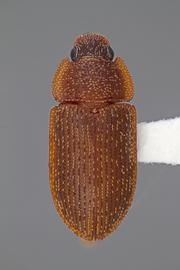
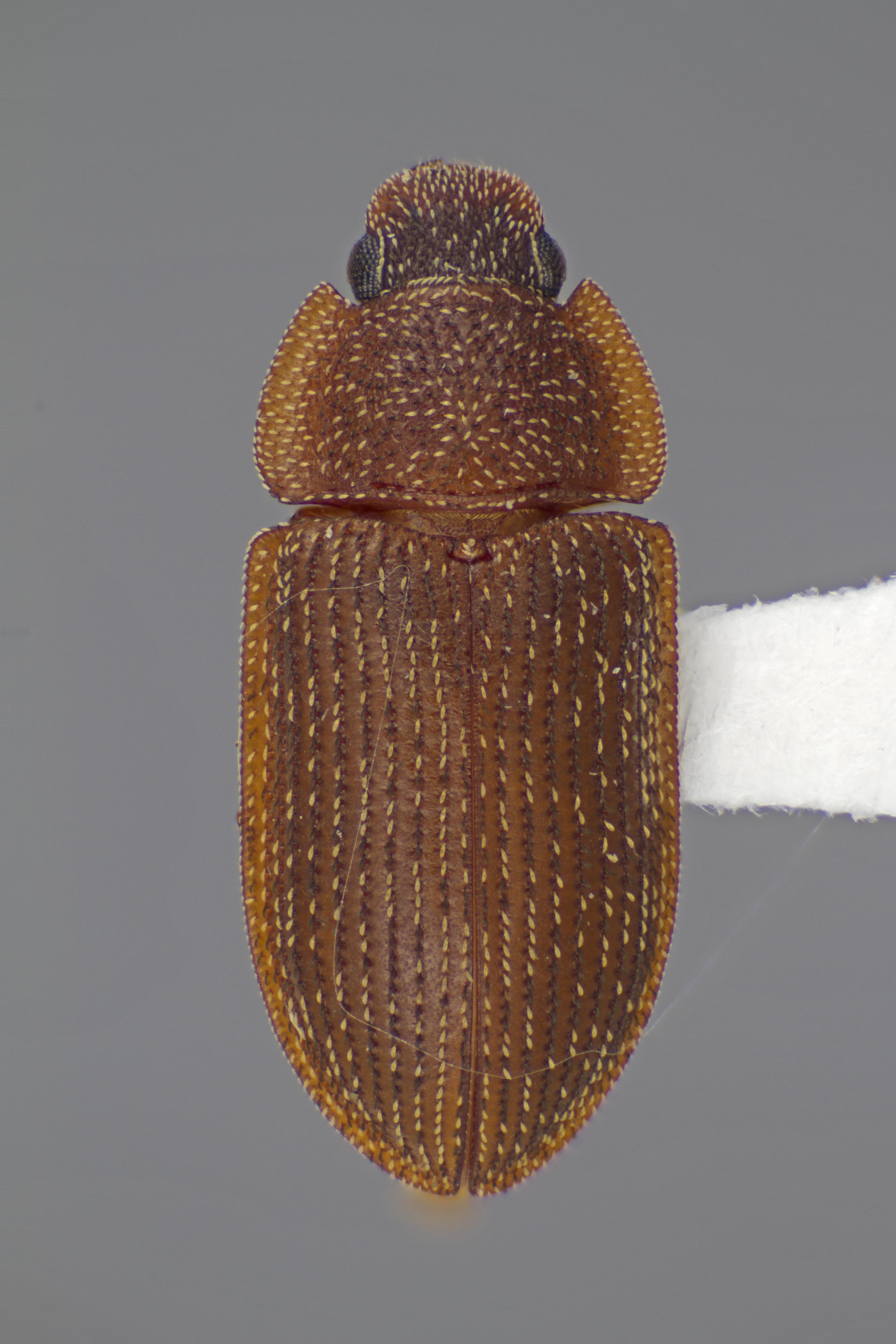
Body distinctly flattened. Antennaeantennae:
paired, segmental appendages, borne one on each side of head, functioning as sense organs and bearing a large number of sensilla.
11-segmented with a distinct, 2-segmented club. Antennal setation sparse. Antennomereantennomere:
antennal segment; including scape, pedicel and flagellomeres. NOTE: the flagellum is composed of all antennal segments proceeding the scape and pedicel. Any individual antennal segment is commonly called an antennomere.
3 distinctly elongate (at least twice as long as 4). Subantennal groovessubantennal groove:
groove or concavity lying below the antennal insertion and housing the base of the antenna. Placed between the eye (if present) and the mandibular articulation, and sometimes extends below or behind the eye.
long, reaching posteriorposterior:
hinder or hindmost, opposed to anterior; hind or rear.
margin of eye. Eyes round, well-developed, facets fine. Pronotumpronotum:
dorsal portion of the pronotum, lying above the lateral pronotal carinae when these are present.
simple, with flattened, short, recumbent setaeseta:
a sclerotized, hairlike (or scalelike) projection of cuticula arising from a single trichogen cell and surrounded at the base by a small cuticular ring.
. Pronotal lateral margins smooth, widest basally, distinctly explanateexplanate:
spread out and flattened; applied to a margin.
. Procoxal cavitiesprocoxal cavities:
external closure: Externally closed when the postcoxal processes of the hypomera meet the prosternal process or meet one another.
narrowly open. Metacoxaemetacoxae:
the coxae of the metathorax.
narrowly separated, separation less than metacoxal length. Elytral lateral margins weakly explanateexplanate:
spread out and flattened; applied to a margin.
. Elytraelytron:
the fore wing in Coleoptera, which is more or less uniformly sclerotized and in resting position is longitudinally oriented, usually meeting the opposite elytron along the midline.
with distinct striae composed flattened, short, recumbent setaeseta:
a sclerotized, hairlike (or scalelike) projection of cuticula arising from a single trichogen cell and surrounded at the base by a small cuticular ring.
. Tarsal formulatarsal formula:
the number of tarsomeres on the fore, mid, and hind tarsi, respectively.
4–4–4.
The genus Colobicus is superficially similar to the genera Acolobicus and Eucicones. The smaller size, presence of faint carinae on the pronotal disc, lack of thick, flattened, club-shaped setae and unicolored dorsal surface serve to distinguish Acolobicus. The smaller size, variegated elytra, rougher dorsal surface, and distinctly more setose vestiture serve to distinguish Eucicones.
Colobicus parilis Pascoe, 1860
Hawaiʻi, Southeastern (LA) USA.
Colobicus parilis has been found at UV/MV light and from under the bark of a number of trees. It has been noted that this species has been found on commercial shipments and in stores of sweet potatoes and other crops, where it is suspected to spread fungal disease (Hinton 1945Hinton 1945:
Hinton, H.E. 1945. A monograph of the beetles associated with stored products. Volume 1. British Museum of Natural History. London. 440 pp., Ivie 2002aIvie 2002a:
Ivie, M.A. 2002a. 127. Colydiidae, pp. 445-453 In: R. H. Arnett, Jr., Jr. and M. C. Thomas (eds.), American Beetles. CRC Press, Gainesville, Florida.). Due to the destruction of crops from fungal disease spread by this beetle, it should be considered harmful.
Abundance: Rare.
This genus is found throughout the Australo-Pacific region. It has likely been introduced into the United States, possibly on crop products.
Ford (1968)Ford (1968):
Ford EJ Jr. 1968. Colydiid beetles of Hawaii, With the description of a new species. Pacific Insects 10: 161-165., Ivie (2002a)Ivie (2002a):
Ivie, M.A. 2002a. 127. Colydiidae, pp. 445-453 In: R. H. Arnett, Jr., Jr. and M. C. Thomas (eds.), American Beetles. CRC Press, Gainesville, Florida., Pascoe (1860)Pascoe (1860):
Pascoe, F.P. 1860. Notices of new or little-known genera and species of Coleoptera. Journal of Entomology, 1(2): 98-132., Ślipiński and Lawrence (1997)Ślipiński and Lawrence (1997):
Ślipiński, S.A. and J.F. Lawrence. 1997. Genera of Colydiinae (Coleoptera: Zopheridae) of the Australo-Pacific region. Annales Zoologici (Warszawa), 47: 341-440.
Authors: Lord NP, Nearns EH, Miller KB. 2011–2015.
Content updated Apr 2015; taxonomy updated Feb 2026
idtools.org