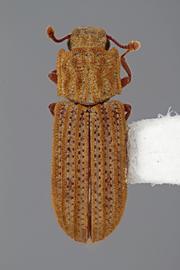
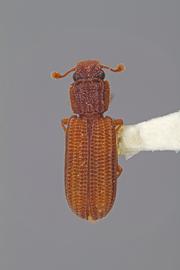
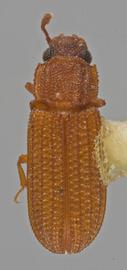
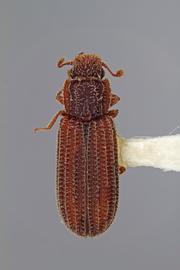
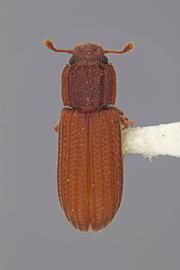
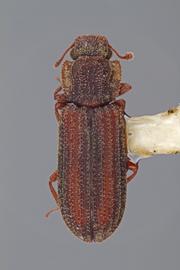
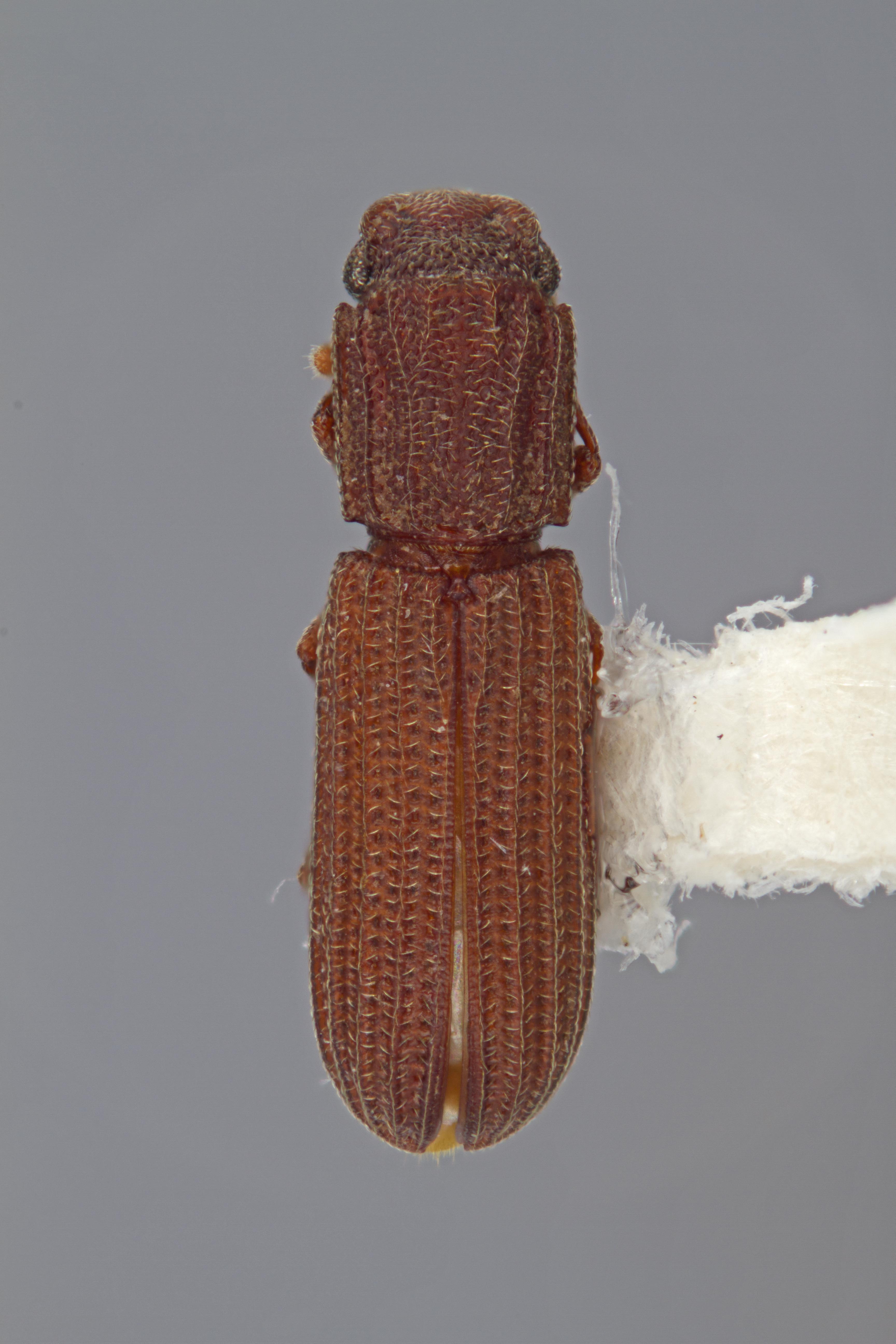
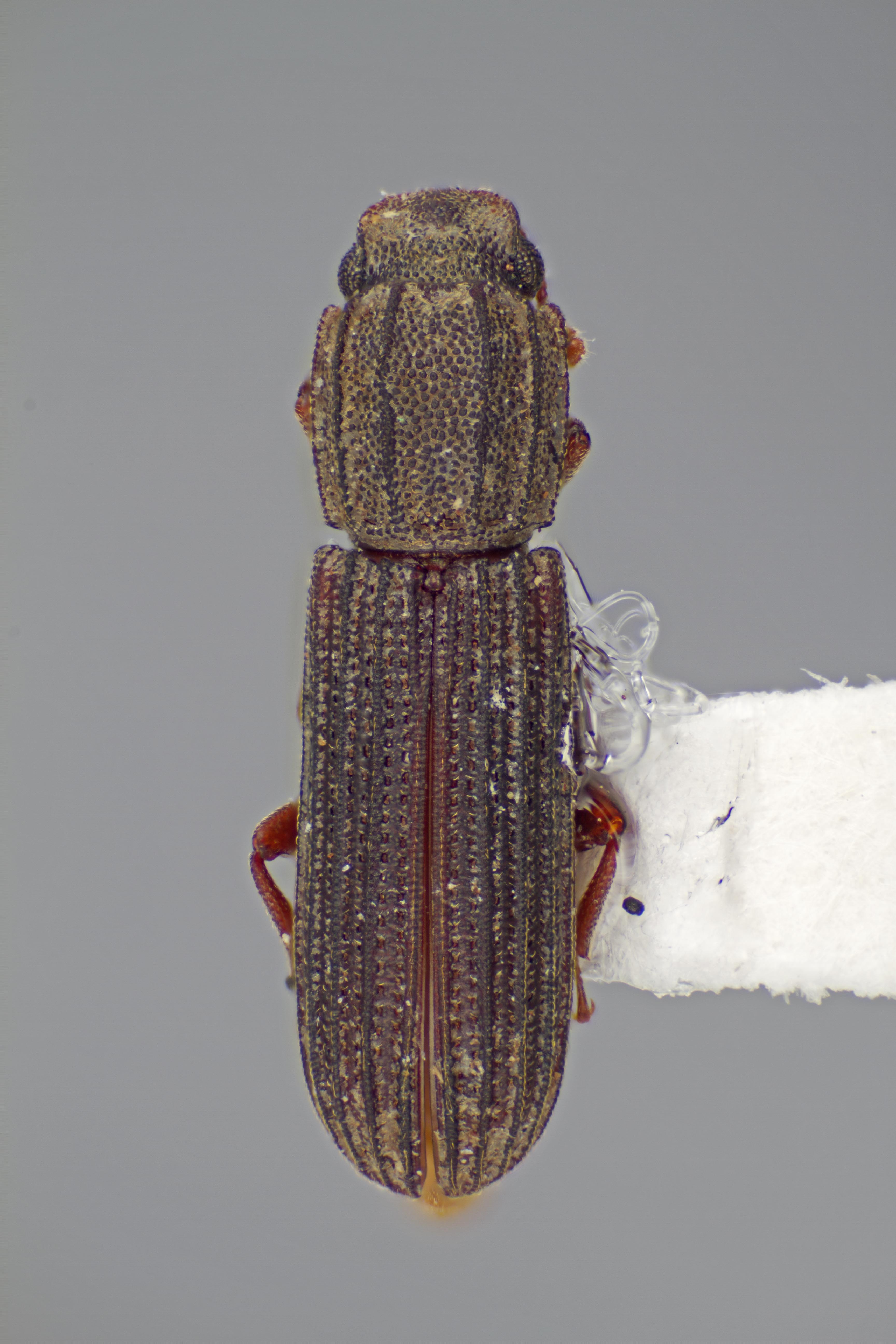
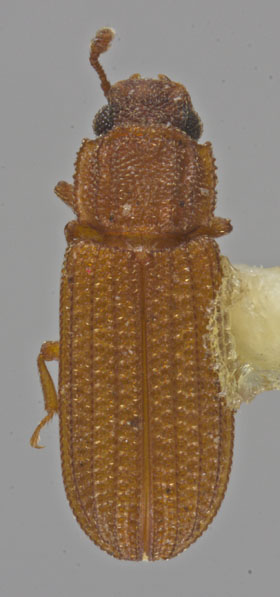
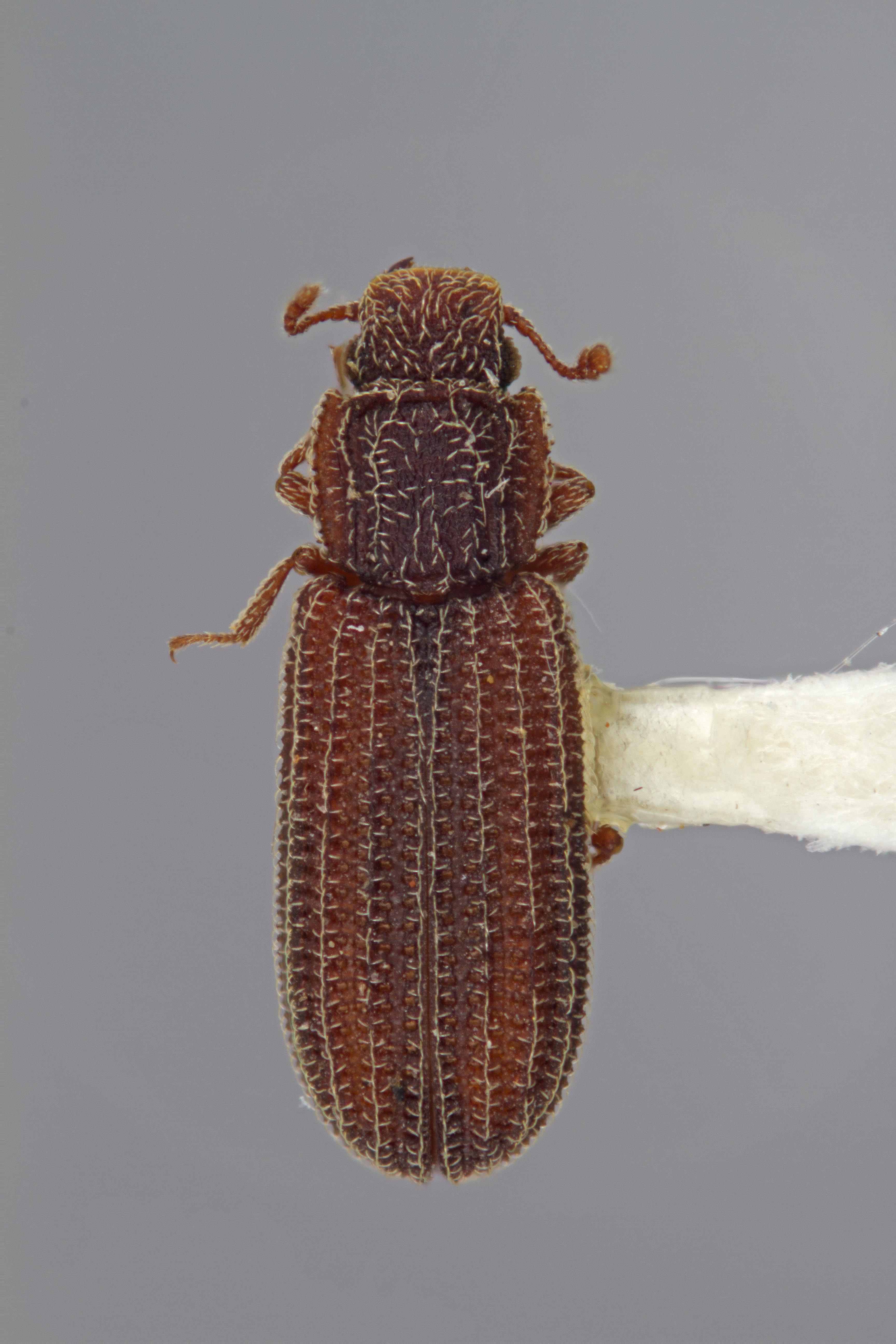
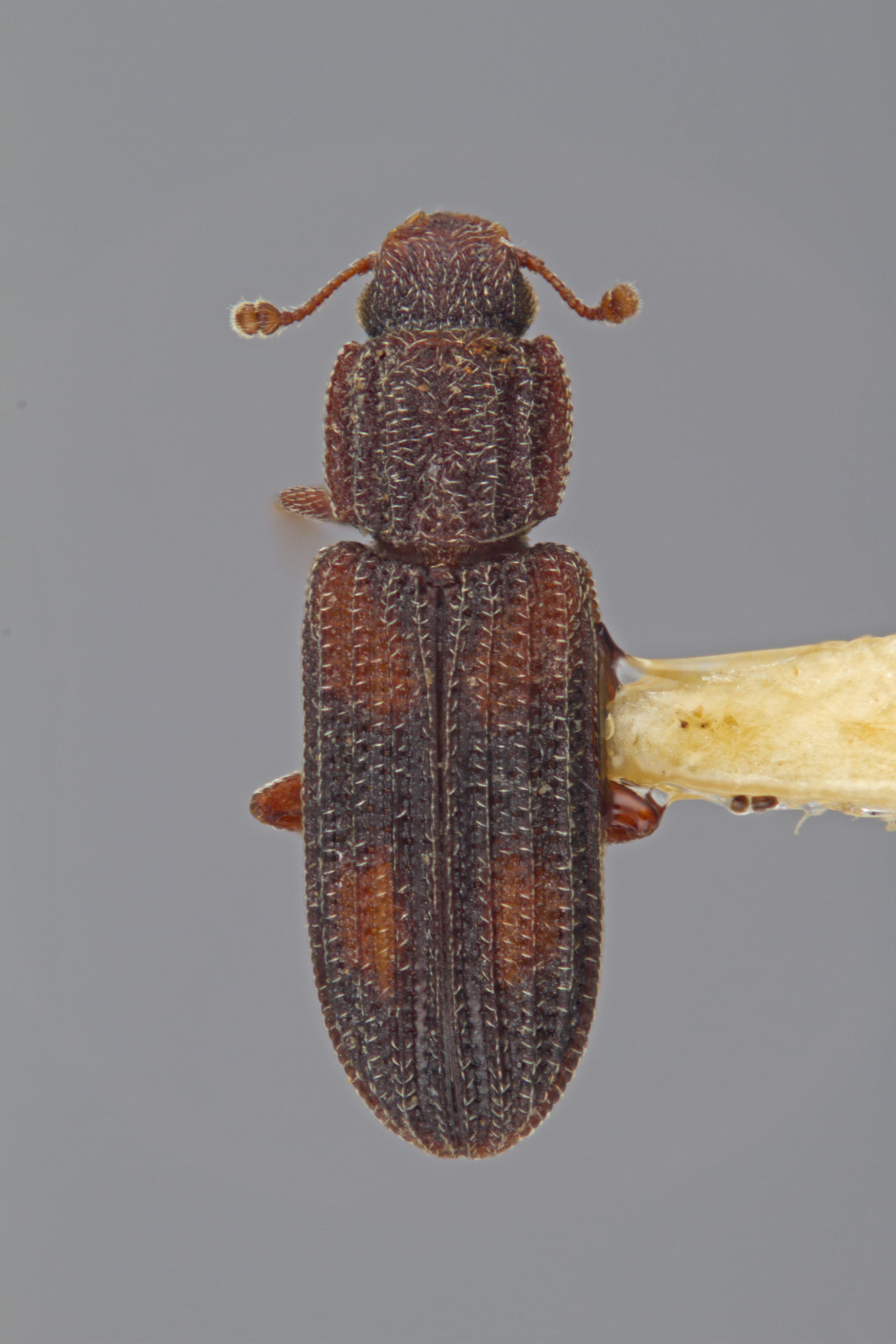
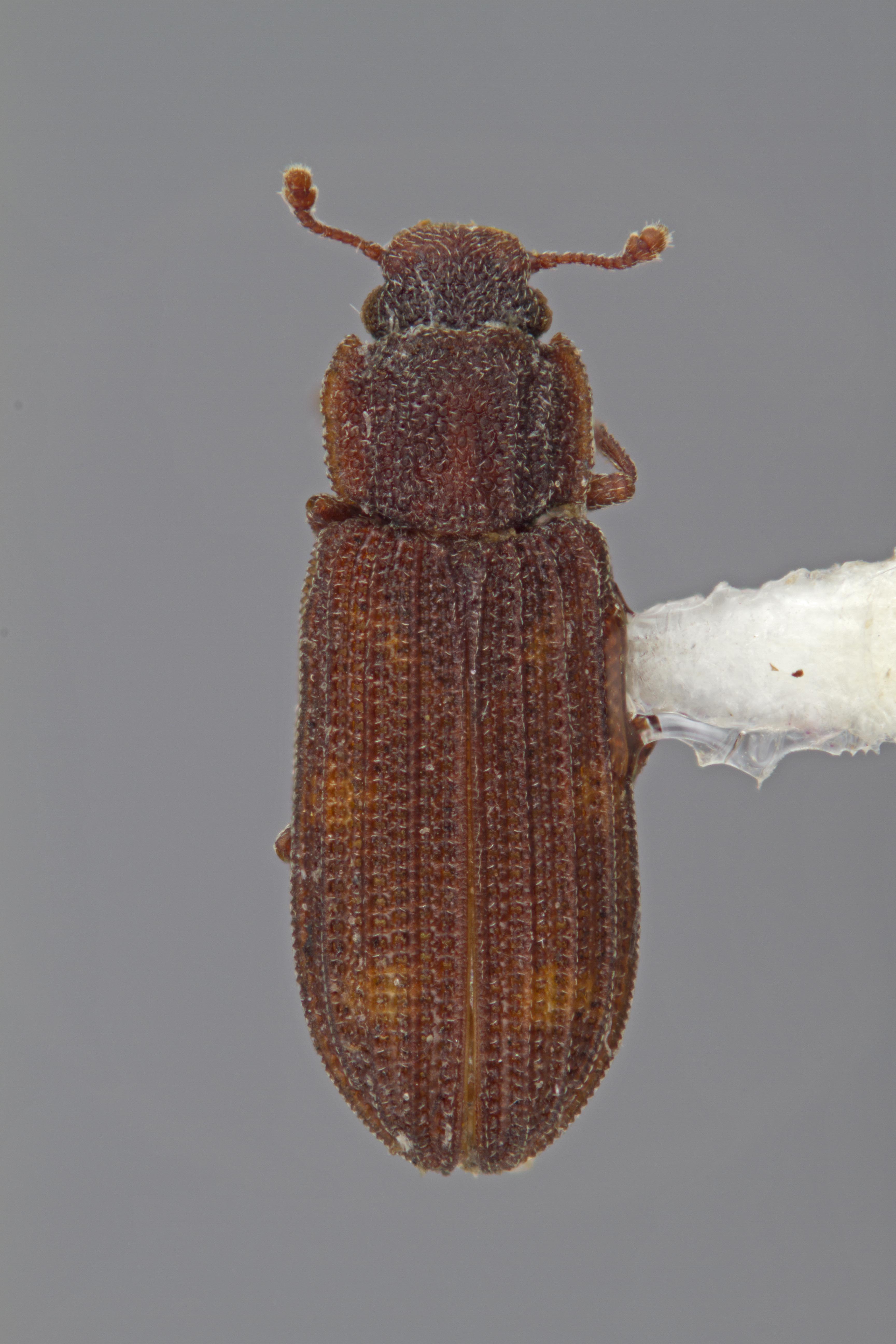
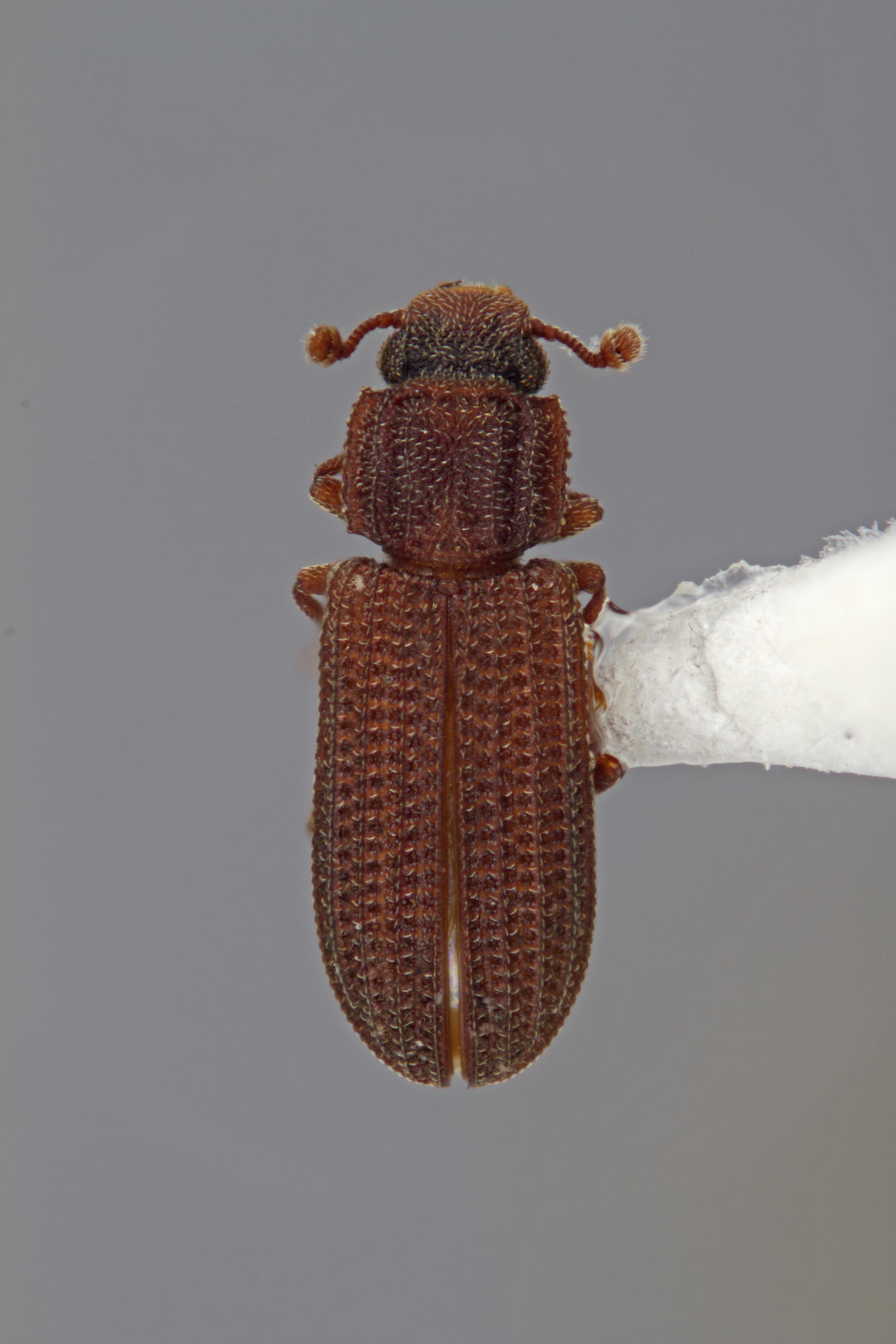
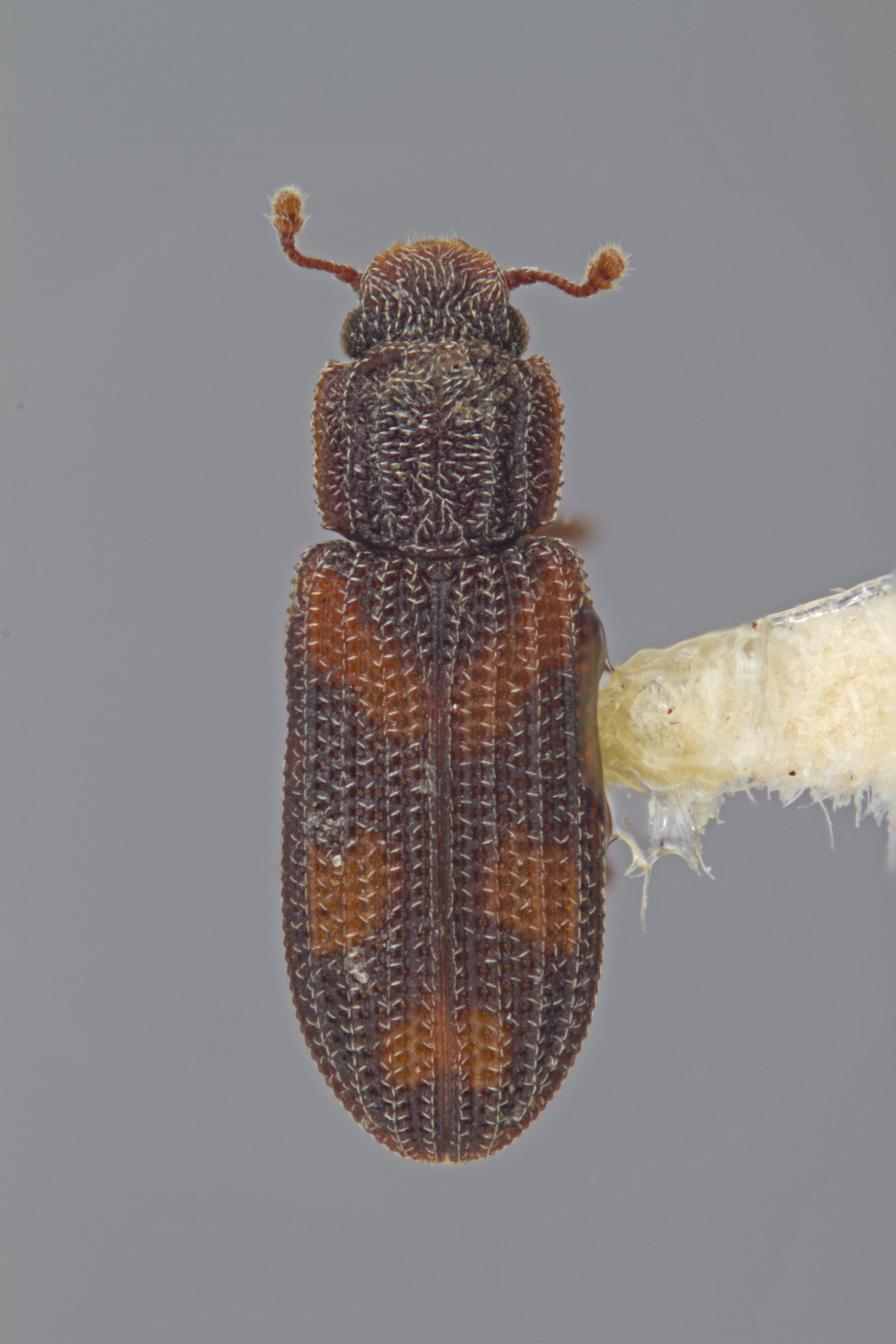
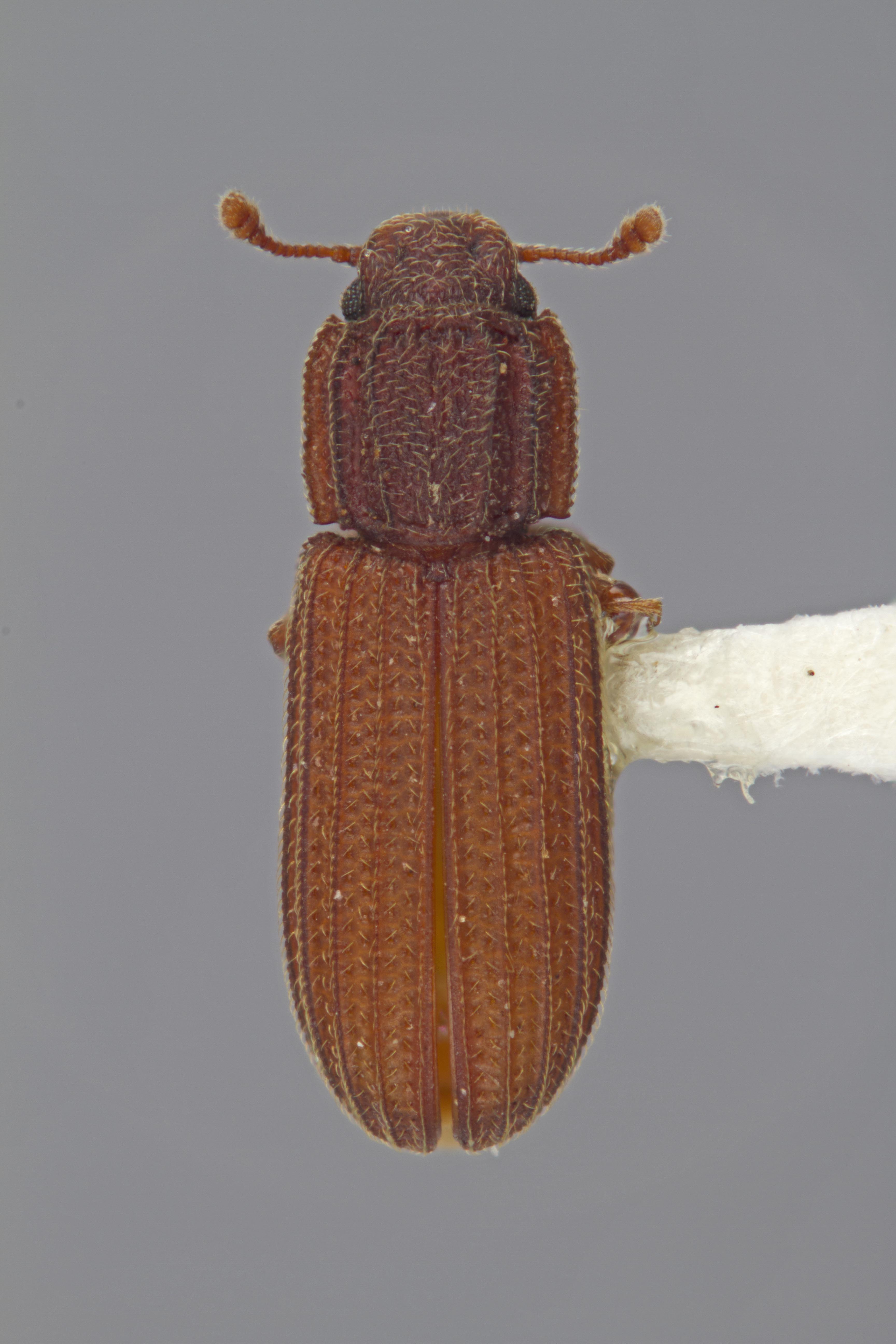
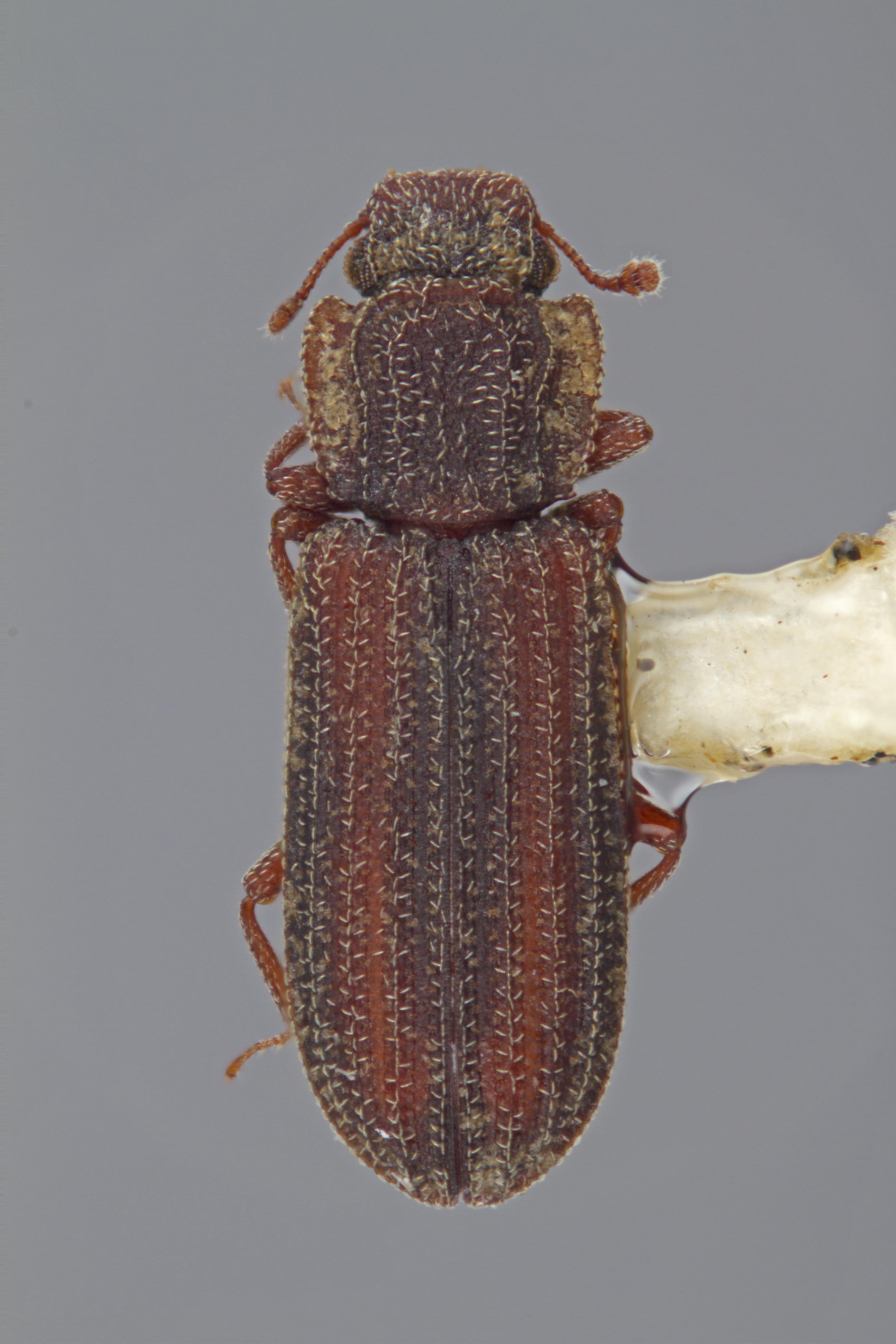
Antennaeantennae:
paired, segmental appendages, borne one on each side of head, functioning as sense organs and bearing a large number of sensilla.
11-segmented with a distinct, 2-segmented club (rarely antennomereantennomere:
antennal segment; including scape, pedicel and flagellomeres. NOTE: the flagellum is composed of all antennal segments proceeding the scape and pedicel. Any individual antennal segment is commonly called an antennomere.
9 expanded apically, causing club to appear 3-segmented). Antennal setation sparse. Subantennal groovessubantennal groove:
groove or concavity lying below the antennal insertion and housing the base of the antenna. Placed between the eye (if present) and the mandibular articulation, and sometimes extends below or behind the eye.
greatly reduced to a small depresseddepressed:
flattened down as if pressed.
area or absent. Eyes large, well-developed, finely to coarsely faceted, nearly always with obvious interfacetal setaeseta:
a sclerotized, hairlike (or scalelike) projection of cuticula arising from a single trichogen cell and surrounded at the base by a small cuticular ring.
. Antennal segment 3 slightly elongate (only slightly longer than 4) Pronotal discpronotal disc:
the area of the pronotum which is visible dorsally and usually delimited laterally by the two lateral carinae. Contrasted with the paired pronotal hypomera, which extend onto the ventral surface.
carinate, with at least 2 pairs of longitudinal carinaecarina:
an elevated ridge or keel, not necessarily high or acute.
, lateral margins (in most) slightly to strongly explanateexplanate:
spread out and flattened; applied to a margin.
, serrulateserrulate:
finely serrated; with minute teeth or notches.
to denticulatedenticulate:
set with little teeth or notches.
. Pronotumpronotum:
dorsal portion of the pronotum, lying above the lateral pronotal carinae when these are present.
usually wider than long. Procoxal cavitiesprocoxal cavities:
external closure: Externally closed when the postcoxal processes of the hypomera meet the prosternal process or meet one another.
open. Metacoxaemetacoxae:
the coxae of the metathorax.
narrowly separated, separation less than metacoxal length. Tarsal formulatarsal formula:
the number of tarsomeres on the fore, mid, and hind tarsi, respectively.
4–4–4. Dorsal surface consisting of thin, fine, hair-like setaeseta:
a sclerotized, hairlike (or scalelike) projection of cuticula arising from a single trichogen cell and surrounded at the base by a small cuticular ring.
(rarely clothed in velvet-like setaeseta:
a sclerotized, hairlike (or scalelike) projection of cuticula arising from a single trichogen cell and surrounded at the base by a small cuticular ring.
).
The genus Bitoma is similar in general appearance to Microprius, Paha, and Lasconotus. In Microprius, the antennal groove is long and reaches to the posteriorposterior:
hinder or hindmost, opposed to anterior; hind or rear.
margin of the eye. Bitoma differs from Paha and Lasconotus in having a 2-segmented antennal clubantennal club:
an enlarged portion of the antennal apex, consisting of a variable number of antennomeres (often 3). In an incrassate, antenna the antennomeres gradually enlarge towards to apex, but if there is an abrupt change in length or width at some point, then the antennomeres beyond this are considered to be part of the club.
(1-segmented in Paha and 3-segmented in Lasconotus). In Lasconotus, the procoxal cavitiesprocoxal cavities:
external closure: Externally closed when the postcoxal processes of the hypomera meet the prosternal process or meet one another.
are closed.
Bitoma brevipes (Sharp, 1894), B. carinata (LeConte, 1863), B. crenata (Fabricius, 1775), B. discolor Schaeffer, 1907, B. exarata (Pascoe, 1863), B. gracilis Sharp, 1894, B. granulata (Blatchley, 1910), B. ornata (LeConte, 1858), B. neglecta Stephan, 1989, B. pinicola Schaeffer, 1907, B. quadricollis (Horn, 1885), B. quadriguttata (Say, 1826), B. sulcata (LeConte, 1858), B. vittata Schaeffer, 1907
Northeast (CT, DE, MA, MD, NH, NJ, NY, VA, VT, WV), North Central (IA, IN, MO, OH), Southeast (AL, FL, GA, NC, SC, TN), South Central (OK, MS, TX), Northwest (ID, OR, WA), Southwest (AZ, CA, CO, NM, NV) USA; Ontario, Canada.
Bitoma has been collected at MV/UV lights and from injured or dead cacti (B. gracilis), in leaf axils of dying agave and yucca (B. gracilis), in the nest piles of packrats (B. gracilis, B. sulcata), in flood debris (B. ornata), and under the bark of dead hardwoods and pines, including: mesquite and palo verde, sotol (B. neglecta, B. gracilis), cottonwoods (B. sulcata, B. ornata), maples (B. ornata, B. quadricollis), pines (B. pinicola), oaks (B. quadricollis, B. sulcata, B. carinata), and beech (B. quadricollis).
Abundance: Some species are common.
Bitoma quadriguttata (eastern) and B. ornata (western) are, by far, the most abundant species.
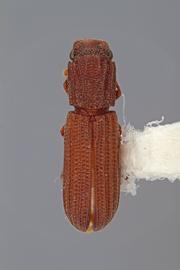
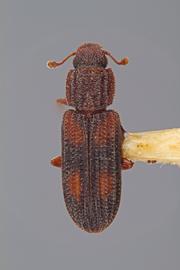
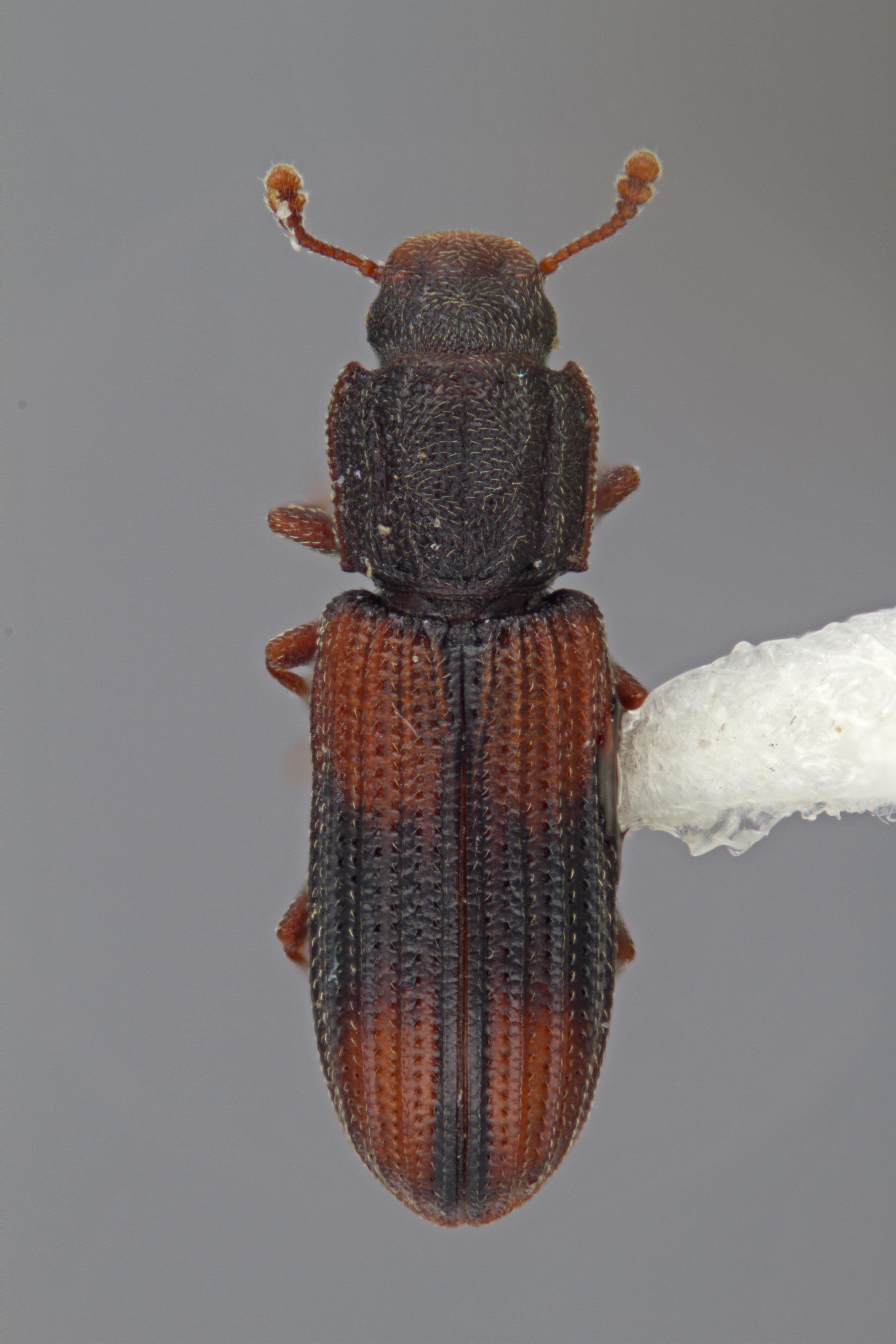
Bitoma brevipes: Eastern species. Bitoma brevipes can be readily distinguished by the dark, cylindrical body, pronotm distinctly longer than wide, with 2 pairs of well-defined, full-length, slightly curved to sinuate carinaecarina:
an elevated ridge or keel, not necessarily high or acute.
and an additional pair of short carinaecarina:
an elevated ridge or keel, not necessarily high or acute.
anteromedially, and reduced interfacetal setaeseta:
a sclerotized, hairlike (or scalelike) projection of cuticula arising from a single trichogen cell and surrounded at the base by a small cuticular ring.
. This species can be separated from the similar B. carinata by the additional short pair of carinaecarina:
an elevated ridge or keel, not necessarily high or acute.
on the anterioranterior:
in front; before.
portion of the pronotal discpronotal disc:
the area of the pronotum which is visible dorsally and usually delimited laterally by the two lateral carinae. Contrasted with the paired pronotal hypomera, which extend onto the ventral surface.
and less granulate pronotumpronotum:
dorsal portion of the pronotum, lying above the lateral pronotal carinae when these are present.
. Distribution: Known from Fort Meyers, Florida, although this is probably an introduction. Bitoma brevipes is known from Mexico, Panama, and Costa Rica. This species may also occur in the Southwest USA, and it is unclear whether or not this species has been established in the United States.
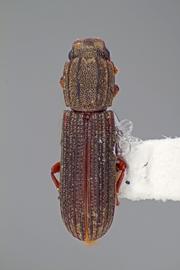
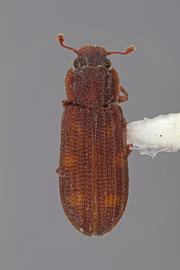
Bitoma carinata: Eastern species. Bitoma carinata can be readily distinguished by the dark, cylindrical body, pronotm distinctly longer than wide, distinctly granulate with 2 pairs of well-defined, full-length, slightly curved to sinuate carinaecarina:
an elevated ridge or keel, not necessarily high or acute.
, and reduced interfacetal setaeseta:
a sclerotized, hairlike (or scalelike) projection of cuticula arising from a single trichogen cell and surrounded at the base by a small cuticular ring.
. This species can be separated from the similar B. brevipes by the lack of an addition short pair of carinaecarina:
an elevated ridge or keel, not necessarily high or acute.
on the anterioranterior:
in front; before.
portion of the pronotal discpronotal disc:
the area of the pronotum which is visible dorsally and usually delimited laterally by the two lateral carinae. Contrasted with the paired pronotal hypomera, which extend onto the ventral surface.
and more granulate pronotumpronotum:
dorsal portion of the pronotum, lying above the lateral pronotal carinae when these are present.
. Distribution: Alabama, Florida, Georgia, Mississippi, South Carolina, Virginia, USA.
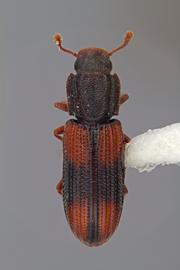
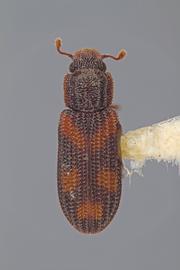
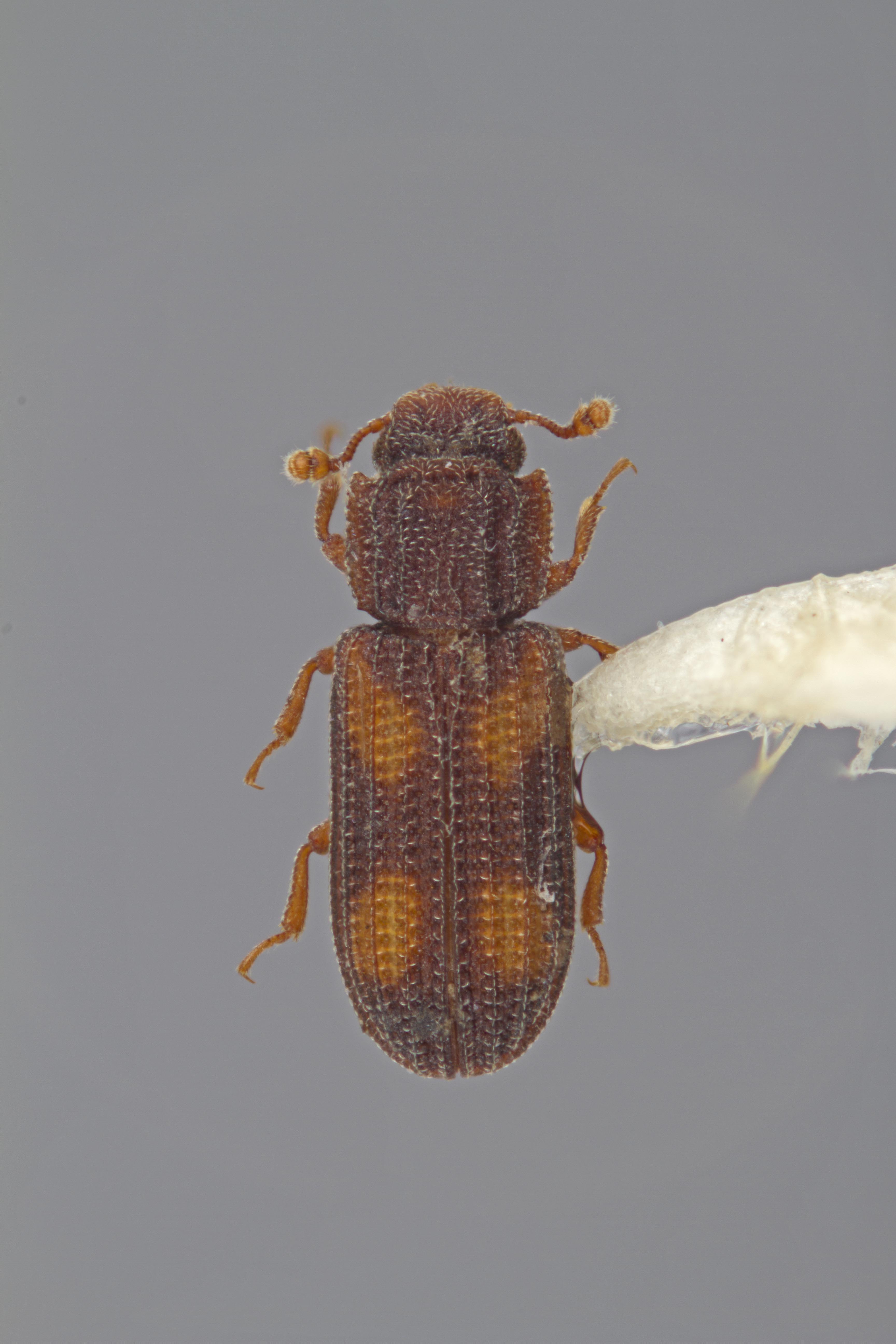
Bitoma crenata: Eastern species. This species can be distinguished by the large red spots and apically enlarged 9th antennal segment, causing the antennal clubantennal club:
an enlarged portion of the antennal apex, consisting of a variable number of antennomeres (often 3). In an incrassate, antenna the antennomeres gradually enlarge towards to apex, but if there is an abrupt change in length or width at some point, then the antennomeres beyond this are considered to be part of the club.
to appear 3-segmented. Bitoma crenata most closely resembles B. sulcata but can be separated by the more smooth central area of the pronotal discpronotal disc:
the area of the pronotum which is visible dorsally and usually delimited laterally by the two lateral carinae. Contrasted with the paired pronotal hypomera, which extend onto the ventral surface.
, eyes flattened and not nearly as protruding, reduced to absent interfacetal setaeseta:
a sclerotized, hairlike (or scalelike) projection of cuticula arising from a single trichogen cell and surrounded at the base by a small cuticular ring.
, generally bi-colorous body, and geographic distribution. This species is locally common. Distribution: Indiana, New York, Ohio, Vermont, Washington, USA; Ontario, Canada. This species has been introduced from Europe (apparently twice).
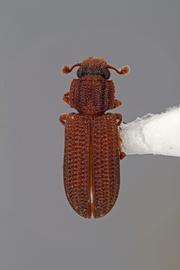
Bitoma discolor: Eastern species. Bitoma discolor can be distinguished from other Bitoma by the larger eyes with dense, stout, curved interfacetal setaeseta:
a sclerotized, hairlike (or scalelike) projection of cuticula arising from a single trichogen cell and surrounded at the base by a small cuticular ring.
, larger antennal clubantennal club:
an enlarged portion of the antennal apex, consisting of a variable number of antennomeres (often 3). In an incrassate, antenna the antennomeres gradually enlarge towards to apex, but if there is an abrupt change in length or width at some point, then the antennomeres beyond this are considered to be part of the club.
, and distinctly denticulatedenticulate:
set with little teeth or notches.
lateral pronotal margins. This species is most similar to the more common B. quadricollis and can be separated by the dark elytraelytron:
the fore wing in Coleoptera, which is more or less uniformly sclerotized and in resting position is longitudinally oriented, usually meeting the opposite elytron along the midline.
with lighter spots and geographical distribution. This species is rare. Distribution: Southern Florida and the Florida Keys, USA. This species is also found in Cuba.
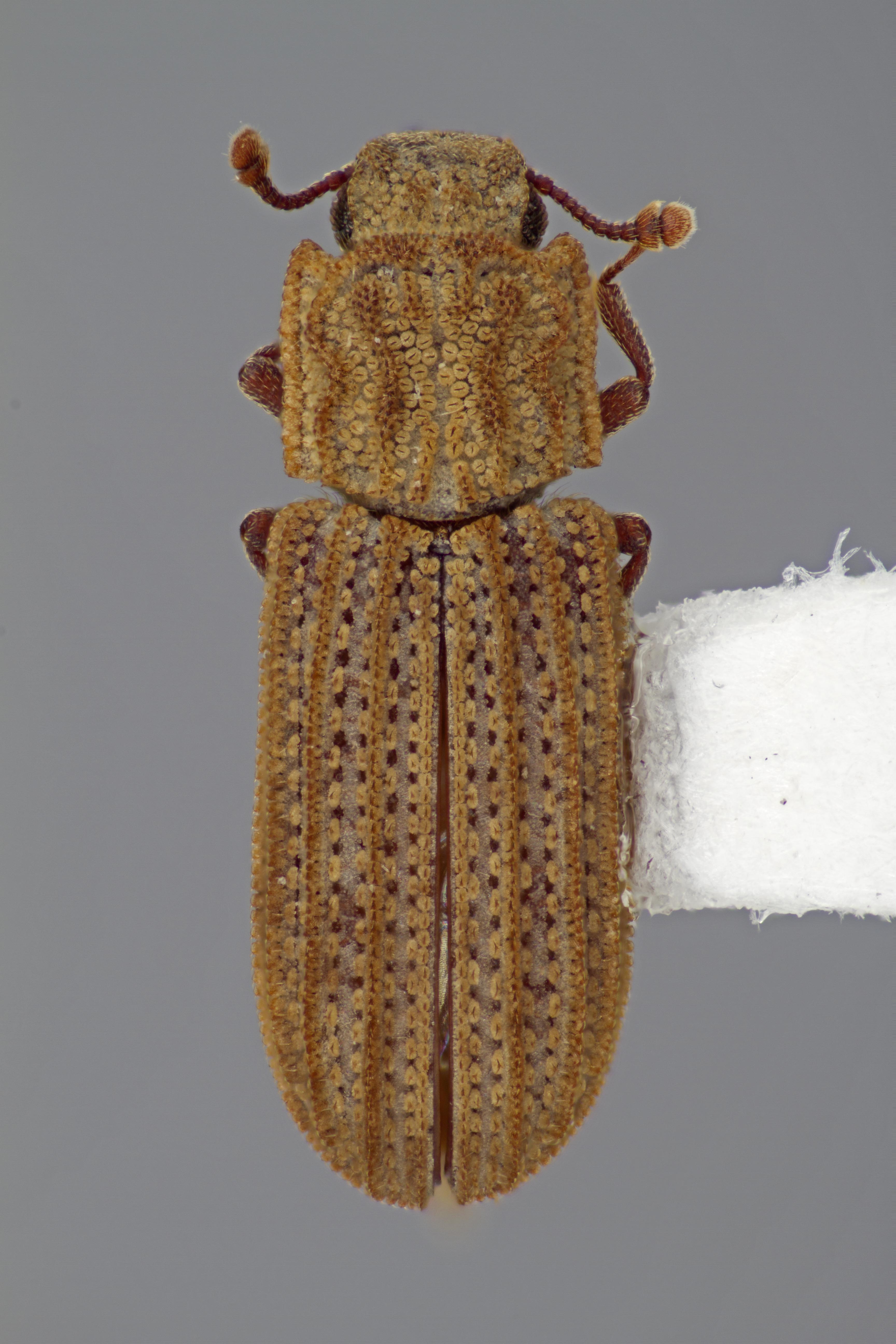
Bitoma exarata: Western species. The larger size and distinctive dorsal ornamentation consisting of carinaecarina:
an elevated ridge or keel, not necessarily high or acute.
and granules clothed in velvety scales (tomentosetomentose:
covered with a form of pubescence composed of short, matted, woolly hair.
) should adequately distinguish this species. Distribution: Extreme southern Arizona, USA. This species also occurs from Brazil to Mexico.
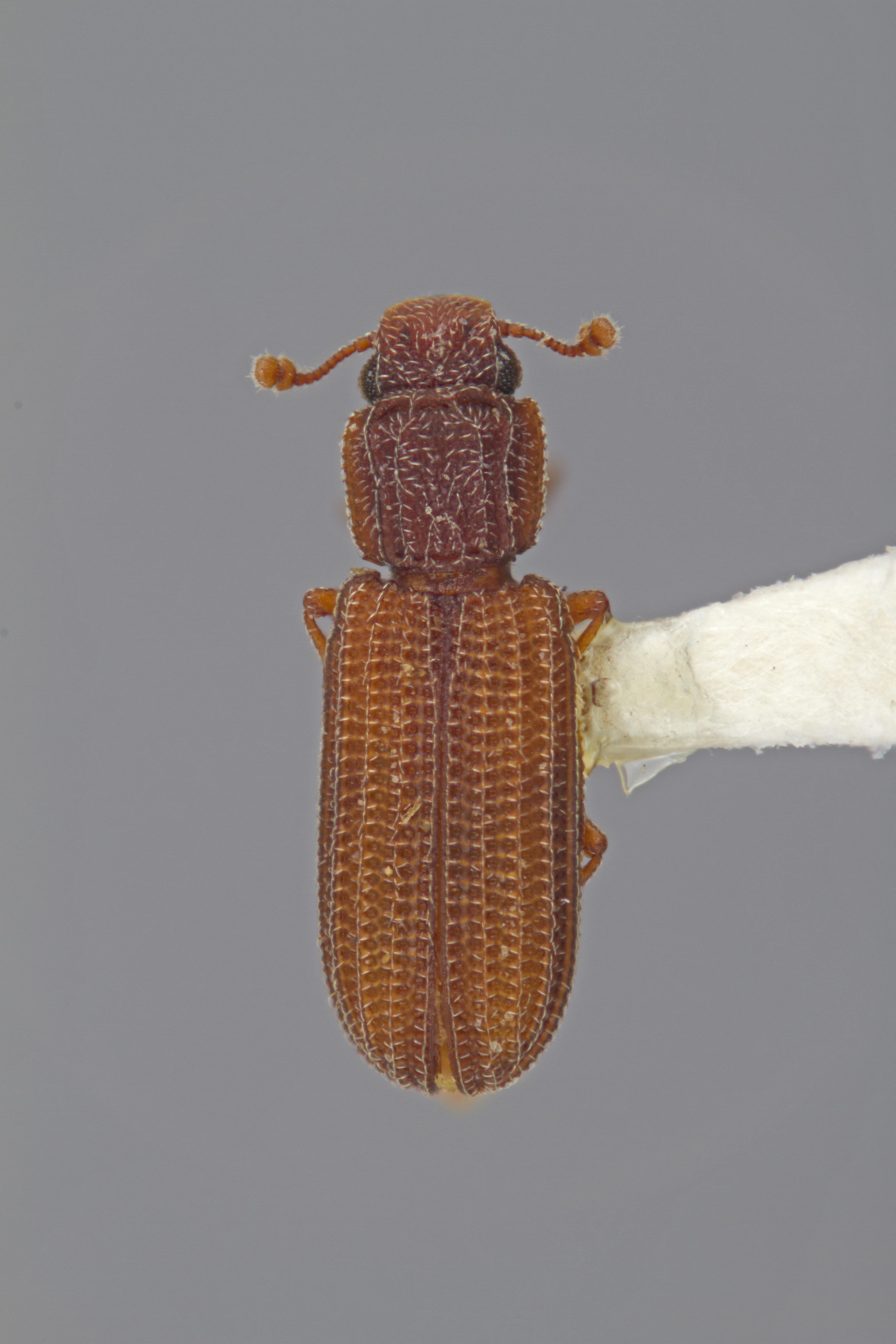
Bitoma granulata: Central/eastern species. Bitoma granulata can be easily separated from the remaining North American Bitoma by the greatly reduced eyes and the extremely flattened body. This species is extremely rare. Distribution: Missouri, Indiana, Iowa, USA.
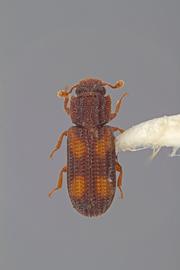
Bitoma ornata: Western species. Most similar to the introduced B. crenata, but differs in the smaller 9th antennal segment. This is the only native western species with red spots. Distribution: Arizona, California, Colorado, Idaho, Nevada, Oregon, USA.
Bitoma neglecta: Western species. Most similar to B. gracilis, but differs in having a setose prosternumProsternum:
used for the entire ventral plate lying in front of and between the procoxae and between the notosternal or pleurosternal sutures.
, eyes set farther apart ventrally, wider pronotumpronotum:
dorsal portion of the pronotum, lying above the lateral pronotal carinae when these are present.
, less elongate, generally darker in color and larger in size. Distribution: Arizona, USA.
Bitoma pinicola: Eastern species. This species can be separated from all other eastern species by the larger size, greatly flattened body, and widely separated eyes (ventrally). Distribution: Delaware, Massachusetts, New Jersey, North Carolina, USA.
Bitoma quadricollis: Eastern species. Bitoma quadricollis can be distinguished from other Bitoma by the larger eyes with dense, stout, curved interfacetal setaeseta:
a sclerotized, hairlike (or scalelike) projection of cuticula arising from a single trichogen cell and surrounded at the base by a small cuticular ring.
, larger antennal clubantennal club:
an enlarged portion of the antennal apex, consisting of a variable number of antennomeres (often 3). In an incrassate, antenna the antennomeres gradually enlarge towards to apex, but if there is an abrupt change in length or width at some point, then the antennomeres beyond this are considered to be part of the club.
, and distinctly denticulatedenticulate:
set with little teeth or notches.
lateral pronotal margins. This species is most similar to the rarer B. discolor and can be separated by the unicolorous elytraelytron:
the fore wing in Coleoptera, which is more or less uniformly sclerotized and in resting position is longitudinally oriented, usually meeting the opposite elytron along the midline.
and geographical distribution. This species is uncommon. Distribution: Florida, Maryland, Mississippi, New Jersey, North Carolina, Ohio, Oklahoma, Tennessee, Virginia, West Virginia, USA.
Bitoma quadriguttata: Eastern species. This species varies widely in coloration and is most often confused with B. quadricollis, B. granulata (darker specimens), and B. gracilis, B. discolor (redder specimens). Dark B. quadriguttata can be distinguished by the size and position of the eyes. Bitoma quadriguttata can be distinguished from B. gracilis by the less narrow body, eyes closer together ventrally, and inner pair of pronotal carinaecarina:
an elevated ridge or keel, not necessarily high or acute.
curved outward. Bitoma quadriguttata can be distinguished from B. discolor by the more well-separated eyes ventrally and more granulate prosternumProsternum:
used for the entire ventral plate lying in front of and between the procoxae and between the notosternal or pleurosternal sutures.
. Distribution: Alabama, Connecticut, Delaware, Florida, Georgia, Indiana, Maryland, Mississippi, New Hampshire, New Jersey, New York, North Carolina, Ohio, Oklahoma, South Carolina, Tennessee, Texas, Virginia, West Virginia, USA; Ontario, Canada. This is by far the most commonly encountered North American species of Bitoma.
Bitoma sulcata: Western species. This species can be distinguished by the apically enlarged 9th antennal segment, causing the antennal clubantennal club:
an enlarged portion of the antennal apex, consisting of a variable number of antennomeres (often 3). In an incrassate, antenna the antennomeres gradually enlarge towards to apex, but if there is an abrupt change in length or width at some point, then the antennomeres beyond this are considered to be part of the club.
to appear 3-segmented. Bitoma sulcata most closely resembles B. crenata but can be separated by the more rugoserugose:
wrinkled.
and setose central area of the pronotal discpronotal disc:
the area of the pronotum which is visible dorsally and usually delimited laterally by the two lateral carinae. Contrasted with the paired pronotal hypomera, which extend onto the ventral surface.
, eyes rounder and greatly protruding, interfacetal setaeseta:
a sclerotized, hairlike (or scalelike) projection of cuticula arising from a single trichogen cell and surrounded at the base by a small cuticular ring.
more prominent and dense, generally uni-colorous body, and geographic distribution. This species is locally common. Distribution: Arizona, California, Texas, USA.
Bitoma vittata: Western species. Bitoma vittata can be immediately distinguished from the other North American Bitoma by the lateral margins of the pronotumpronotum:
dorsal portion of the pronotum, lying above the lateral pronotal carinae when these are present.
greatly explanateexplanate:
spread out and flattened; applied to a margin.
and distinctly narrowed basally. This species is uncommon. Distribution: Extreme southern Texas, USA.
On a regional level, the genus Bitoma appears stable, although the defining characters break down on a worldwide scale. The overall generic concept is still in question, with many aberrant forms currently included in this large, cosmopolitan genus. A worldwide revision of the genus and a closer investigation of the generic definitions of the genera within the tribe Synchitini is the only way to resolve this issue.
The North American species within this genus all appear very similar and will be hard to differentiate without a synoptic collection. Most of the species are rarely encountered. If identification is uncertain, it is suggested the specimens are checked against the most common species for that particular geographic region. Teneral specimens are much paler in color and may not exhibit the standard patterns of coloration diagnostic for the species
Blatchley (1910)Blatchley (1910):
Blatchley WS. 1910. An Illustrated Descriptive Catalogue of the Coleoptera or Beetles (Exclusive of the Rhynchophora) Known to Occur in Indiana. The Nature Publishing, Indianapolis. 1386 pp., Fabricius (1775)Fabricius (1775):
Fabricius JC. 1775. Systema Entomologiae, sistems Insectorum classes, ordines, genera, species, adiectis synonymis, locis, descriptionibus, observationibus. Korte, Flensburgi & Lipsiae, ixxx+ 832pp., Horn (1885)Horn (1885):
Horn, G.H. 1885. Contributions to the coleopterology of the United States. No.4. Transactions of the American Entomological Society, 12: 128-162, illus., Ivie (2002a)Ivie (2002a):
Ivie, M.A. 2002a. 127. Colydiidae, pp. 445-453 In: R. H. Arnett, Jr., Jr. and M. C. Thomas (eds.), American Beetles. CRC Press, Gainesville, Florida., LeConte (1858)LeConte (1858):
LeConte, J.L. 1858. Description of new species of Coleoptera, chiefly collected by the United States and Mexican Boundary Commission, under Major W. H. Emory, U.S.A. Proceedings of the Academy of National Science of Philadelphia, 10: 59-89., LeConte (1863)LeConte (1863):
LeConte, J.L. 1863. New species of North American Coleoptera. Part I. Smithsonian Miscellaneous Collections, 167: 1-92., Pascoe (1863a)Pascoe (1863a):
Pascoe, F.P. 1863a. Notices of new or little-known genera and species of Coleoptera. Part IV. Journal of Entomology, 2: 26-56., Say (1826)Say (1826):
Say, T. 1826. Descriptions of new species of coleopterous insects inhabiting the United States. Journal of the Academy of Natural Sciences of Philadelphia, 5(2): 237-284., Schaeffer (1907)Schaeffer (1907):
Schaeffer, C.F.A. 1907. A few new Coleoptera of the genus Bitoma, with notes on other Colydiidae. Proceedings of the Entomological Society of Washington, 8: 136-141., Sharp (1894)Sharp (1894):
Sharp, D. 1894. Colydiidae, pp. 443-488. In: F. Godman and O. Salvin (eds.), Biologia- Centralia Americana. Insecta. Coleoptera. Volume 2, part 1. Dulau, London., Stephan (1989)Stephan (1989):
Stephan, K.H. 1989. The Bothrideridae and Colydiidae of America north of Mexico (Coleoptera: Clavicornia and Heteromera). Occasional Papers of the Florida State Collection of Arthropods, 6: xii + 65 pp.
Authors: Lord NP, Nearns EH, Miller KB. 2011–2015.
Content updated Apr 2015; taxonomy updated Feb 2026
idtools.org