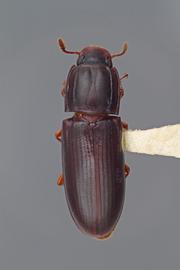
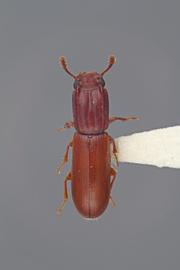
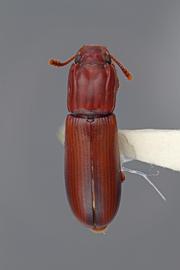
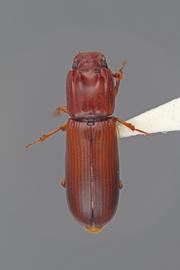
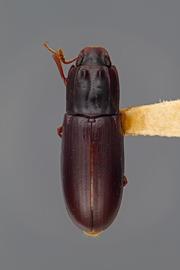
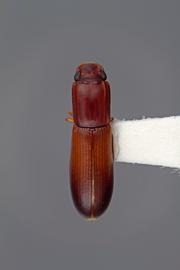
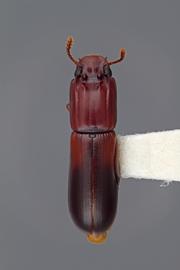
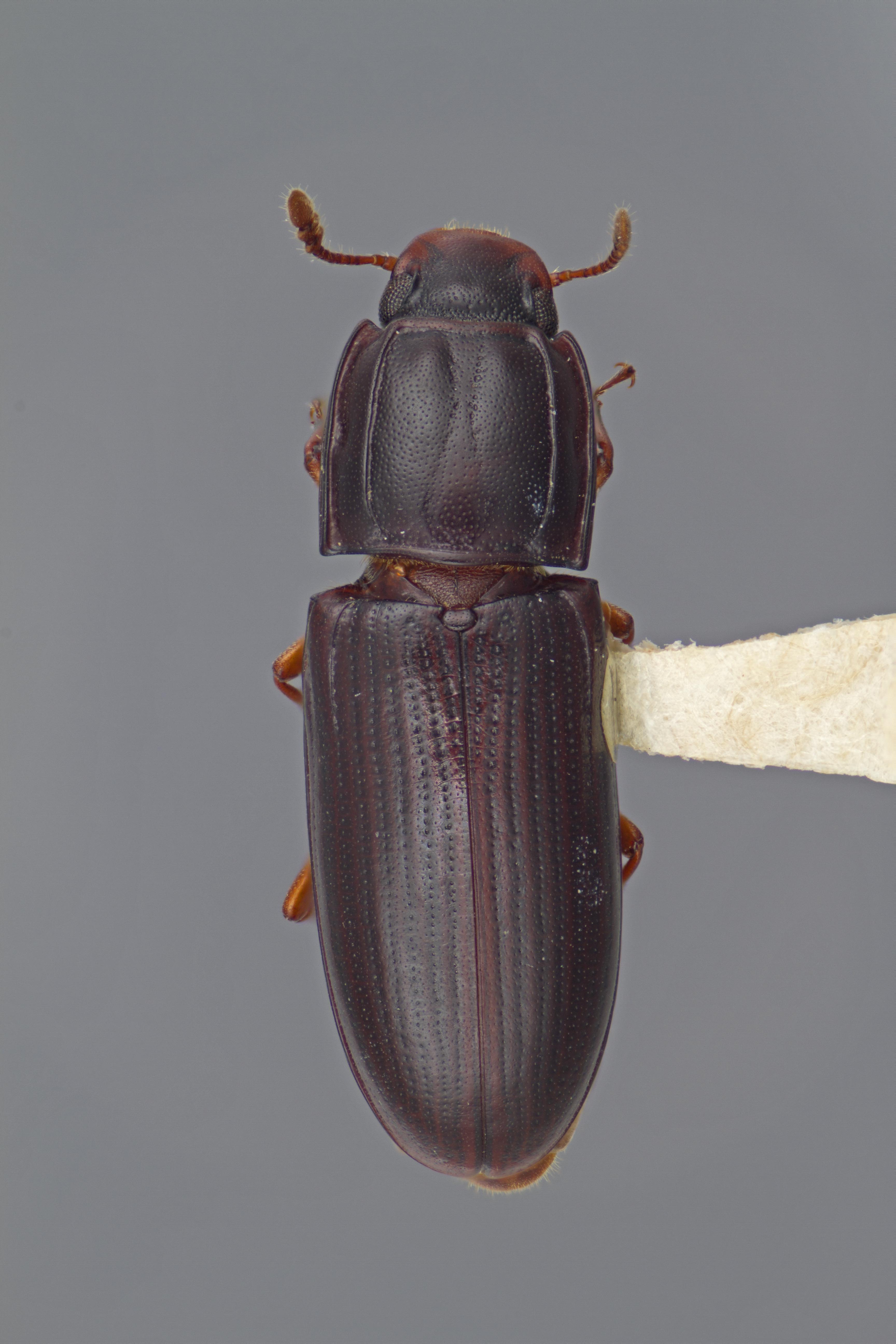
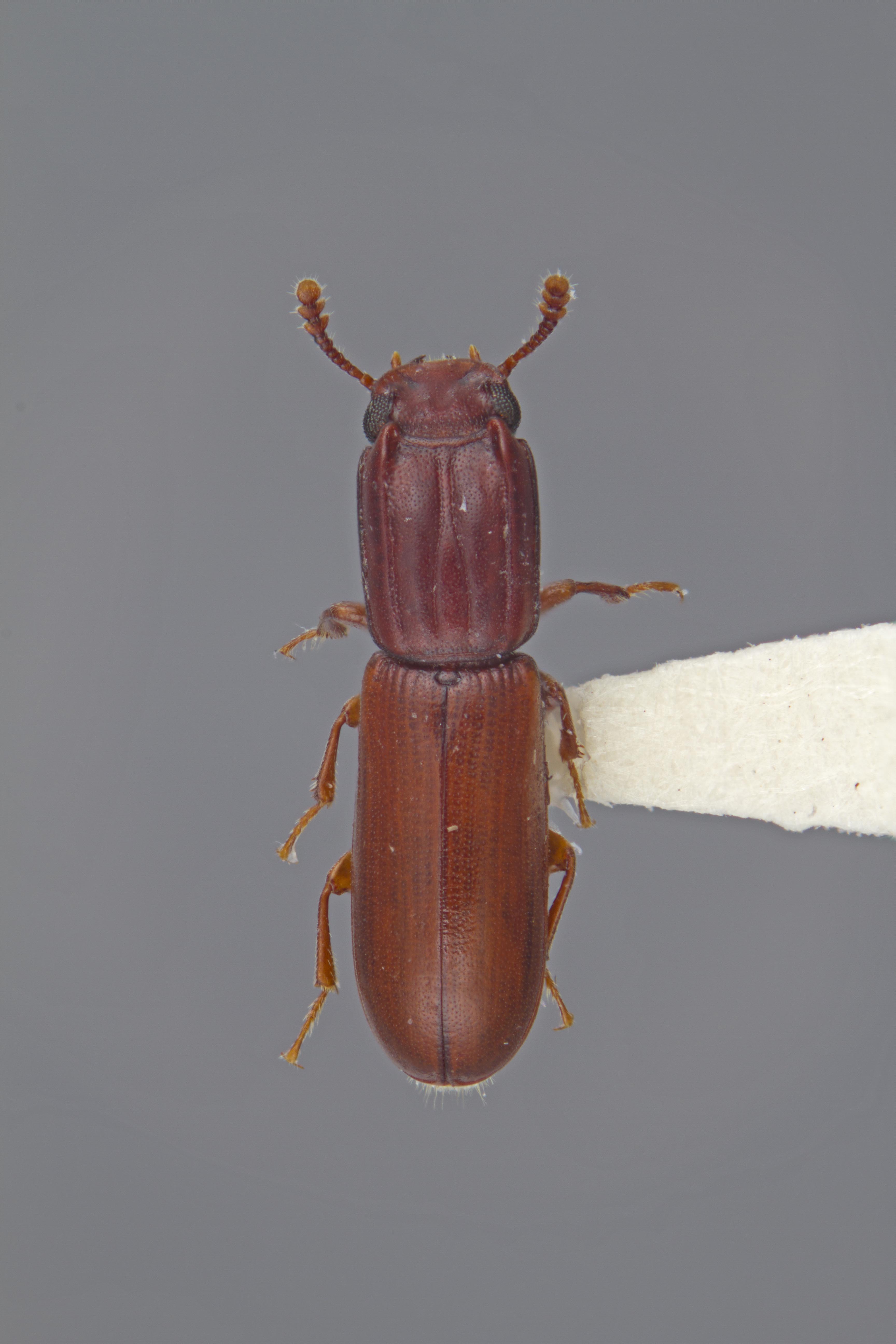
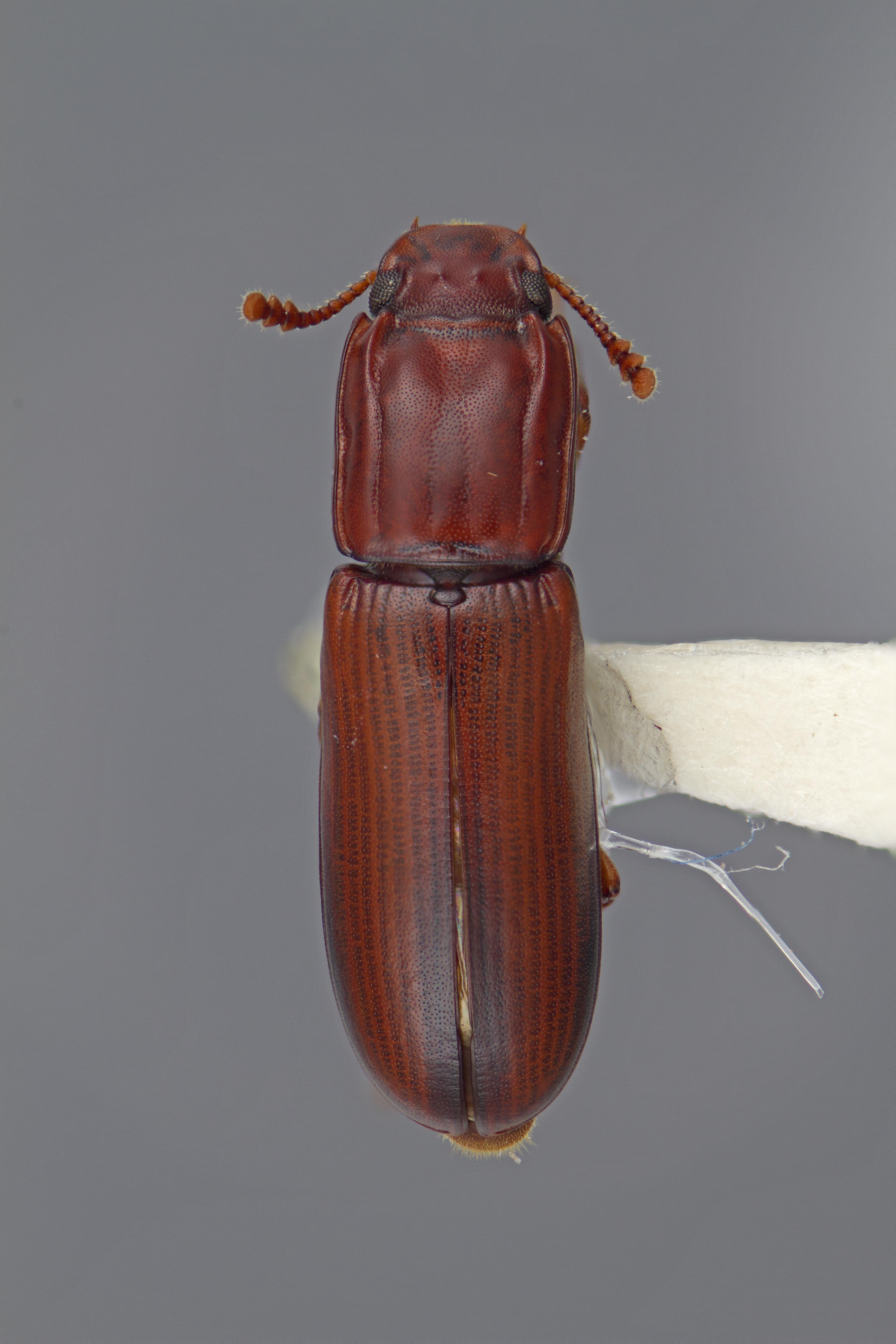
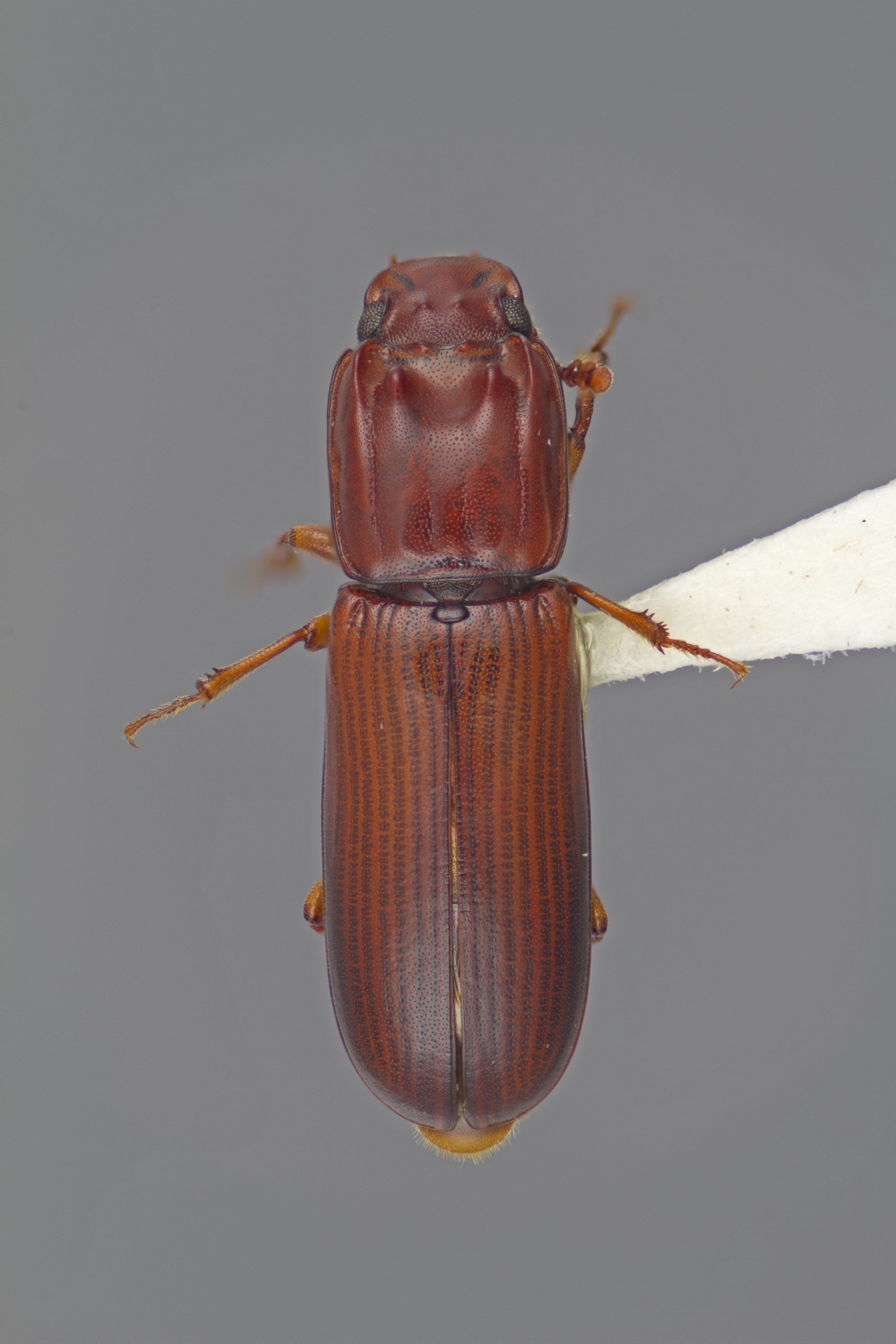
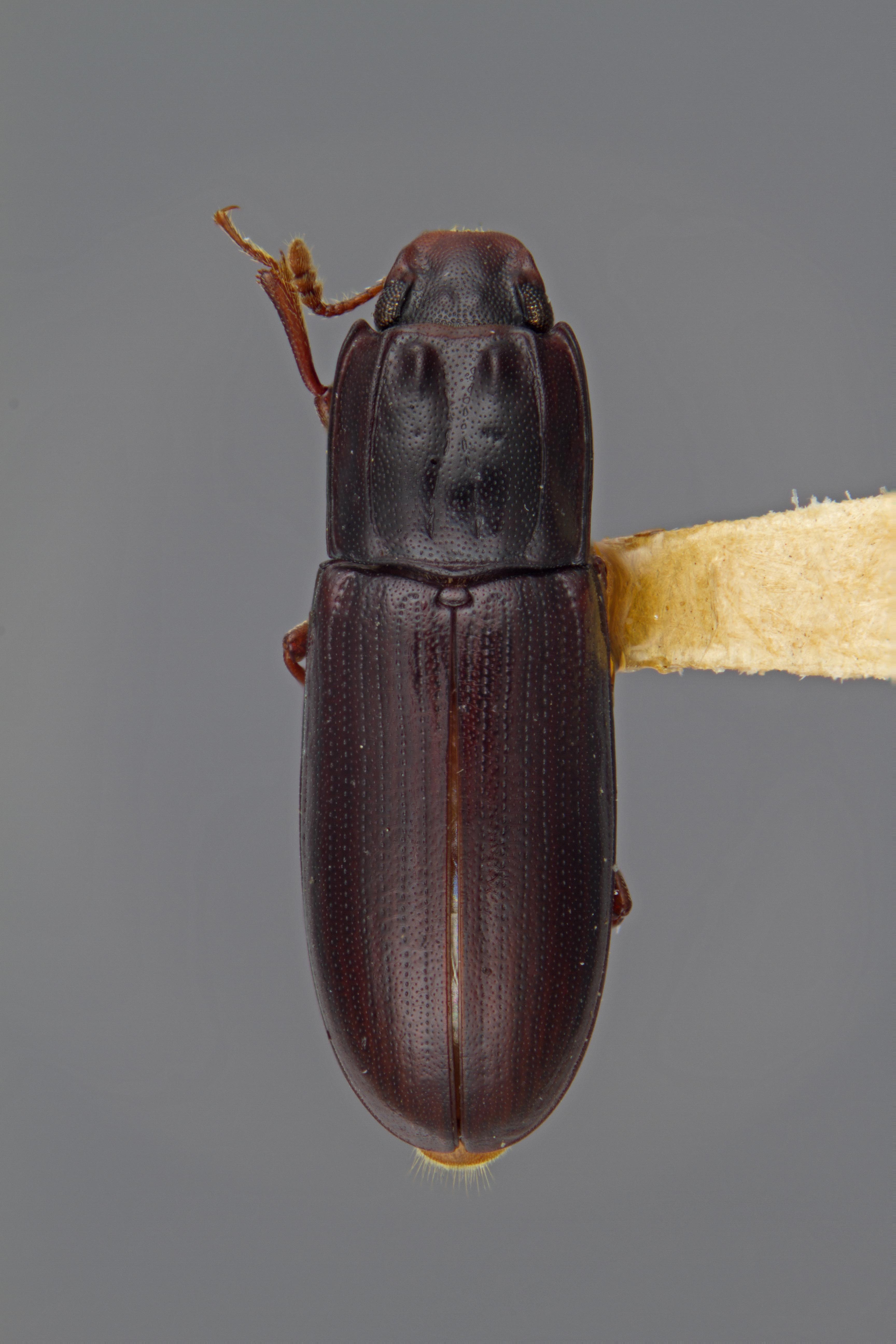
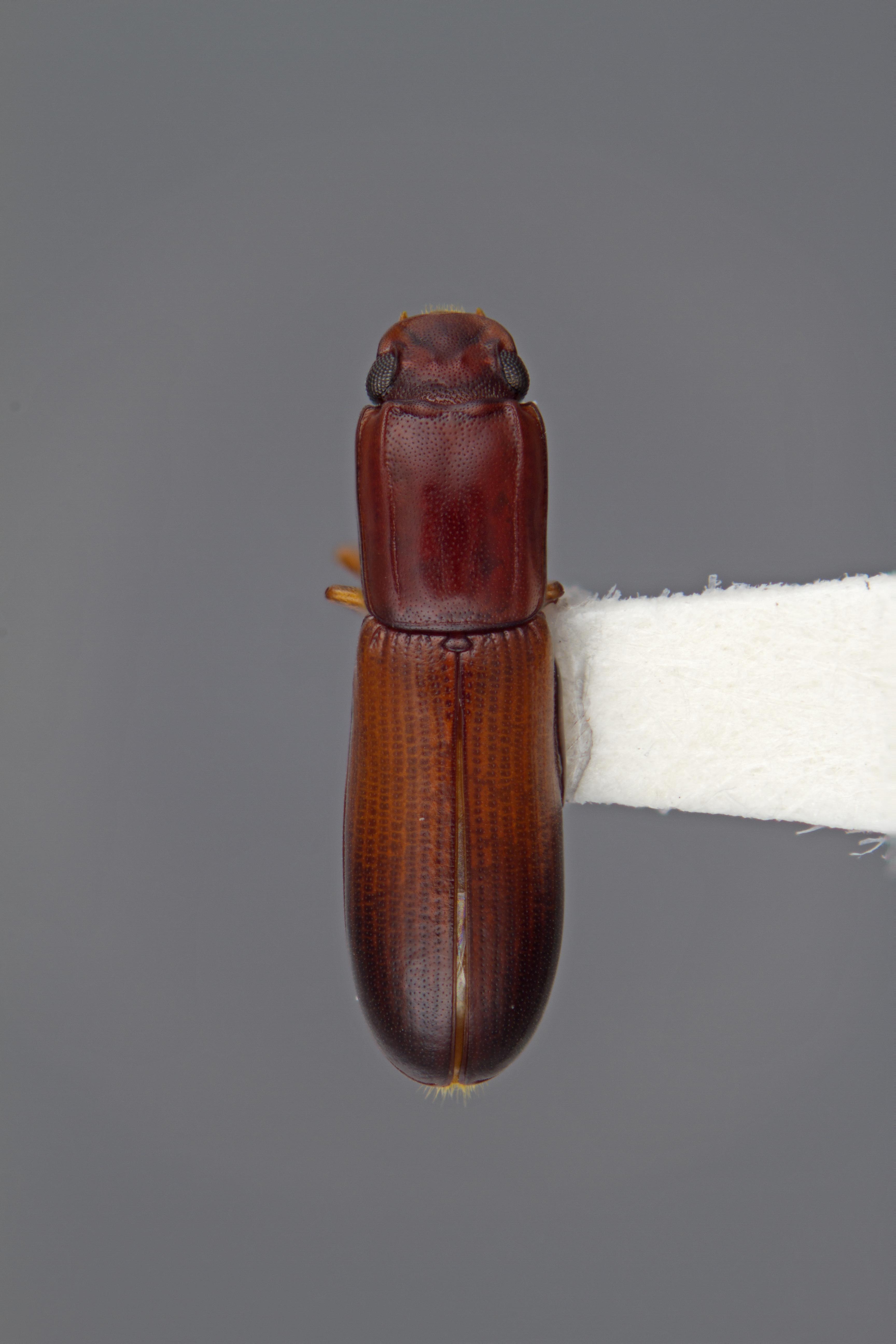
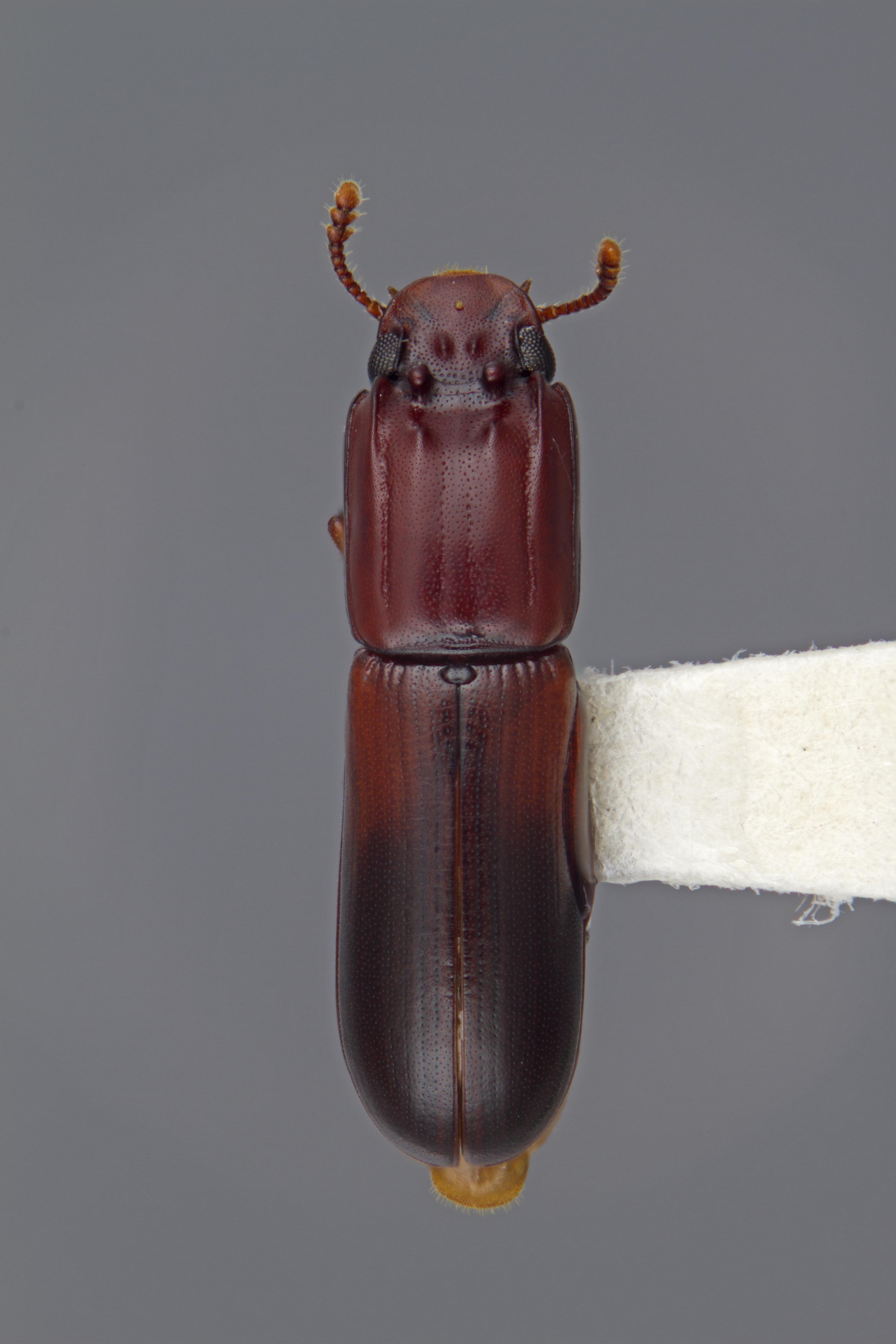
Body elongate, subcylindrical to subdepressed. Antennaeantennae:
paired, segmental appendages, borne one on each side of head, functioning as sense organs and bearing a large number of sensilla.
11-segmented with a 3-segmented club. Antennal setation sparse. Subantennal groovessubantennal groove:
groove or concavity lying below the antennal insertion and housing the base of the antenna. Placed between the eye (if present) and the mandibular articulation, and sometimes extends below or behind the eye.
absent. Eyes ovate, well-developed, coarsely faceted. Eyes emarginateemarginate:
notched at the margin.
anteriorly by projection of fronsfrons:
the area between the eyes and just behind the frontoclypeal suture. In Coleoptera it is not or only rarely separated from the vertex posteriorly.
, forming a distinct canthuscanthus:
a sclerotized bar encroaching on the eye.
. Pronotumpronotum:
dorsal portion of the pronotum, lying above the lateral pronotal carinae when these are present.
subquadrate to elongate, sides nearing parallel. Pronotal discpronotal disc:
the area of the pronotum which is visible dorsally and usually delimited laterally by the two lateral carinae. Contrasted with the paired pronotal hypomera, which extend onto the ventral surface.
often with pair of sublateral carinaecarina:
an elevated ridge or keel, not necessarily high or acute.
and pair of faint submedial lines, anterioranterior:
in front; before.
portion of disc usually with pair of sulci or knob-like tuberclestubercle:
a small knoblike or rounded protuberance.
. Procoxal cavitiesprocoxal cavities:
external closure: Externally closed when the postcoxal processes of the hypomera meet the prosternal process or meet one another.
narrowly closed. Metacoxaemetacoxae:
the coxae of the metathorax.
narrowly separated, separation less than metacoxal length. Tarsal formulatarsal formula:
the number of tarsomeres on the fore, mid, and hind tarsi, respectively.
4–4–4. Apexapex:
end of any structure distad to the base.
of protibia expanded, armed with a stout, apical spinespine:
a multicellular, more or less thornlike process or outgrowth of the cuticle not separated from it by a joint.
. Dorsal surface glabrousglabrous:
without hairs (setae).
, moderately shiny.
The genus Aulonium is superficially similar in general appearance to Colydium. The carinate elytral declivity and presence of a pair of long setae near the apicalapical:
an adjective (or adverb) denoting position near or movement toward the apex of a body part. The apex of the head or pronotum is at the anterior end while that of the abdomen or an elytron is at the posterior end; on the legs or antennae, apical and distal are synonymous.
margin of the last abdominal ventriteabdominal ventrite:
visible ventral abdominal sclerite. Ventrite number does not correspond to true sternite number except in rare cases where sternite 1 is visible. Also called ventrite.
serve to distinguish Colydium. The genus Phloeonemus also has emarginated eyes formed by a projection of the frons, but is readily distinguished from Aulonium and Colydium by the 2-segmented antennal clubantennal club:
an enlarged portion of the antennal apex, consisting of a variable number of antennomeres (often 3). In an incrassate, antenna the antennomeres gradually enlarge towards to apex, but if there is an abrupt change in length or width at some point, then the antennomeres beyond this are considered to be part of the club.
, lack of a stout apicalapical:
an adjective (or adverb) denoting position near or movement toward the apex of a body part. The apex of the head or pronotum is at the anterior end while that of the abdomen or an elytron is at the posterior end; on the legs or antennae, apical and distal are synonymous.
spine on the protibia, explanate lateral pronotal margins, very different sculpturing of the pronotal disc.
Aulonium aequicolle LeConte, 1859, A. ferrugineum Zimmermann, 1869Zimmermann, 1869:
Zimmermann, C.C.A. 1869. Synonymical notes on Coleoptera of the United States - with descriptions of new species, from the MSS of the late Dr. C. Zimmermann. Transactions of the American Entomological Society, 2: 243-259., A. longum LeConte, 1866LeConte, 1866:
LeConte, J.L. 1866. Additions to the coleopterous fauna of the United States, No. 1. Proceedings of the Academy of National Science of Philadelphia, 1866: 361-394., A. parallelopipedum (Say, 1826Say, 1826:
Say, T. 1826. Descriptions of new species of coleopterous insects inhabiting the United States. Journal of the Academy of Natural Sciences of Philadelphia, 5(2): 237-284.), A. tuberculatum LeConte, 1863LeConte, 1863:
LeConte, J.L. 1863. New species of North American Coleoptera. Part I. Smithsonian Miscellaneous Collections, 167: 1-92.
Northwest (ID, MT, OR, WA), Southwest (AZ, CA, CO, NM, NV, UT), North Central (SD, IL, IN, MI, OH), Northeast (DC, DE, NJ, NY, MA, MD, PA, WV, VA), Southeast (AL, FL, GA, KY, NC, SC, TN), South Central (AR, LA, MS, OK, TX) USA; British Columbia, Canada.
Aulonium has been collected at MV/UV lights and from under the bark of various dead hardwoods and conifers. Adults and larvae of Aulonium have been found in the galleries of scolytine weevils (Curculionidae), and they are suspected to feed on the larvae of those beetles within the galleries (Ivie 2002aIvie 2002a:
Ivie, M.A. 2002a. 127. Colydiidae, pp. 445-453 In: R. H. Arnett, Jr., Jr. and M. C. Thomas (eds.), American Beetles. CRC Press, Gainesville, Florida., Craighead 1920Craighead 1920:
Craighead FC. 1920. Biology of some Coleoptera of the families Colydiidae and Bothrideridae. Proceedings of the Entomological Society of Washington 22: 1-13., Marshall 1978Marshall 1978:
Marshall, J.E. 1978. The larva of Aulonium trisulcum (Fourcroy) (Coleoptera: Colydiidae) and its association with elm bark beetles (Scolytus spp.). Entomologist's Gazette, 29: 59-69., Podoler et al. 1990). This genus is a beneficial insect, attacking destructive wood boring beetles.
Abundance: Moderately common.
Aulonium aequicolle: Western species. Pronotum quadratequadrate:
four-sided.
, as long as wide. Anterioranterior:
in front; before.
pronotal margin nearly straight. Sublateral carinaecarina:
an elevated ridge or keel, not necessarily high or acute.
slightly curved basally, not distinctly raised anteriorly, merge with raised anterioranterior:
in front; before.
margin of pronotumpronotum:
dorsal portion of the pronotum, lying above the lateral pronotal carinae when these are present.
. Submedial lines diverge apically and basally, narrowed in apicalapical:
an adjective (or adverb) denoting position near or movement toward the apex of a body part. The apex of the head or pronotum is at the anterior end while that of the abdomen or an elytron is at the posterior end; on the legs or antennae, apical and distal are synonymous.
1/3. Pronotal discpronotal disc:
the area of the pronotum which is visible dorsally and usually delimited laterally by the two lateral carinae. Contrasted with the paired pronotal hypomera, which extend onto the ventral surface.
more or less convexconvex:
the outer curved surface of a segment of a sphere, as opposed to concave.
, slightly depresseddepressed:
flattened down as if pressed.
in between submedial lines. Tuberclestubercle:
a small knoblike or rounded protuberance.
of anterioranterior:
in front; before.
margin of pronotumpronotum:
dorsal portion of the pronotum, lying above the lateral pronotal carinae when these are present.
not sexually dimorphic – in both sexes tuberclestubercle:
a small knoblike or rounded protuberance.
extremely reduced or absent. Strial rows of elytraelytron:
the fore wing in Coleoptera, which is more or less uniformly sclerotized and in resting position is longitudinally oriented, usually meeting the opposite elytron along the midline.
distinct, puncturespuncture:
a small impression on the cuticle, like that made by a needle.
larger. Color usually piceuspiceus:
black.
. Rarely collected. Associated with oaks. Distribution: Arizona, California, USA.
Aulonium ferrugineum: Eastern species. Body more elongate, 3.6x longer than wide. Pronotumpronotum:
dorsal portion of the pronotum, lying above the lateral pronotal carinae when these are present.
nearly quadratequadrate:
four-sided.
, distinctly longer than wide. Anterioranterior:
in front; before.
pronotal margin concaveconcave:
hollowed out; the interior of a sphere as opposed to the outer or convex surface.
. Sublateral carinaecarina:
an elevated ridge or keel, not necessarily high or acute.
straight basally, distinctly raised and strongly carinate anteriorly. Tuberclestubercle:
a small knoblike or rounded protuberance.
of anterioranterior:
in front; before.
margin of pronotumpronotum:
dorsal portion of the pronotum, lying above the lateral pronotal carinae when these are present.
not sexually dimorphic – in both sexes tuberclestubercle:
a small knoblike or rounded protuberance.
extremely reduced or absent. Submedial lines parallel in anterioranterior:
in front; before.
half, diverging in basal half. Pronotal discpronotal disc:
the area of the pronotum which is visible dorsally and usually delimited laterally by the two lateral carinae. Contrasted with the paired pronotal hypomera, which extend onto the ventral surface.
more or less convexconvex:
the outer curved surface of a segment of a sphere, as opposed to concave.
, slightly depresseddepressed:
flattened down as if pressed.
in between submedial lines. Strial rows of elytraelytron:
the fore wing in Coleoptera, which is more or less uniformly sclerotized and in resting position is longitudinally oriented, usually meeting the opposite elytron along the midline.
indistinct, puncturespuncture:
a small impression on the cuticle, like that made by a needle.
minute. Color ferrugineousferrugineous:
rusty red-brown.
throughout. Associated with pines. Distribution: Pennsylvania, Florida, Georgia, Oklahoma, Texas, Alabama, North Carolina, South Carolina, USA.
Aulonium longum: Western species. Pronotum quadratequadrate:
four-sided.
, slightly longer than wide. Anterioranterior:
in front; before.
pronotal margin sinuatesinuate:
wavy, applying specifically to edges and margins.
. Sublateral carinaecarina:
an elevated ridge or keel, not necessarily high or acute.
straight basally, distinctly raised and strongly carinate anteriorly. Submedial lines parallel, weak, only present in basal half. Pronotal discpronotal disc:
the area of the pronotum which is visible dorsally and usually delimited laterally by the two lateral carinae. Contrasted with the paired pronotal hypomera, which extend onto the ventral surface.
strongly excataved in central 1/3. Tuberclestubercle:
a small knoblike or rounded protuberance.
of anterioranterior:
in front; before.
margin of pronotumpronotum:
dorsal portion of the pronotum, lying above the lateral pronotal carinae when these are present.
sexually dimorphic – in males, tuberclestubercle:
a small knoblike or rounded protuberance.
strongly raised, in females, tuberclestubercle:
a small knoblike or rounded protuberance.
reduced, only slightly raised. Strial rows of elytraelytron:
the fore wing in Coleoptera, which is more or less uniformly sclerotized and in resting position is longitudinally oriented, usually meeting the opposite elytron along the midline.
indistinct, puncturespuncture:
a small impression on the cuticle, like that made by a needle.
minute. Color usually reddish brown. Commonly collected. Associated with pines. Distribution: Arizona, California, New Mexico, Idaho, Nevada, Oregon, Utah, Washington, Colorado, Montana, South Dakota, USA; British Columbia, Canada.
Aulonium parallelopipedum: Eastern species. Body slightly broader and shorter, 3x longer than wide. Pronotum quadratequadrate:
four-sided.
. Sublateral carinaecarina:
an elevated ridge or keel, not necessarily high or acute.
slightly curved basally, not distinctly raised anteriorly, merge with raised anterioranterior:
in front; before.
margin of pronotumpronotum:
dorsal portion of the pronotum, lying above the lateral pronotal carinae when these are present.
. Anterioranterior:
in front; before.
pronotal margin slightly sinuatesinuate:
wavy, applying specifically to edges and margins.
. Submedial lines diverge apically and basally, narrowed in apicalapical:
an adjective (or adverb) denoting position near or movement toward the apex of a body part. The apex of the head or pronotum is at the anterior end while that of the abdomen or an elytron is at the posterior end; on the legs or antennae, apical and distal are synonymous.
1/3. Pronotal discpronotal disc:
the area of the pronotum which is visible dorsally and usually delimited laterally by the two lateral carinae. Contrasted with the paired pronotal hypomera, which extend onto the ventral surface.
more or less convexconvex:
the outer curved surface of a segment of a sphere, as opposed to concave.
, slightly depresseddepressed:
flattened down as if pressed.
in between submedial lines. Tuberclestubercle:
a small knoblike or rounded protuberance.
of anterioranterior:
in front; before.
margin of pronotumpronotum:
dorsal portion of the pronotum, lying above the lateral pronotal carinae when these are present.
not sexually dimorphic—in both sexes, tuberclestubercle:
a small knoblike or rounded protuberance.
present but not distinctly produced, slightly larger in males. Strial rows of elytraelytron:
the fore wing in Coleoptera, which is more or less uniformly sclerotized and in resting position is longitudinally oriented, usually meeting the opposite elytron along the midline.
distinct, puncturespuncture:
a small impression on the cuticle, like that made by a needle.
larger. Color piceuspiceus:
black.
. Associated strictly with hardwoods. Distribution: Washington D.C., Delaware, Illinois Indiana, Massachusetts, Maryland, Michigan, New Jersey, New York, Ohio, Pennsylvania, Alabama, Arkansas, Florida, Georgia, Kentucky, Louisiana, Mississippi, North Carolina, South Carolina, Tennessee, Virginia, Oklahoma, Texas, USA.
Aulonium tuberculatum: Eastern species. Body more elongate, 3.6x longer than wide. Pronotumpronotum:
dorsal portion of the pronotum, lying above the lateral pronotal carinae when these are present.
nearly quadratequadrate:
four-sided.
, distinctly longer than wide. Anterioranterior:
in front; before.
pronotal margin sinuatesinuate:
wavy, applying specifically to edges and margins.
. Sublateral carinaecarina:
an elevated ridge or keel, not necessarily high or acute.
straight basally, distinctly raised and strongly carinate anteriorly in males, not strongly raised anteriorly in females. Tuberclestubercle:
a small knoblike or rounded protuberance.
of anterioranterior:
in front; before.
margin of pronotumpronotum:
dorsal portion of the pronotum, lying above the lateral pronotal carinae when these are present.
distinctly sexually dimorphic—in males, tuberclestubercle:
a small knoblike or rounded protuberance.
strongly raised, with an additional pair of raised areas beneath, in females, tuberclestubercle:
a small knoblike or rounded protuberance.
absent. Submedial lines parallel, extremely weak. Pronotal discpronotal disc:
the area of the pronotum which is visible dorsally and usually delimited laterally by the two lateral carinae. Contrasted with the paired pronotal hypomera, which extend onto the ventral surface.
weakly excataved in central 1/5 in males only. Strial rows of elytraelytron:
the fore wing in Coleoptera, which is more or less uniformly sclerotized and in resting position is longitudinally oriented, usually meeting the opposite elytron along the midline.
indistinct, puncturespuncture:
a small impression on the cuticle, like that made by a needle.
minute. Color ferrugineousferrugineous:
rusty red-brown.
, with elytral apexapex:
end of any structure distad to the base.
darker. Associated with pines. Distribution: Washington, D.C., Indiana, Maryland, New Jersey, New York, Pennsylvania, Alabama, Florida, Georgia, Louisiana, Mississippi, North Carolina, South Carolina, Virginia, West Virginia, Oklahoma, Texas, USA.
The species of Aulonium seem to fall into two distinct groups, the A. aequolle, A. parallelopipedum group defined by the larger, darker body and lack of tubercles near the anterioranterior:
in front; before.
margin of the pronotum, and the A. longum, A. tuberculatum, A. ferrugineum group, with the more elongate body and presence of tubercles (except in A. ferrugineum) near the anterioranterior:
in front; before.
margin of the pronotum. These species can be distinguished by the characters given above, but separation of species within the genus becomes much more difficult on a worldwide scale.
Ivie (2002a)Ivie (2002a):
Ivie, M.A. 2002a. 127. Colydiidae, pp. 445-453 In: R. H. Arnett, Jr., Jr. and M. C. Thomas (eds.), American Beetles. CRC Press, Gainesville, Florida., LeConte (1859a)LeConte (1859a):
LeConte, J.L. 1859a. Catalogue of the Coleoptera of Fort Tejon, California. Proceedings of the Academy of National Science of Philadelphia, 11: 69-90., LeConte (1863)LeConte (1863):
LeConte, J.L. 1863. New species of North American Coleoptera. Part I. Smithsonian Miscellaneous Collections, 167: 1-92., LeConte (1866)LeConte (1866):
LeConte, J.L. 1866. Additions to the coleopterous fauna of the United States, No. 1. Proceedings of the Academy of National Science of Philadelphia, 1866: 361-394., Say (1826)Say (1826):
Say, T. 1826. Descriptions of new species of coleopterous insects inhabiting the United States. Journal of the Academy of Natural Sciences of Philadelphia, 5(2): 237-284., Stephan (1989)Stephan (1989):
Stephan, K.H. 1989. The Bothrideridae and Colydiidae of America north of Mexico (Coleoptera: Clavicornia and Heteromera). Occasional Papers of the Florida State Collection of Arthropods, 6: xii + 65 pp., Zimmermann (1869)Zimmermann (1869):
Zimmermann, C.C.A. 1869. Synonymical notes on Coleoptera of the United States - with descriptions of new species, from the MSS of the late Dr. C. Zimmermann. Transactions of the American Entomological Society, 2: 243-259.
Authors: Lord NP, Nearns EH, Miller KB. 2011–2015.
Content updated Apr 2015; taxonomy updated Feb 2026
idtools.org