No male specimens were available for study or imaging, limiting the development of identification tools. Mesothoracic vestiturevestiture:
covering of hairs on a surface. In the attached image, that surface is the mesoscutum in profile view.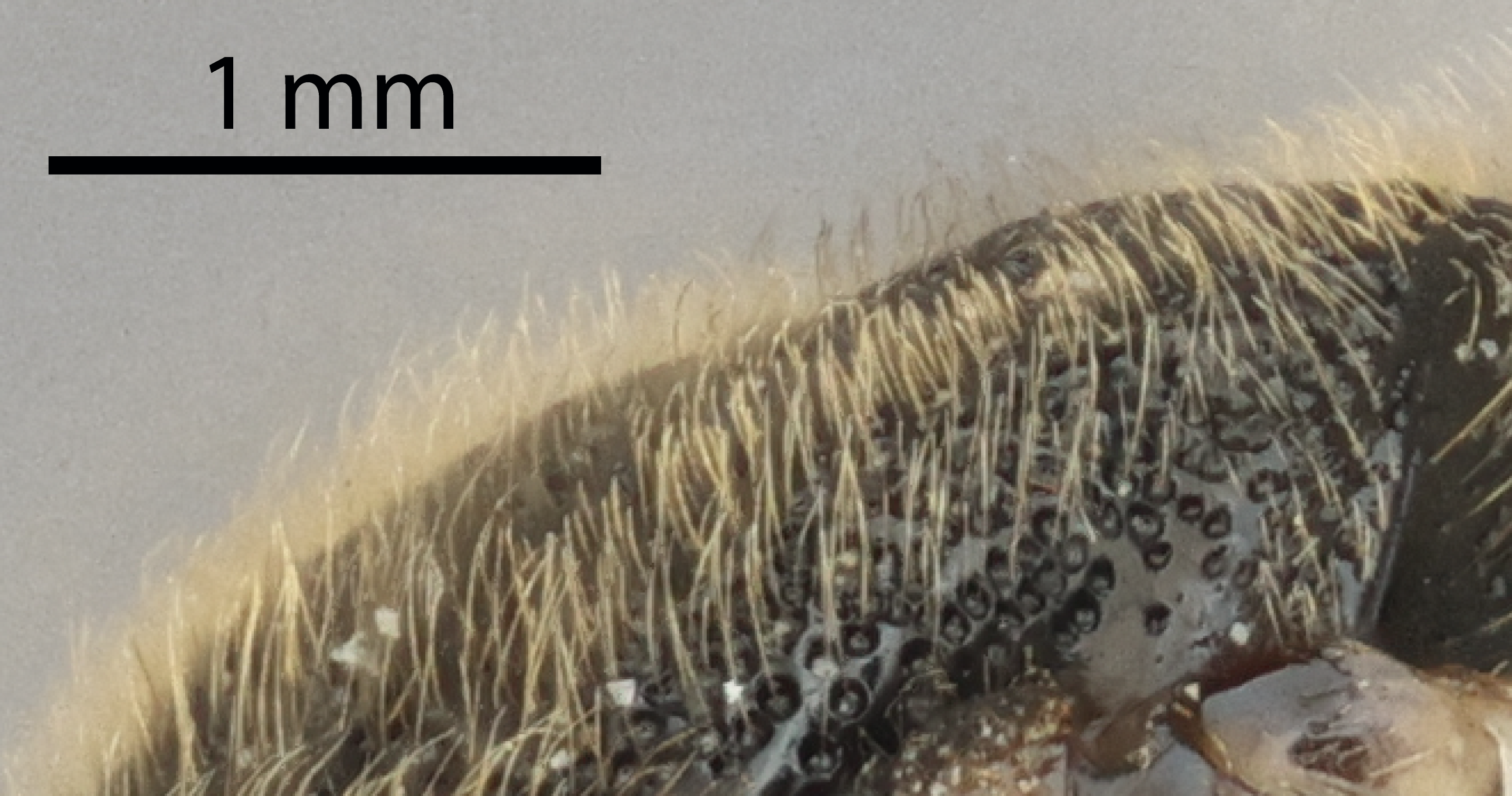 could not be assessed.
Diprion kashmirensis is distinguishable from D. similis and most D. pini by the absence of occipital maculaemacula:
a swatch or spot of coloration.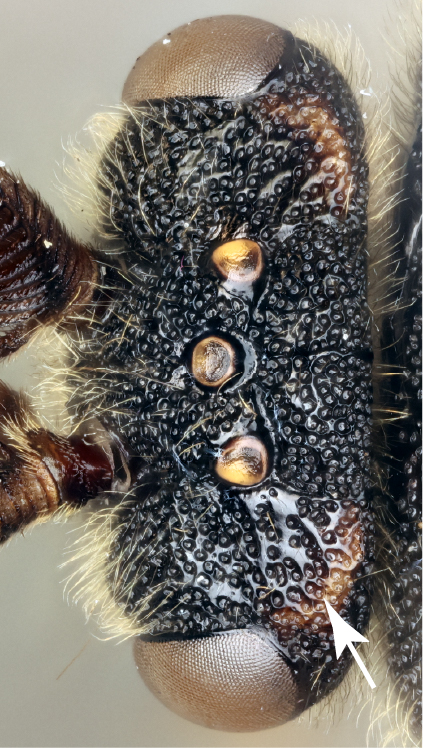 . A count of 21 antennomeresantennomere:
articulated components of the antenna. in the holotype discriminates D. kashmirensis from D. hani, D. jingyuanensis, D. koreanus, D. liuwanensis, D. nanhuaensis, and D. wenshanicus, while the emarginate ventral valvicipital margin discriminates from D. nipponicus.
Currently, D. kashmirensis can only be discriminated from close relative (and possible synonym) D. hutacharernae by distribution and possibly the host plant, although the host is unknown.
Host is unknown. It can be inferred that unlike its close relative Diprion hutacharernae, D. kashmirensis cannot natively feed on Khasi pine (Pinus kesiya), since Khasi pine does not occur in the western Himalayas.
Jammu and Kashmir, India (Saini and Thind 1993Saini and Thind 1993:
Saini M.S. and Thind A.S. 1993. First record of genus Diprion Schrank (Hymenoptera: Symphyta: Diprionidae) from India, with description of a new species. Journal of the Bombay Natural History Society 90: 263-265.).
No natural enemies known.
Basionymbasionym:
the original combination of a species name, consisting of the genus name and a specific epithet.
: Diprion kashmirensis Saini and Thind, 1993Saini and Thind, 1993:
Saini M.S. and Thind A.S. 1993. First record of genus Diprion Schrank (Hymenoptera: Symphyta: Diprionidae) from India, with description of a new species. Journal of the Bombay Natural History Society 90: 263-265.
The species is known only from the male holotype, which cannot be located at the Indian Agricultural Research Institute (P. R. Shashank, pers. comm.).
Diprion kashmirensis may be better considered a junior synonym of D. hutacharernae but without access to the holotype of D. kashmirensis this remains uncertain.
Author: Z. Griebenow
Content last updated January 2026
idtools.org