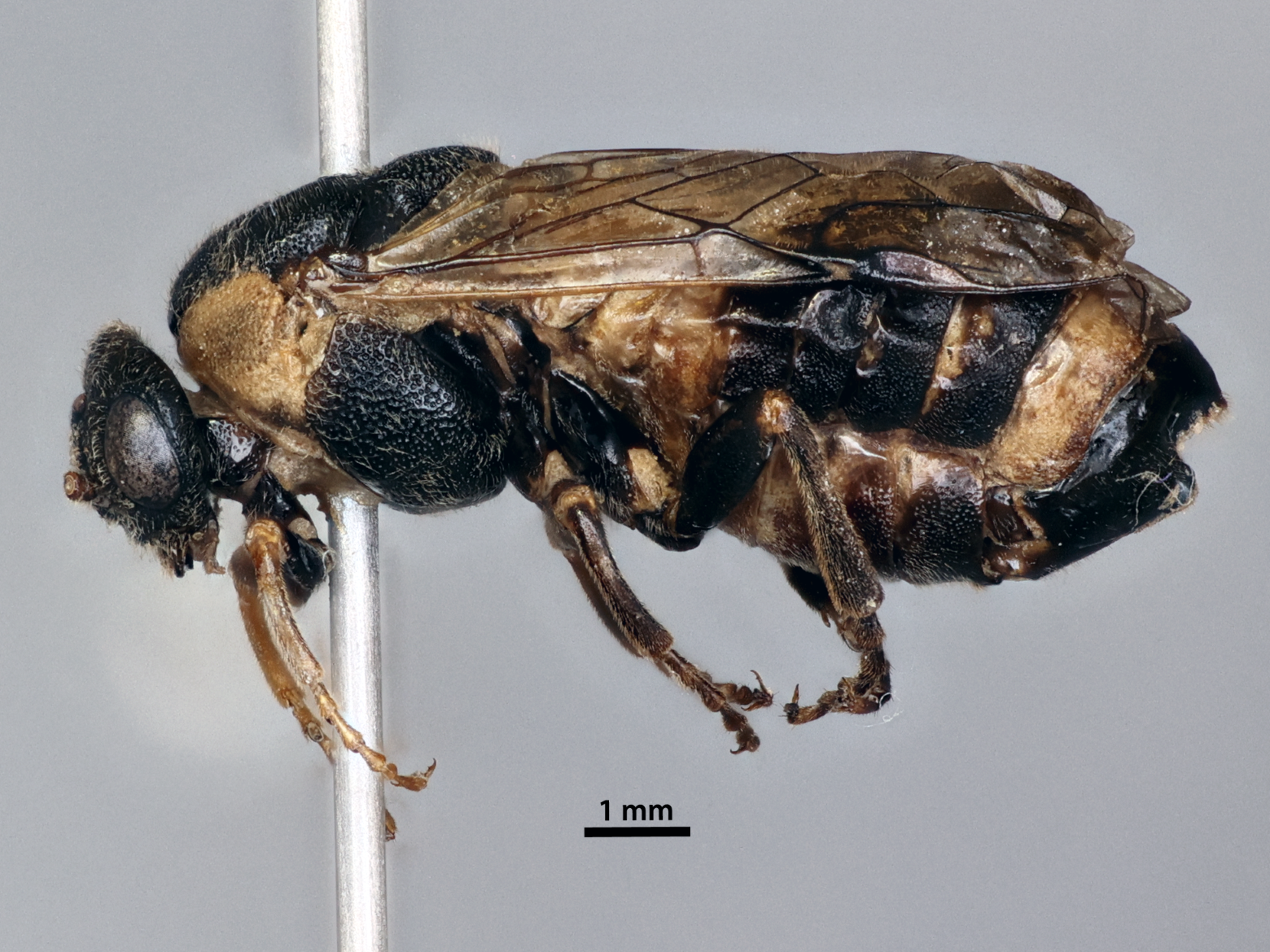
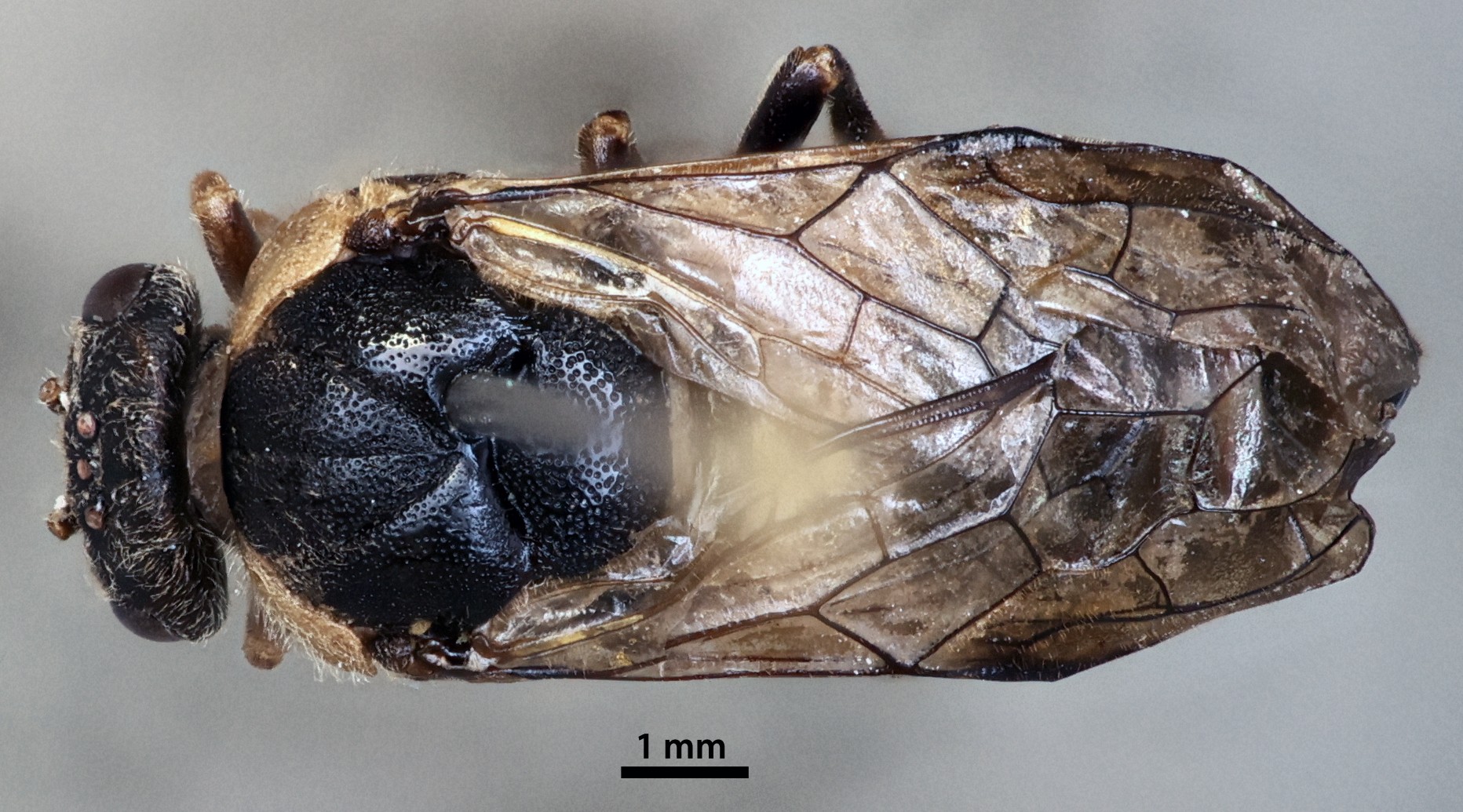
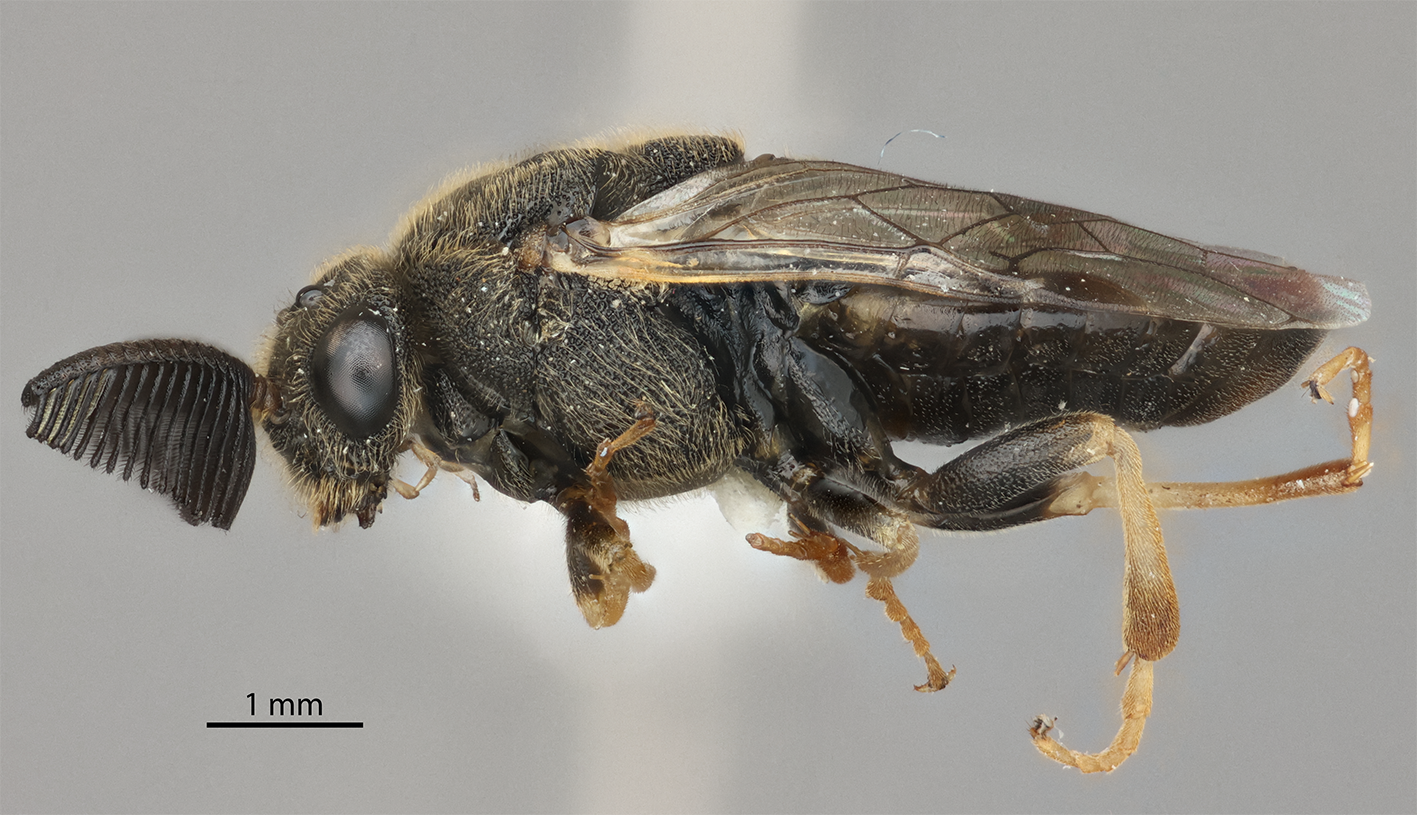
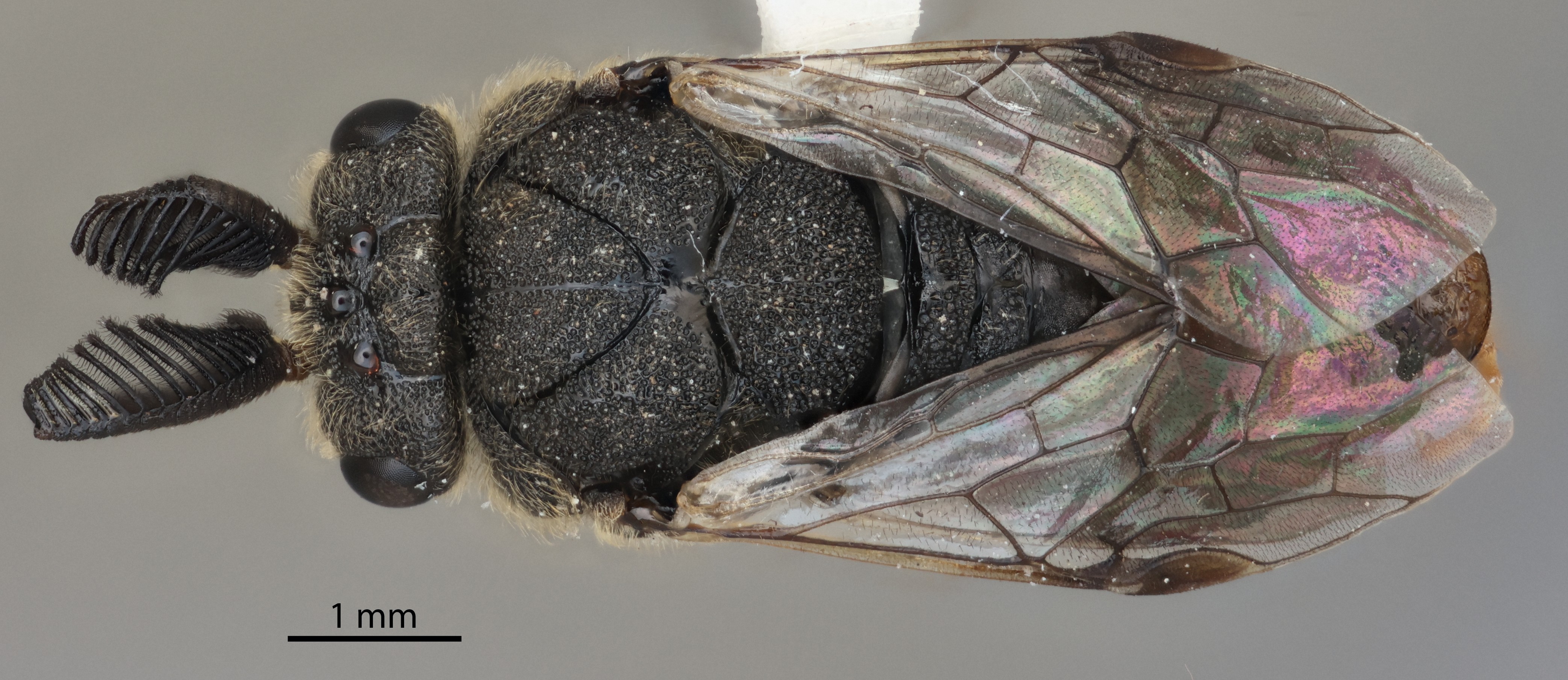
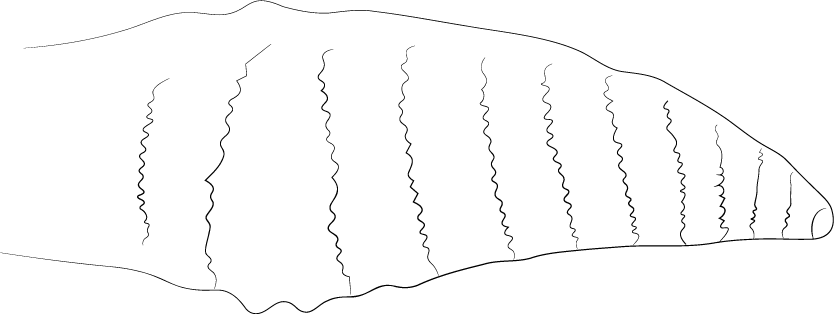
The Diprion jingyuanensis female is unique in having 12 annuliannulus:
vertical row of teeth which occurs at regular intervals on both sides of female gonapophysis VIII. In Diprion, there are 9–12 annuli.
on gonapophysis VIII and is distinguished from all other east Asian Diprion except D. koreanus in having a bicolored ATIXabdominal tergite IX:
( = ATIX) the dorsal sclerite of abdominal segment IX.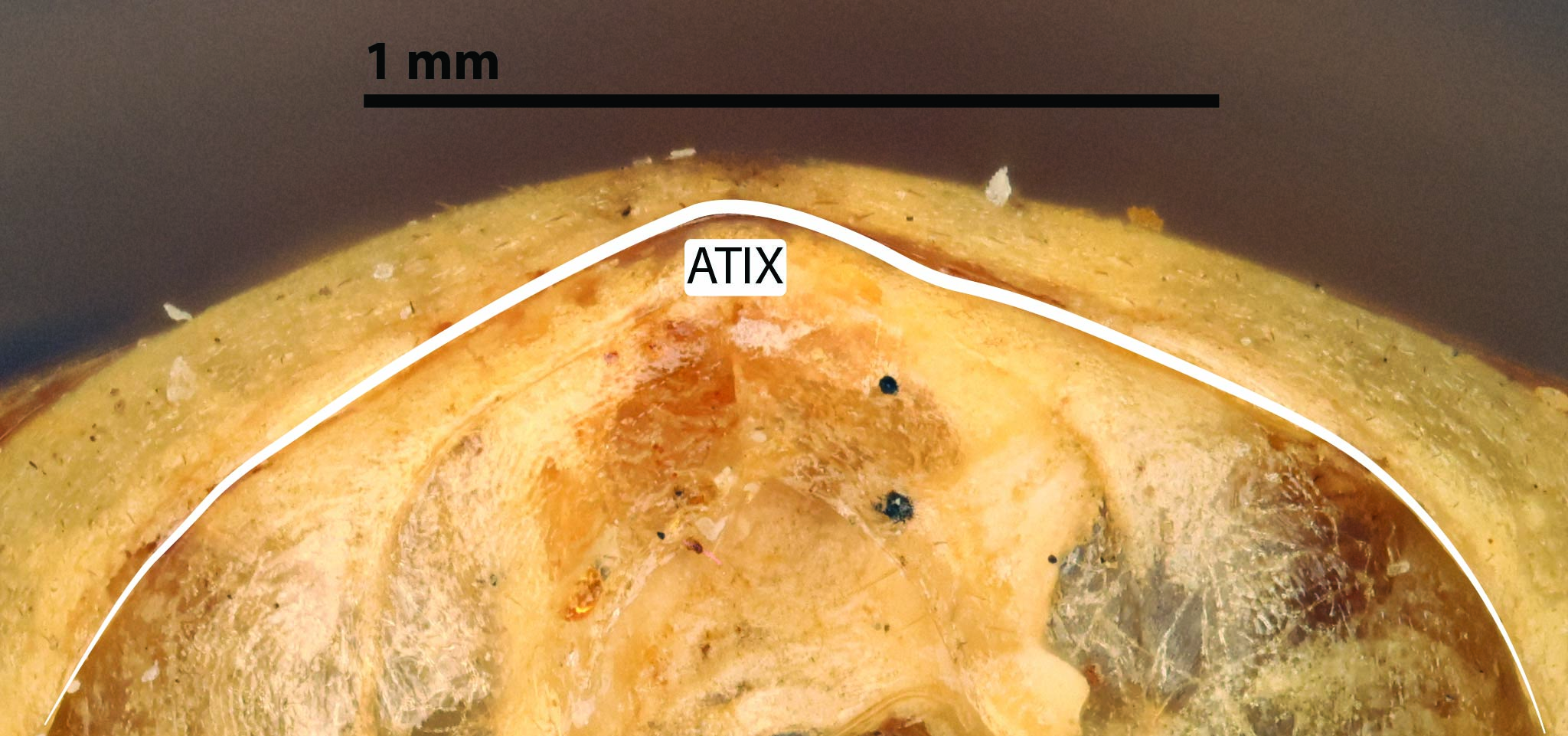 .
.
The male is indistinguishable from D. hutacharernae and D. nanhuaensis, at least with currently known phenotypic characters.
The final feeding larval instarinstar:
the stages of the sawfly larva, delimited by moulting events in which the larva sheds its exoskeleton and thus grows larger. The appearance of the larva changes dramatically throughout its growth from hatching to prepupa. The number of instars may differ according to sex.
of D. jingyuanensis is yellow, with three black longitudinal stripes: one on the dorsum, and a pair of lateral stripes (Chen, pers. comm.). Short black spines are present. These spines are lost in the prepupaprepupa:
The final larval instar, which does not feed. Its appearance can differ somewhat from preceding instars.
, and in this stage, breaks also appear in the longitudinal stripes (Chen, pers. comm.). Larvae of all instars can be discriminated from those of D. liuwanensis by behavior, as the former species does not lift its abdomen in a defensive posture (Zhang et al. 2003Zhang et al. 2003:
Zhang Y, Ye W-H, Li Y-L. 2003. Bionomics of the pine sawfly, Diprion jingyuanensis. Journal of Jishou University 24(3): 55–61.).
View full screen host table here
Shanxi, Gansu, and Inner Mongolia Provinces, People's Republic of China (Xiao and Zhang 1994Xiao and Zhang 1994:
Xiao G, Zhang Y. 1994. A new species of genus Diprion (Hymenoptera: Diprionidae) from China. [In Chinese.] Forest Research 7(6): 663–665., Anderbrant et al. 2023Anderbrant et al. 2023:
Anderbrant O, Zhang QH, Chen GF, Östrand F, Bergström G, Wassgren AB, Zhang Z, Hedenström E, Högberg HE. 2023. Attraction of male pine sawflies, Diprion jingyuanensis, to synthetic pheromone candidates: synergism between two stereoisomers. Forests 14(6): 1187.).
The main larval parasitoids of Diprion jingyuanensis are Drino auricapita (Diptera: Oestroidea: Tachinidae), a true fly; and Chrysomalla sp. (Hymenoptera: Chalcidoidea: Perilampidae), a parasitoid wasp. Reference to the wasp Chrysis sp. (Hymenoptera: Chrysidoidea: Chrysididae: Chrysidinae) as a larval parasitoid is presumably a misidentification of Cleptes sp. (Chrysididae: Cleptinae) (Zhang et al. 2003Zhang et al. 2003:
Zhang Y, Ye W-H, Li Y-L. 2003. Bionomics of the pine sawfly, Diprion jingyuanensis. Journal of Jishou University 24(3): 55–61.).
The D. jingyuanensis prepupae are mainly attacked by the parasitoid wasps (Hymenoptera: Ichneumonoidea: Ichneumonidae: Cryptinae) Apsilops and Pleolophus (Zhang et al. 2003Zhang et al. 2003:
Zhang Y, Ye W-H, Li Y-L. 2003. Bionomics of the pine sawfly, Diprion jingyuanensis. Journal of Jishou University 24(3): 55–61.).
Basionymbasionym:
the original combination of a species name, consisting of the genus name and a specific epithet.
: Diprion jingyuanensis Xiao and Zhang, 1994Xiao and Zhang, 1994:
Xiao G and Zhang Y. 1994. A new species of genus Diprion (Hymenoptera: Diprionidae) from China. [In Chinese.] Forest Research 7(6): 663–665.
Author: Z. Griebenow
Content last updated January 2026
idtools.org