Content is from Kirkbride et al. 2006Kirkbride et al. 2006:
Kirkbride JH, Jr, Gunn CR, and Dallwitz MJ. 2006. Family guide for fruits and seeds, vers. 1.0. Accessed September 2020-January 2022. URL:  https://nt.ars-grin.gov/seedsfruits/keys/frsdfam/index.cfm ., without modification.
Updates are forthcoming.
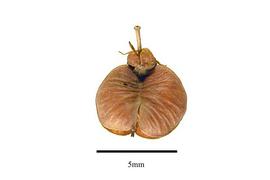
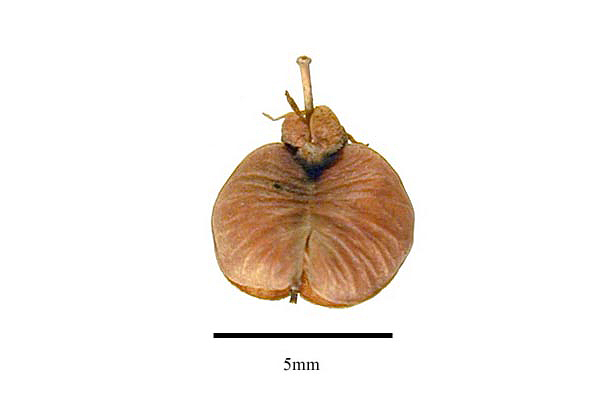
Fruits: Pistil(s) compound; 1; 1-pistillate; with carpels nearly separate to base. Fruit pericarpium; simplesimple:
fruit formed from a single flower with one pistil, solitary carpel or several fused carpels
; capsulecapsule:
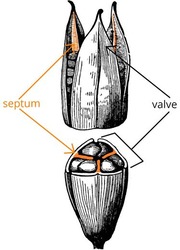
a dry, dehiscent fruit derived from a compound ovary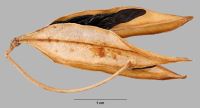 ; loculicidalloculicidal:
type of capsular dehiscence, opening longitudinally through the locules (compare septicidal)
 capsulecapsule:
a dry, dehiscent fruit derived from a compound ovary (assumed); capsulecapsule:
a dry, dehiscent fruit derived from a compound ovary not inflated; capsulecapsule:
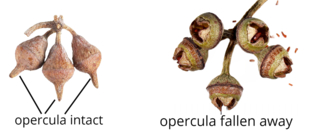
a dry, dehiscent fruit derived from a compound ovary without operculumoperculum:
a dehiscent cap (or lid) of a seed or fruit that opens during germination or dehiscence
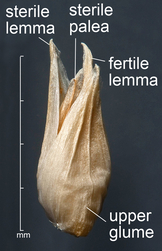
 ; without persistent central column; not within accessory organ(s); many-seeded; many; without sterilesterile:
lacking male and/or female reproductive parts; also, not producing fruit or seed
 carpels; apexapex:
the point farthest from the point of attachment, or the "tip" of an organ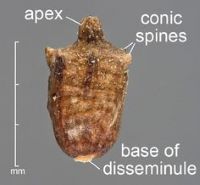 not beaked; dehiscentdehiscent:
(v. dehisce) splitting open at maturity to release contents (of a fruit)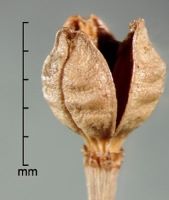 . Dehiscentdehiscent:
(v. dehisce) splitting open at maturity to release contents (of a fruit) unit seed(s). Dehiscentdehiscent:
(v. dehisce) splitting open at maturity to release contents (of a fruit) regularly (only upper one-half opening); passively; at apexapex:
the point farthest from the point of attachment, or the "tip" of an organ (only); without replumreplum:
the rim, formed by the persistent placentas, and connected by a false septum in Brassicaceae fruits. The fruit valves are attached to this rim and separate from it in dehiscent fruits.
. Epicarpepicarp:
outer layer of fruit wall or pericarp, if divided into layers; note here used synonymously with exocarp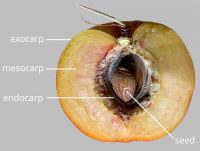 durable; without armature; without wing(s); without apicalapical:
at or pertaining to the end of the seed or fruit distal from its point of attachment (i.e., base)
respiratory hole. Endocarpendocarp:
the inner layer of the pericarp, if divided into layers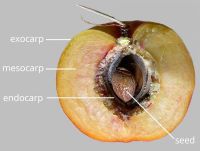 present; not separating from exocarpexocarp:
outer layer of fruit wall or pericarp, if divided into layers; note here used synonymously with epicarp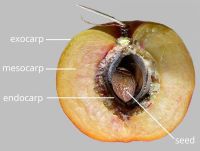 ; thinthin:
having or being of relatively little depth
; not splitting into 1-seeded pyrenes; without operculumoperculum:
a dehiscent cap (or lid) of a seed or fruit that opens during germination or dehiscence
; without secretory cavities; without longitudinallongitudinal:
of or relating to length or the lengthwise dimension
ridges. Funiculusfuniculus:
(alt. funicle) stalk connecting the ovule (later seed) to the ovary (later fruit) placenta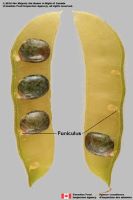 short; short without seed bearing hooks (retinacula); not persisting in fruit after seed shed.
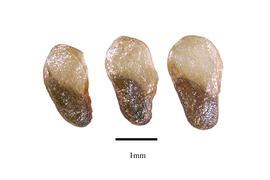
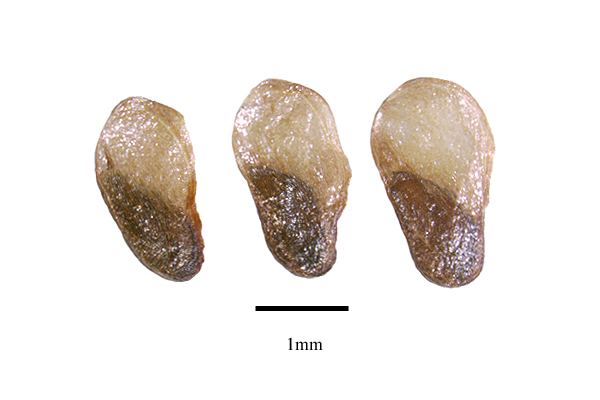
Seeds: Seed larger than minute; less than 1 mm long, or 1 to less than 5 mm long; 1 mm long; ellipsoidellipsoid:
3D shape—elliptic
, or ovateovate:
2D shape—egg-shaped in outline, widest point is towards one end of the organ, the other end tapers gradually, attachment at or near the broad end (compare obovate, ovoid)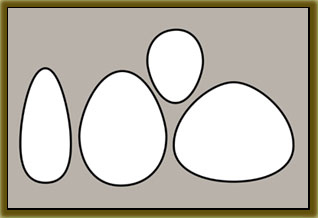 ; in transectiontransection:
a cross section; representing a plane made by cutting across an organ at a right angle to its length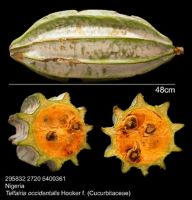 flattened; not bowl shaped; not nutlike; without winglike beakbeak:
a usually firm, terminal appendage, sometimes tapered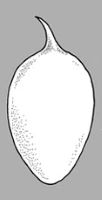 ; without caudatecaudate:
tapering to a long, tail-like appendage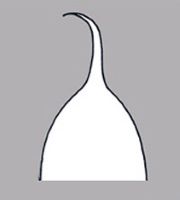 appendage(s); without canavanine. Sarcotestasarcotesta:
pulpy or fleshy outer layer of the seed coat, simulates aril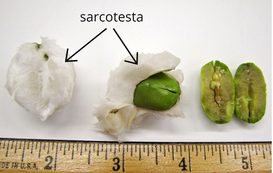 absent. Testatesta:
seed coat
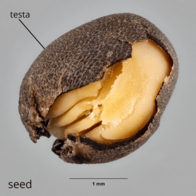 present; with markedly different marginalmarginal:
at, on, or close to the margin or border
tissue; marginalmarginal:
at, on, or close to the margin or border
tissue winglike; without fleshyfleshy:
texture—fairly firm and dense, juicy or at least moist, and easily cut
or leatheryleathery:
texture—moderately thick, tough, and very pliable
layer over hard layer; shinyshiny:
uniformly reflecting a high proportion of incident light at all angles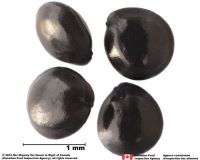 ; without glands; without bristles; glabrousglabrous:
without hairs
; with wing(s); 1-winged; with wing on one side (& 2 times seed length); without collar; without operculumoperculum:
a dehiscent cap (or lid) of a seed or fruit that opens during germination or dehiscence
; colored; monochrome; not becoming mucilaginousmucilaginous:
resembling mucilage; moist and sticky
when wetted. Rapheraphe:
a ridge or seam on the seed coat, formed by the portion of the funiculus united to the ovule wall in longitudinally curved ovules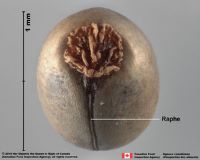 conspicuous (running laterallateral:
(of embryo) embryo lies along the side of the seed, generally towards one end; of, at, or from the side; in grasses, can refer to the sides adjacent to the dorsal and ventral sides
to wing margin). Embryo differentiated from food reserve (assumed); well developed; without coleorhiza; with 2 or more cotyledons (assumed). Cotyledons 2 (assumed); equal in size; not punctatepunctate:
surface relief—dotted with pits or with translucent, sunken glands or with colored dots, similar to pitted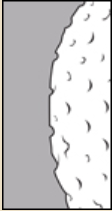 dotted.
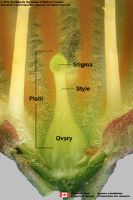
with 2 valves which at the top bear a half of the longitudinally split stylestyle: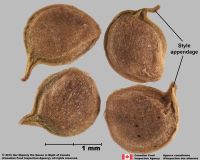 and stigmastigma:
 . Seed depressed-ovoid; its wing elliptic-ovate, ca. 2 times longer than body of seed, thinthin: running in laterallateral: containing many tiny seeds, pea-sized, slightly beakedbeak:, clearly marked into the usual two divisions, light brown, much veinedveined:
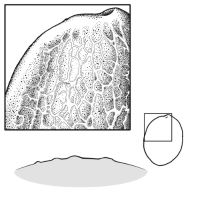 or ribbedribbed:
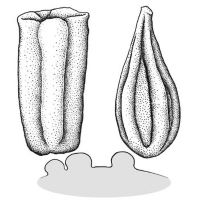 , the tips splitting opne slightly to release a number of flat, thinthin:
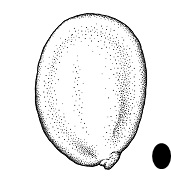 , shinyshiny: seeds, wind dispersed".
Literature specific to this family: Beusekom-Osinga, R.J. van & C.F. van Beusekom. 1975. Delimation and subdivisions of the Crypteroniaceae (Myrtales). Blumea 22:255–266; Palmer, E. & N. Pitman. 1972b. Trees of Southern Africa, vol 3. A.A. Balkema, Cape Town; Oliver, D., ed. 1895. Icon. pl. 24: pl. 2348.
General references: Gunn, C.R., J.H. Wiersema, C.A. Ritchie, & J.H. Kirkbride, Jr. 1992 & amendments. Families and genera of Spermatophytes recognized by the Agricultural Research Service. Techn. Bull. U.S.D.A. 1796:1–500.
Authors: M. Islam, A. Gottlieb, M. Maher, J. Scher, A. Redford
Content last updated August 2024
idtools.org