Adult
Most of the characters presented in the keys to pine sawfly species are based on coloration. These are continuous characters, rather than structural ones, and so the limits of different character states can be difficult to assess, especially in old (≥ 80 years) specimens in which color has faded. Nonetheless, many of these characters are crucial for definitive identification when the genitalia are inaccessible. The following are some tips to help users of this tool reliably interpret certain color-based characters in adult pine sawflies.
- Occipital maculaemacula:
a swatch or spot of coloration.
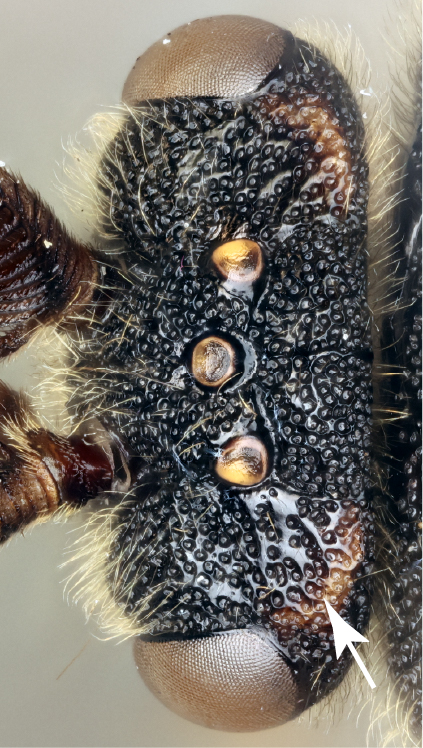 , ♂: the occipital maculaemacula:
a swatch or spot of coloration.
are to be scored “present” only if there is a pronounced splotch of pale color behind and medial to the compound eye. If there is only a slight hint of such coloration, occipital maculaemacula:
a swatch or spot of coloration.
are scored “absent”.
- Distaldistal:
remote from the body.
forewing color, ♀: when scored as present, distaldistal:
remote from the body.
wing infumation begins at a line traversing the forewing from the base of the pterostigmapterostigma:
the sclerotized patch on the front margin of the forewing.
straight to the hind margin of the forewing. No specimens of Diprion tianmunicus were available to examine, and so it is possible that in this species distaldistal:
remote from the body.
infumation begins at a different point along the forewing.
- Distaldistal:
remote from the body.
hindwing color, ♂: distaldistal:
remote from the body.
wing infumation begins at, or immediately distaldistal:
remote from the body.
to, either the hamulihamuli:
Hairs on the anterior margin of the hindwing that hook onto the posterior margin of the forewing in flight.
or cu-a. Some Diprion hani and D. similis show faint infumation. Distaldistal:
remote from the body.
infumation is far more pronounced in almost all D. pini, to an extent unique among pine sawflies, with the sole known exception of a population from Ireland provisionally assigned to D. pini based on female characters.
- Metascutellar color, ♀: to be coded as “bicolored”, the metascutellummetascutellum:
a roughly rectangular platform in the middle of the metanotum, elevated above the metanotal trough. It is located behind and between the cenchri.
must have a distinct division between the pale anterior and dark posterior regions. In some “concolorous” cases, the metascutellummetascutellum:
a roughly rectangular platform in the middle of the metanotum, elevated above the metanotal trough. It is located behind and between the cenchri.
shows slightly paler splotching at the anterior corners, but no distinct pale anterior band.
- Metafemur color, ♀: to be scored as concolorousconcolorous:
having a single color throughout.
, the female metafemur must lack any yellow color at the apex. Membrane at the femoral-tibial articulation is not considered part of the metafemur, and so must be ignored when making this assessment.
- ATIX color, ♀: if any trace of dark coloration occurs at the anterolateral margins of ATIX, this sclerite is considered versi- or bicoloredbicolored:
having two colors, with the change between these colors being abrupt.
.
Larva
Identification of pine sawfly larvae to species entirely relies on external coloration. However, the color and texture of the larvae changes dramatically from instarinstar:
the stages of the sawfly larva, delimited by moulting events in which the larva sheds its exoskeleton and thus grows larger. The appearance of the larva changes dramatically throughout its growth from hatching to prepupa. The number of instars may differ according to sex.
to instarinstar:
the stages of the sawfly larva, delimited by moulting events in which the larva sheds its exoskeleton and thus grows larger. The appearance of the larva changes dramatically throughout its growth from hatching to prepupa. The number of instars may differ according to sex.
. Therefore, larvae can often only be identified confidently to species in the final feeding instarinstar:
the stages of the sawfly larva, delimited by moulting events in which the larva sheds its exoskeleton and thus grows larger. The appearance of the larva changes dramatically throughout its growth from hatching to prepupa. The number of instars may differ according to sex.
, and in the prepupa—and these two final instars may differ notably from each other. Larval coloration can be distorted by preservation in ethanol.
For hints and tips on using Lucid keys, see Lucid key best practices.