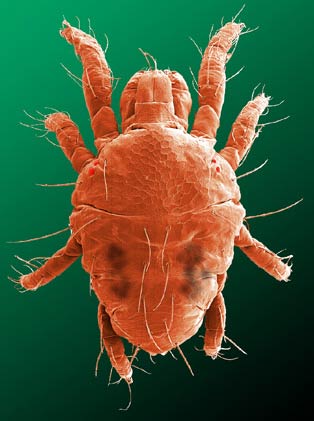
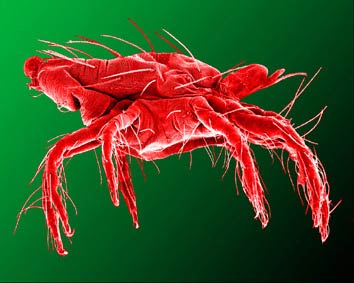
Exotic mite families
t
Taxonomy
updated 2025
Common names
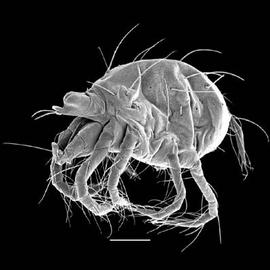
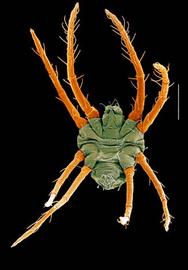
spider mites, red mites, two-spotted mites, six-spotted mites
Probability of encounter
very high
Quarantine importance
Very high. The Tetranychidae contains a number of devastating pests of plants and most of the species of high importance on the Priority Pest List.
Diagnosis
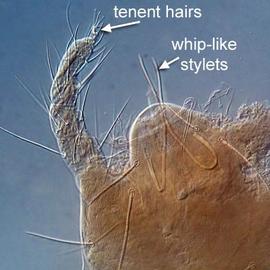
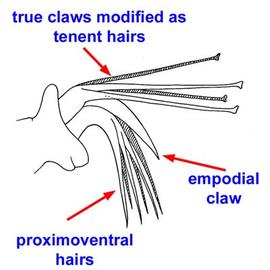
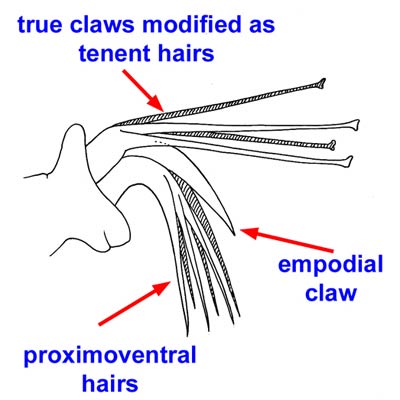
- Empodium without tenent hairs, usually claw-like, bifurcate, with or without proximoventral hairs; sometimes highly reduced and appearing absent.
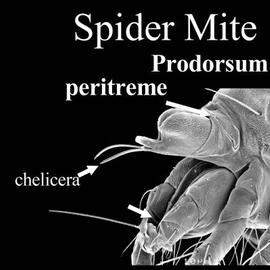
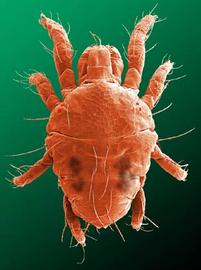
- Prodorsum with 4 pairs of setae (vi, ve, sci, sce)
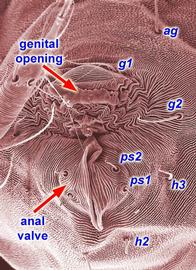
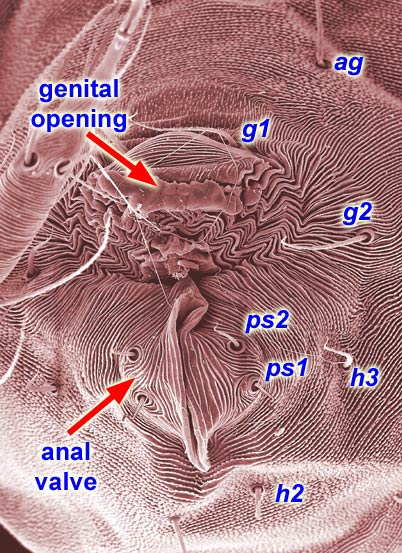
- Adult female with 1–2 pairs of anal setae (males with 4 pairs of ano-genital setae)
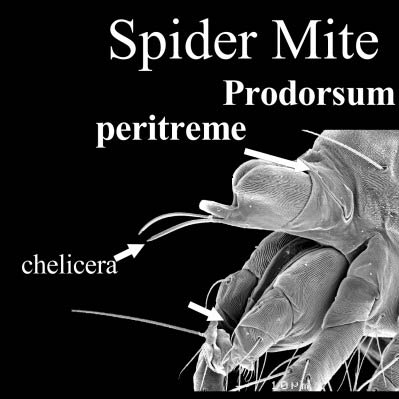
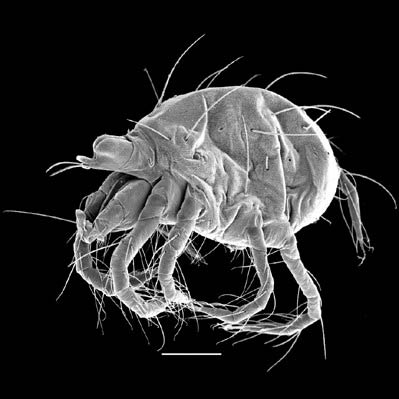
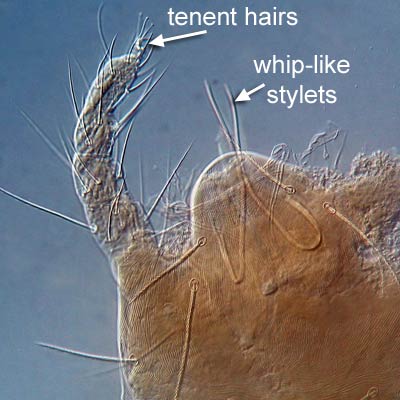
- Cheliceral bases adnate, fused mesally into a stylophore (sometimes withdrawn into the body); chelicerae with fixed digit reduced and movable digit whiplike.
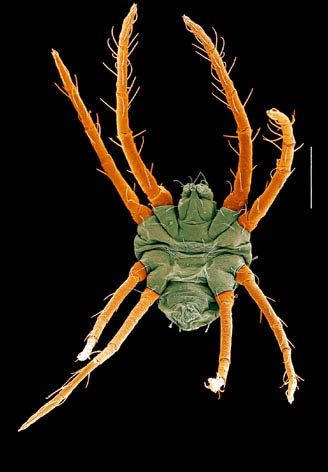
- Peritremes typically chambered structures on the dorso-lateral surface of the prodorsum; naso absent; prodorsal trichobothria absent; 2 pairs of eye lenses usually present. Palps 5 segmented; with thumbclaw process (claw-like seta on the palp tibia and a thumb- or button-like subterminal palp tarsus). Leg tarsi usually with tenent hairs on claws or empodium. Genital papillae absent; males with an intromittent aedeagus.
Open Tetranychinae key
Similar taxa
The Stigmaeidae are sometimes confused with spider mites, but these predatory mites lack the whip-like movable digits. Cryptognathidae are capable of retracting their gnathosoma, but their cheliceral bases are free and the movable digit is hook-like. Bryobiinae have empodia with tenent hairs.
Ecology and distribution
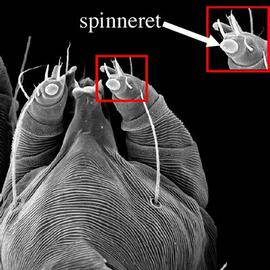
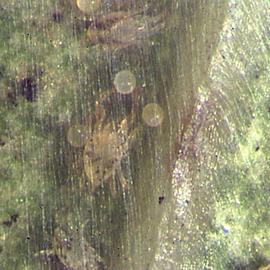
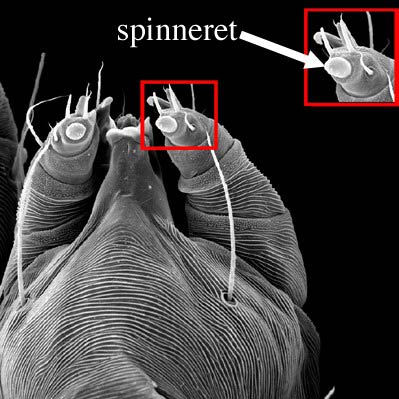
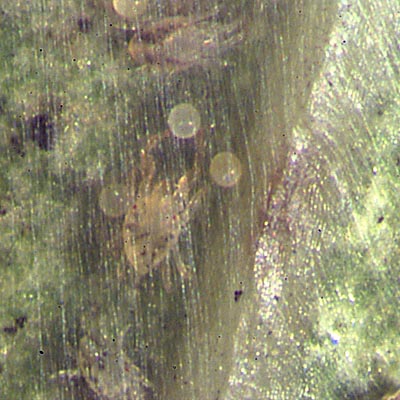
The Tetranychinae includes the infamous two-spotted and other major economic spider mite pests. Many are capable of spinning dense webs; others use silk only to attach their eggs to leaves and stems.
References
- Baker and Pritchard 1960Baker and Pritchard 1960:
Baker EW, Pritchard AE. 1960. The tetranychoid mites of Africa. Hilgardia 29 (11): 455–574.
- Baker and Tuttle 1994Baker and Tuttle 1994:
Baker EW, Tuttle DM. 1994. A guide to the spider mites (Tetranychidae) of the United States. Indira Publishing House, West Bloomfield, Michigan. 347 pp.
- Beard et al. 2003Beard et al. 2003:
Beard JJ, Walter DE, Allsopp P. 2003. Spider mites of sugarcane in Australia: A review of grass-feeding Oligonychus Berlese (Acari: Prostigmata: Tetranychidae) with the description of four new species. Australian Journal of Entomology 42: 51–78.
- Bolland et al. 1998Bolland et al. 1998:
Bolland HR, Gutierrez J, Flechtmann CHW. 1998. World catalogue of the spider mite family (Acari: Tetranychidae). Brill, Leiden.
- Evans et al. 1993Evans et al. 1993:
Evans GA, Cromroy HL, Ochoa R. 1993. The Tenuipalpidae of Honduras (Tenuipalpidae: Acari). Florida Entomologist 76: 126–155.
- Helle and Sabelis 1985Helle and Sabelis 1985:
Helle W and Sabelis MW, eds. 1985. Spider mites: Their biology, natural enemies, and control. World Crop Pests, Vol. 1A. Elsevier, New York.
- Hislop and Jeppson 1976Hislop and Jeppson 1976:
Hislop RG, Jeppson LR. 1976. Morphology of the mouthparts of several species of phytophagous mites. Annals of the Entomological Society of America 69: 1125–1135.
- Jeppson et al. 1975Jeppson et al. 1975:
Jeppson LR, Keifer HH, Baker EW. 1975. Mites injurious to economic plants. University of California Press, Berkeley.
- Krantz 1978Krantz 1978:
Krantz GW. 1978. A manual of acarology [2nd ed.]. Oregon State University Book Stores, Corvallis.
- Meyer 1979Meyer 1979:
Meyer MKPS. 1979. The Tenuipalpidae (Acari) of Africa with keys to the world fauna. Republic of South Africa, Department of Agricultural Technical Services, Entomology Memoir No. 50: 135 pp.
- Meyer and Ueckermann 1997Meyer and Ueckermann 1997:
Meyer MKPS, Ueckermann EA. 1997. A review of some species of the families Allochaetophoridae, Linotetranidae and Tuckerellidae (Acari: Tetranychoidea). International Journal of Acarology 23: 67–92.
- Migeon and Flechtmann 2004Migeon and Flechtmann 2004:
Migeon A, Flechtmann CHW. 2004. First additions and corrections to the World Catalogue of the Spider Mite Family (Acari: Tetranychidae). International Journal of Acarology 30 (2): 143–152.
- Ochoa et al. 1994Ochoa et al. 1994:
Ochoa R, Aguilar H, Vargas C. 1994. Phytophagous mites of Central America: An illustrated guide. CATIE, Turrialba, Costa Rica.
- Tseng 1990Tseng 1990:
Tseng Y-H. 1990. A monograph of the mite family Tetranychidae (Acarina: Trombidiformes) from Taiwan. Taiwan Museum Special Publication Series 9. 224 pp.
- Zhang 2003Zhang 2003:
Zhang Z-Q. 2003. Mites of greenhouses: Identification, biology and control. CABI Publishing, Wallingford. 244 pp.