Exotic mite families
t
Taxonomy
updated 2025
Common names
clover mites
Probability of encounter
high
Quarantine importance
High. The Bryobiinae contains a number of important pests of grains, fruit trees, and some other crops.
Diagnosis
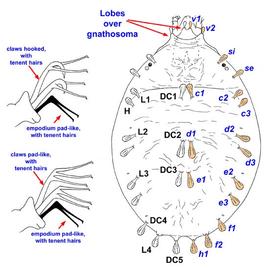
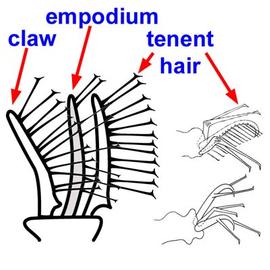
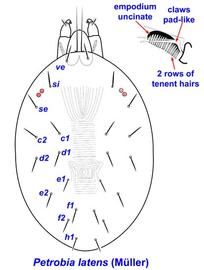
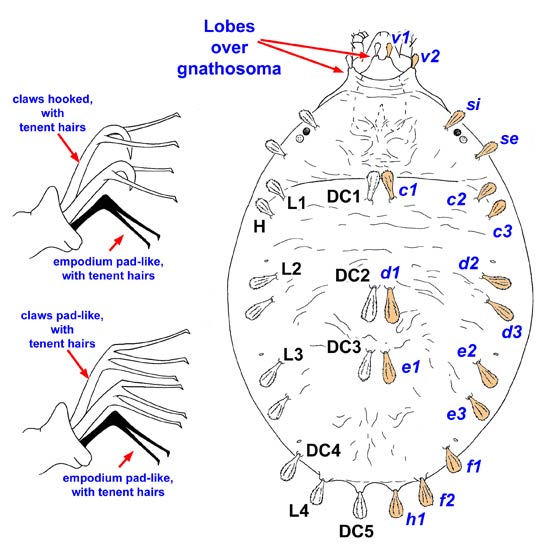
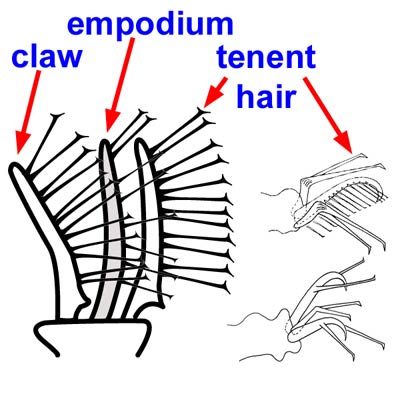
- Empodium with tenent hairs
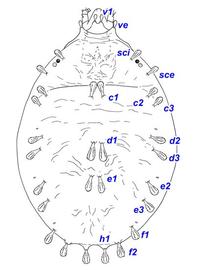
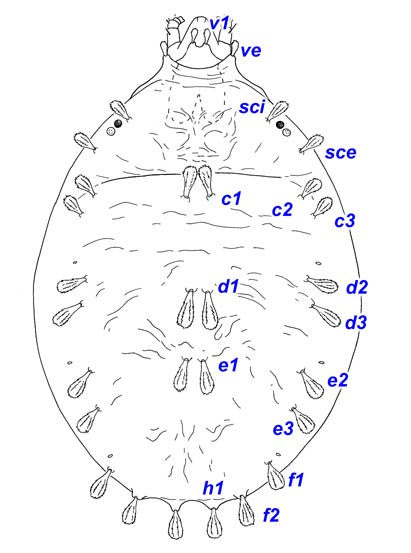
- Prodorsum with 4 pairs of setae (vi, ve, sci, sce)
- Adult female with 3 pairs of anal setae (males with 5 pairs of ano-genital setae)
- Cheliceral bases adnate, fused mesally into a stylophore (sometimes withdrawn into the body); chelicerae with fixed digit reduced and movable digit whiplike.
- Peritremes typically chambered structures on the dorso-lateral surface of the prodorsum; naso absent; prodorsal trichobothria absent; 2 pairs of eye lenses usually present. Palps 5 segmented; with thumbclaw process (claw-like seta on the palp tibia and a thumb- or button-like subterminal palp tarsus). Leg tarsi usually with tenent hairs on claws or empodium. Genital papillae absent; males with an intromittent aedeagus.
Open Bryobiinae key
Similar taxa
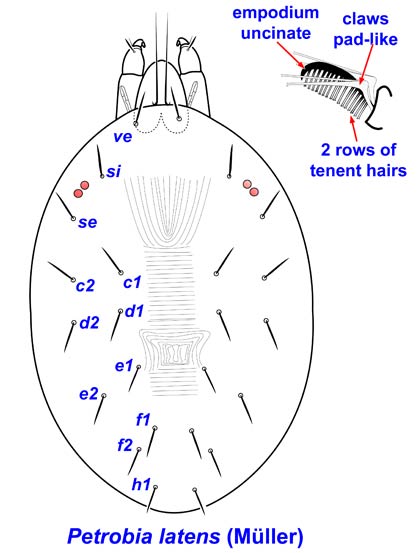
The true spider mites in the Tetranychinae do not have empodia with tenent hairs.
Ecology and distribution
Bryobiinae are often found on twigs or the undersides of leaves. They are not able to produce silk and do not have a spinneret on their palp tarsus.
References
- Baker and Pritchard 1960Baker and Pritchard 1960:
Baker EW, Pritchard AE. 1960. The tetranychoid mites of Africa. Hilgardia 29 (11): 455–574.
- Baker and Tuttle 1994Baker and Tuttle 1994:
Baker EW, Tuttle DM. 1994. A guide to the spider mites (Tetranychidae) of the United States. Indira Publishing House, West Bloomfield, Michigan. 347 pp.
- Bolland et al. 1998Bolland et al. 1998:
Bolland HR, Gutierrez J, Flechtmann CHW. 1998. World catalogue of the spider mite family (Acari: Tetranychidae). Brill, Leiden.
- Helle and Sabelis 1985Helle and Sabelis 1985:
Helle W and Sabelis MW, eds. 1985. Spider mites: Their biology, natural enemies, and control. World Crop Pests, Vol. 1A. Elsevier, New York.
- Jeppson et al. 1975Jeppson et al. 1975:
Jeppson LR, Keifer HH, Baker EW. 1975. Mites injurious to economic plants. University of California Press, Berkeley.
- Migeon and Flechtmann 2004Migeon and Flechtmann 2004:
Migeon A, Flechtmann CHW. 2004. First additions and corrections to the World Catalogue of the Spider Mite Family (Acari: Tetranychidae). International Journal of Acarology 30 (2): 143–152.
- Ochoa et al. 1994Ochoa et al. 1994:
Ochoa R, Aguilar H, Vargas C. 1994. Phytophagous mites of Central America: An illustrated guide. CATIE, Turrialba, Costa Rica.
- Tseng 1990Tseng 1990:
Tseng Y-H. 1990. A monograph of the mite family Tetranychidae (Acarina: Trombidiformes) from Taiwan. Taiwan Museum Special Publication Series 9. 224 pp.
- Zhang 2003Zhang 2003:
Zhang Z-Q. 2003. Mites of greenhouses: Identification, biology and control. CABI Publishing, Wallingford. 244 pp.