Exotic mite families
t
Taxonomy
updated 2025
Name
Linotetranidae Baker and Pritchard, 1953Baker and Pritchard, 1953:
Baker EW, Pritchard AE. 1953. The family categories of tetranychoid mites, with a review of the new families Linotetranidae and Tuckerellidae. Annals of the Entomological Society of America 46: 243–258.
Common names
cryptic false spider mites
Probability of encounter
low
Quarantine importance
Low. The Linotetranidae are associated with soil and grasses around the world. None are known to be important plant pests.
Diagnosis
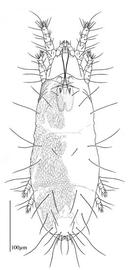
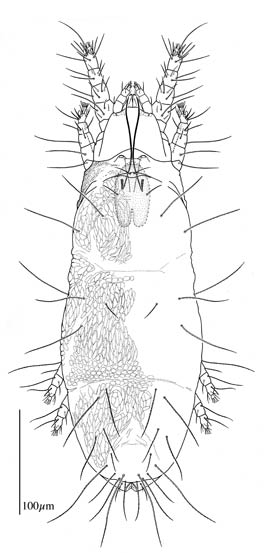
- Empodium with tenent hairs
- Prodorsum with 4 pairs of setae (vi, ve, sci, sce)
- Adult female with 3 pairs of anal setae (males with 5 pairs of ano-genital setae)
- Cheliceral bases adnate, fused mesally into a stylophore (sometimes withdrawn into the body); chelicerae with fixed digit reduced and movable digit whiplike.
- Peritremes typically chambered structures on the dorso-lateral surface of the prodorsum; naso absent; prodorsal trichobothria absent; 2 pairs of eye lenses usually present. Palps 5 segmented; usually (except Anoplopalpus) with thumbclaw process (claw-like seta on the palp tibia and a thumb- or button-like subterminal palp tarsus). Leg tarsi usually with tenent hairs on claws or empodium. Genital papillae absent; males with an intromittent aedeagus.
Similar taxa
Linotetranids resemble other elongate Tetranychoidea associated with grasses such as Allochaetophoridae (which have eyes) and some Tenuipalpidae (which lack a thumbclaw process and usually have eyes).
Ecology and distribution
The Tetranychoidea are plant-associated mites, and includes the infamous spider mites (Tetranychidae). Tetranychoid species that feed on grasses or pasture legumes may occasionally appear in soil samples.
References
- Baker and Pritchard 1953Baker and Pritchard 1953:
Baker EW, Pritchard AE. 1953. The family categories of tetranychoid mites, with a review of the new families Linotetranidae and Tuckerellidae. Annals of the Entomological Society of America 46: 243–258.
- Beard and Walter 2004Beard and Walter 2004:
Beard JJ, Walter DE. 2004. Cryptic false spider mites: A new genus, Austrolinus, and a review of the family Linotetranidae (Acari: Prostigmata: Tetranychoidea). Invertebrate Systematics 18 (5): 593–606.
- Krantz 1978Krantz 1978:
Krantz GW. 1978. A manual of acarology [2nd ed.]. Oregon State University Book Stores, Corvallis.
- Meyer and Ueckermann 1997Meyer and Ueckermann 1997:
Meyer MKPS, Ueckermann EA. 1997. A review of some species of the families Allochaetophoridae, Linotetranidae and Tuckerellidae (Acari: Tetranychoidea). International Journal of Acarology 23: 67–92.