Exotic mite families
t
Taxonomy
updated 2025
Name
Tuckerellidae Baker and Pritchard, 1953Baker and Pritchard, 1953:
Baker EW, Pritchard AE. 1953. The family categories of tetranychoid mites, with a review of the new families Linotetranidae and Tuckerellidae. Annals of the Entomological Society of America 46: 243–258.
Common names
peacock mites, ornamental false spider mites
Probability of encounter
medium
Quarantine importance
Medium. The Tuckerellidae consists of a single genus, Tuckerella, and about two dozen species. A few of these are sometimes pests of crops and one species has been associated with citrus necrosis.
Diagnosis
- Empodium with tenent hairs
- Prodorsum with 4 pairs of setae (vi, ve, sci, sce)
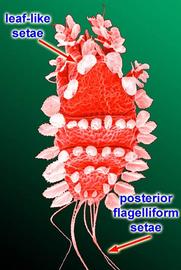
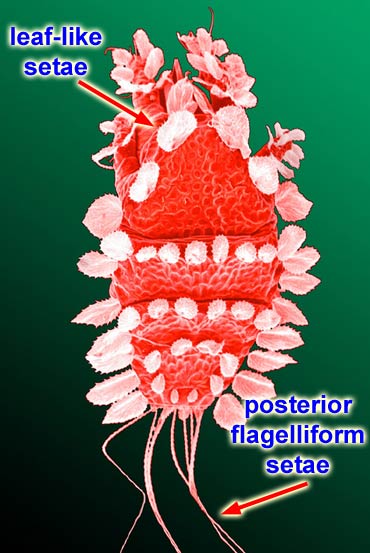
- Most dorsal setae expanded, leaf-like; posterior margin with row of flagelliform setae.
- Adult female with 3 pairs of anal setae (males with 5 pairs of ano-genital setae)
- Cheliceral bases adnate, fused mesally into a stylophore (sometimes withdrawn into the body); chelicerae with fixed digit reduced and movable digit whiplike.
- Peritremes typically chambered structures on the dorso-lateral surface of the prodorsum; naso absent; prodorsal trichobothria absent; 2 pairs of eye lenses usually present. Palps 5 segmented; with thumbclaw process (claw-like seta on the palp tibia and a thumb- or button-like subterminal palp tarsus). Leg tarsi usually with tenent hairs on claws or empodium. Genital papillae absent; males with an intromittent aedeagus.
Similar taxa
The Stigmaeidae are sometimes confused with spider mites, but these predatory mites lack the whip-like movable digits. Cryptognathidae are capable of retracting their gnathosoma, but their cheliceral bases are free and the movable digit is hook-like.
Ecology and distribution
The Tetranychoidea are plant-associated mites, and includes the infamous spider mites (Tetranychidae). Tetranychoid species that feed on grasses or pasture legumes may occasionally appear in soil samples.
References
- Baker and Pritchard 1953Baker and Pritchard 1953:
Baker EW, Pritchard AE. 1953. The family categories of tetranychoid mites, with a review of the new families Linotetranidae and Tuckerellidae. Annals of the Entomological Society of America 46: 243–258.
- Beard and Walter 2005Beard and Walter 2005:
Beard JJ, Walter DE. 2005. A new species of Tuckerella (Prostigmata: Tetranychoidea: Tuckerellidae) from Australia with descriptions of all stages and a discussion of the tritonymphal stage. Acarologia 45: 4–-60.
- Chaudhri 1971Chaudhri 1971:
Chaudhri WM. 1971. Four new species of the genus Tuckerella from Pakistan. Pakistan Journal of Zoology 3: 79–85.
- Corpuz-Raros 2001Corpuz-Raros 2001:
Corpuz-Raros LA. 2001. Tuckerella filipina, a new species of Tuckerellidae (Acari) from the Philippines. International Journal of Acarology 27: 71–74.
- Collyer 1969Collyer 1969:
Collyer E. 1969. Two species of Tuckerella (Acarina: Tuckerellidae) from New Zealand. New Zealand Journal of Science 12: 811–814.
- Ewing 1922Ewing 1922:
Ewing HE. 1922. Three new species of peculiar and injurious spider mites. Proceedings of the Entomological Society of Washington 24 (4): 104–108.
- Krantz 1978Krantz 1978:
Krantz GW. 1978. A manual of acarology [2nd ed.]. Oregon State University Book Stores, Corvallis.
- Lin and Fu 1997Lin and Fu 1997:
Lin Y-M, Fu Y-G. 1997. Two new species of the genus Tuckerella from Hainan Island, China (Acariformes: Tuckerellidae). Acta Zootaxonomica Sinica 22 (2): 150–153.
- Lin and Fu 2000Lin and Fu 2000:
Lin Y-M, Fu Y-G. 2000. A new species of the genus Tuckerella from China (Acariformes: Tuckerellidae). Acta Entomologica Sinica 40 (3): 311–313.
- Meyer and Ueckermann 1997Meyer and Ueckermann 1997:
Meyer MKPS, Ueckermann EA. 1997. A review of some species of the families Allochaetophoridae, Linotetranidae and Tuckerellidae (Acari: Tetranychoidea). International Journal of Acarology 23: 67–92.
- Miller 1964Miller 1964:
Miller LW. 1964. A new species of Tuckerella (Acarina, Tetranychoidea, Tuckerellidae) from Tasmania. Papers and Proceedings of the Royal Society of Tasmania 98: 79–84.
- Ochoa 1989aOchoa 1989a:
Ochoa R. 1989a. The genus Tuckerella in Costa Rica (Acari: Tuckerellidae). International Journal of Acarology 15 (4): 205–207.
- Ochoa 1989bOchoa 1989b:
Ochoa R. 1989b. A note on paedogenesis in Tetranychoidea. International Journal of Acarology 15 (2): 117–118.
- Ochoa 1999Ochoa 1999:
Ochoa R. 1999. A “mite” more information. Science 286 (5449): 2449.
- Tucker 1926Tucker 1926:
Tucker RWE. 1926. Some South African mites, mainly Tetranychidae and Eriophyidae. Union of South Africa Department of Agriculture, Division of Entomology Memoir No. 5: 15 pp.
- Womersley 1940Womersley 1940:
Womersley H. 1940. Studies on Australian Acarina, Tetranychidae and Trichadenidae. Transactions of the Royal Society of South Australia 64: 233–265.
- Womersley 1957Womersley 1957:
Womersley H. 1957. A new species of Tuckerella (Acarina, Tetranychoidea, Tuckerellidae) from South Australia. Transactions of the Royal Society of South Australia 80: 73–75.