t
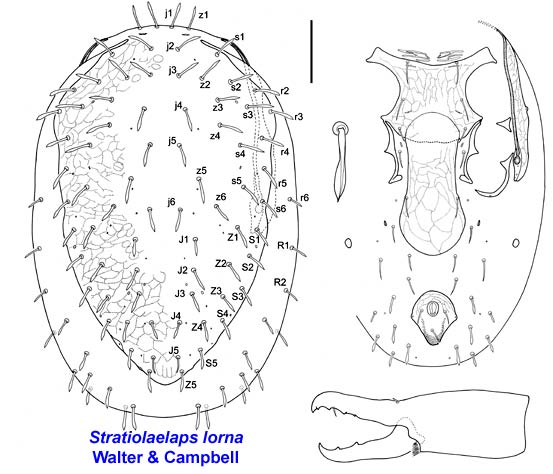
Stratiolaelaps lorna Walter & Campbell
Superorder Parasitiformes » Order Mesostigmata » Suborder Monogynaspida » Infraorder Gamasina » Hyporder Dermanyssiae » Superfamily Dermanyssoidea » Family Laelapidae » Subfamily Hypoaspidinae » Tribe Pseudoparasitini » Genus Stratiolaelaps » Species Stratiolaelaps lorna
Miles-group species (posterior margin of sternal shield convex or with median process, gnathotectum without lateral processes) with short dorsal shield setae, setae J4 and Z4 subequal to J5, and postanal seta, r6 seta, and most dorsal setae on femora and genua II and IV simple.
Fixed digit of chelicera with 2 teeth anterior to pilus dentilis, followed by serrate region; margin of gnathotectum denticulate, with longer median and lateral processes; posterior margin of sternal shield concave.............................. lamington group (2)
- Fixed digit of chelicera with 2 teeth to either side of pilus dentilis; margin of gnathotectum denticulate, with single, smooth median process; posterior margin of sternal shield irregularly convex or produced medially.............................. miles group (3)
Dorsal shield with 39 pairs of spatulate-mucronate setae, paired accessory setae px2, px3 present; postanal seta and marginal setae r6 and R1 spatulate..............................S. lamington
- Dorsal shield with 37 pairs of spatulate-acuminate setae, paired accessory px setae absent; postanal seta and marginal setae r6 and R1 acicular.............................. S. womersleyi
Most dorsal shield setae relatively short, tips not exceeding next seta in series; setae J4 and J5 subequal, Z5 20–40% longer.............................. 4
- Most dorsal shield setae relatively long (e.g., all podonotal setae except z1 are 51–65 µm), tips approaching or passing insertion of next seta in series; setae J4 and Z5 much longer than J5 (50–60% and 60–100% longer, respectively).............................. S. marilyn
Setae r6 similar toothers; dorsal setae of femora and genua of legs II and IV mostly spatulate; dorsal shield 585–690 µm long; fixed digit of male chelicera with one tooth posterior to pilus dentilis.............................. 5
- Setae r6 simple; dorsal setae of femora and genua of legs II and IV simple; dorsal shield 540–590 µm long; fixed digit of male chelicera with 3–5 teeth posterior to pilus dentilis.............................. S. lorna
Dorsal shield tapering gradually after level of setae S2; postanal seta short, only about 60% length of paranal setae; palp apotele with 2 subequal tines.............................. S. miles Evans and Till 1966Evans and Till 1966:
Evans GO, Till WM. 1966. Studies on the British Dermanyssidae (Acari: Mesostigmata). Part II. Classification. Bulletin of the British Museum (Natural History) Zoology 14: 107–370.
- Dorsal shield tapering sharply after level of setae S2; middle article of chelicera >260 µm long; postanal and paranal setae subequal in length; palp apotele with 2 subequal tines and a small basal tine.............................. S. scimitus (Womersley)
Species of Stratiolaelaps are predatory and some are used in greenhouses against thrips and fungus gnats; S. lorna was collected from a tree hollow used as a nest by possums and gliders in eastern Australia.
Author: David E. Walter
Content last updated Sept. 2006, unless indicated otherwise
Lucid key player updated Sept. 2025
idtools.org