t
Digamasellidae Evans, 1957
Dendrolaelapinae sensu Shcherbak 1980 and Karg 1993Karg 1993:
Karg W. 1993. Acari (Acarina), Milben Parasitiformes (Anactinochaeta) Cohors Gamasina Leach, Raubmilben. Die Tierwelt Deutschlands 59: 1–523.
Superorder Parasitiformes » Order Mesostigmata » Suborder Monogynaspida » Infraorder Gamasina » Hyporder Dermanyssiae » Superfamily Rhodacaroidea » Family Digamasellidae
Body extremely narrow and elongate, length 2.5–4 times width; trochanter III with 4 setae.............................. Longoseius
- Body subrectangular to oval in shape; trochanter III with 5 setae.............................. 2
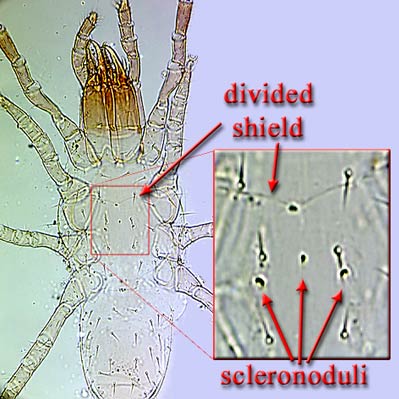
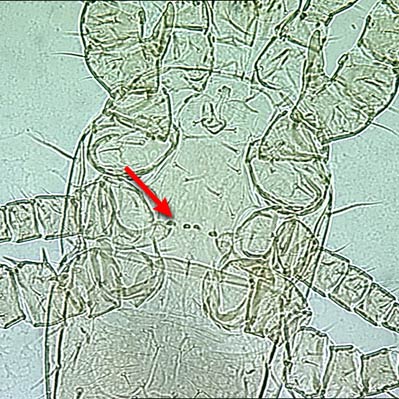
Scleronoduli present under podonotal shield between setae z5; anal opening normal; seta z3 present on podonotal shield.............................. 3
- Scleronoduli absent; anal opening large; seta z3 absent from podonotal shield.............................. Digamasellus
Movable digit of female usually with 4 or more teeth; subcapitulum with 5 rows of denticles.............................. 4
- Movable digit of female with 3 teeth; subcapitulum with 6 rows of denticles.............................. Dendroseius
Opisthonotal shield truncate or bilobed posteriorly and often with several pairs of spatulate setae; setae j2 inserted well behind setae j1–z1 on podonotal shield.............................. Dendrolaelaspis
- Opisthonotal shield convex posteriorly and usually notched anteriorly; setae j2 more or less aligned with j1–z1 on podonotal shield.............................. Dendrolaelaps
Tan, pink to reddish dermanyssine mesostigmatans with subequal podonotal (18–23 pairs of setae) and opisthonotal (15–19 pairs of setae) shields, the latter sometimes with horn-like processes; 2 pairs of scleronoduli often present. Peritremes short or long. Female with entire sternal shield bearing 4 pairs of setae (st1–4) (st4 in soft cuticle in Longoseius) and 3 pairs of lyrifissures (stp1–2), anterior region usually +/- membranous; metasternal shields absent; genital shield usually trapezoidal to subrectangular and bearing 1 pair of setae; ventrianal shield broad, bearing 2–6 pairs of ventral setae and 3 circumanal setae, sometimes fused to opisthonotal shield; anal opening sometimes enlarged (Digamasellus). Tarsus I with claws; trochanter I with 6 setae; tibia and genu I each with 5/3 dorsal/ventral setae; genu IV with 7 setae, 4/1 dorsal/ventral. Chelicerae chelate-dentate to serrate; movable digit without excrescences. Palp genu with 6 setae, palp apotele 2-tined; corniculi horn-like (forked in some males). Tritosternum biflagellate with columnar base. Tectum with 2 subequal lateral tines and usually a median prong originating from the underside. Female sperm induction pores on legs III or IV or at their bases. Males with genital opening at base of tritosternum in sternogenital shield with st5 on separate or partially detached subtriangular plates; spermatodactyl usually S-shaped.
Digamasellids are small mites that resemble some Rhodacaridae and Ascidae. Rhodacarids retain the 6/4 dorsal/ventral setation of tibia I, but Digamasellidae have 5/3 (as well as other reductions) and a distinctive tectum with a subdorsal median tine. Ascine (e.g., Asca, Protogamasellus, Gamasellodes) and arctoseiine (e.g., Arctoseius) ascids also have 3 ventral setae on tibia I, but only 3 pairs of setae on their sternal shields, and lack an elongate median tine on their tecta.
Arthrodial process simple.............................. 4
- Arthrodial process produced as a brush.............................. 2
Basitarsus IV with 4 setae (pl4 present).............................. Pararhodacarus
- Basitarsus IV with 3 setae (pl4 absent).............................. 3
Tectum with single median process or dentate.............................. Afrogamasellus
- Tectum with median stalk y-shaped, usually with lateral tines.............................. Afrodacarellus
Scleronoduli present.............................. 5
- Scleronoduli absent.............................. 10
Tibia I with 4 ventral setae; palp apotele 3-tined.............................. 6
- Tibia I with 3 ventral setae; palp apotele 2-tined.............................. 9
3 scleronoduli (median unpaired); j1–2, z1, and s1 on anterior margin of podonotal shield.............................. 7
- 4 scleronoduli (median pair +/- fused); j1 (but not j2), z1 and s1 on anterior margin of shield.............................. 8
Pretarsus I absent; without presternal platelets.............................. Rhodacarus (+Mediorhodacarus)
- Pretarsus I present; with 2 pairs of presternal platelets.............................. Rhodacaropsis
Podonotal shield entire.............................. Rhodacarellus
- Podonotal shield divided between setae j3–j4; tectum denticulate-trifurcate.............................. Minirhodacarellus
Tibia I with 5 (rarely 4) dorsal setae; 2 pairs of scleronoduli; sternal shield with 4 pairs of setae; anal opening normal.............................. Dendrolaelaps (Digamasellidae)
- Tibia I with 6 dorsal setae; 3 scleronoduli; sternal shield with 3 pairs of setae (st4 in soft cuticle); anal opening enlarged.............................. Protogamasellus mica Group (Ascidae)
Sternal seta st4 on sternal shield.............................. 11
- Sternal seta st4 in soft cuticle.............................. 15
Anal opening large; tibia I with 5 dorsal setae.............................. Digamasellus (Digamasellidae)
- Anal opening normal; tibia I with 6 dorsal setae.............................. 12
Sternal shield strongly sclerotized throughout; tibia I with 4 ventral setae.............................. Geogamasus (Ologamasidae)
- Anterior region of sternal shield poorly sclerotized, setae st1 in soft or granulate cuticle; tibia I with 3 ventral setae.............................. 13
Palp apotele 2-tined; coxa I without dorsal spine .............................. 15
- Palpapotele 3-tined: coxa I with dorsal spine.............................. 14
Presternal area granulate.............................. Protogamasellopsis
- Presternal area with paired stacks of 4 presternal platelets.............................. Rhodacarella
Posterior margin of podonotal (at j6) and anterior margin of opisthonotal (at J1) shields with transverse lines; genu IV with 8 setae, tibia IV with 9 setae.............................. Protogamasellus hibernicus Group (Ascidae)
- Podonotal and opisthonotal shields without transverse lines; genu IV with 9 setae, tibia IV with 10 setae.............................. Gamasellodes (Ascidae)
Author: David E. Walter
Content last updated Sept. 2006, unless indicated otherwise
Lucid key player updated Sept. 2025
idtools.org