Ophionyssus

Mesostigmata

t

Taxonomy

updated 2025

Name

Ophionyssus Mégnin

Classification

Superorder Parasitiformes » Order Mesostigmata » Suborder Monogynaspida » Infraorder Gamasina » Hyporder Dermanyssiae » Superfamily Dermanyssoidea » Family Macronyssidae » Genus Ophionyssus

Children

Ophionyssus natricis Gervais—the snake mite

Diagnostic characters

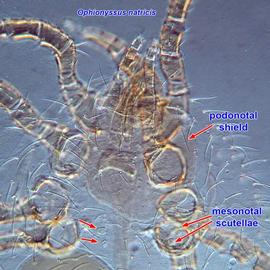
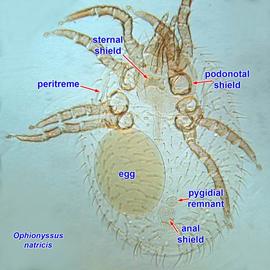
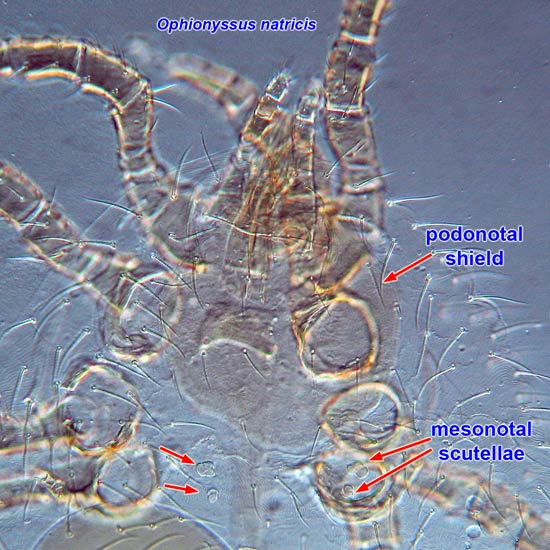
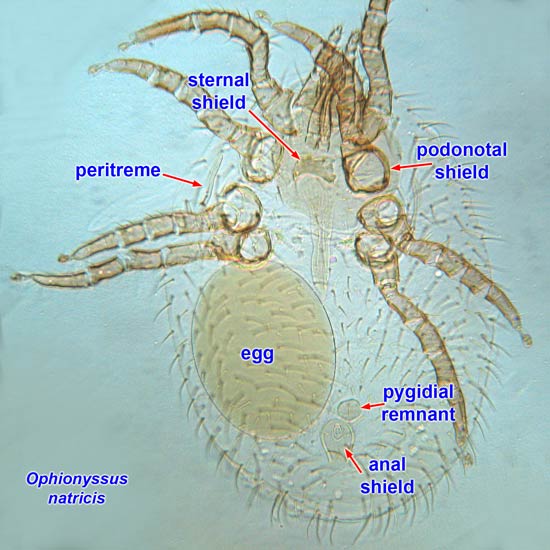
  • Grey-brown to red (when blood engorged) or black parasitic dermanyssine mesostigmatans with a truncate dorsal shield covering the podonotal region and two pairs of small scutellae in the mesonotal region and a small, subcircular pygidial shield
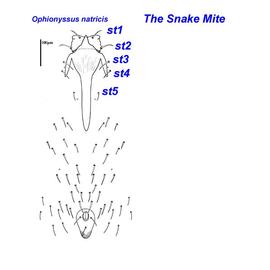
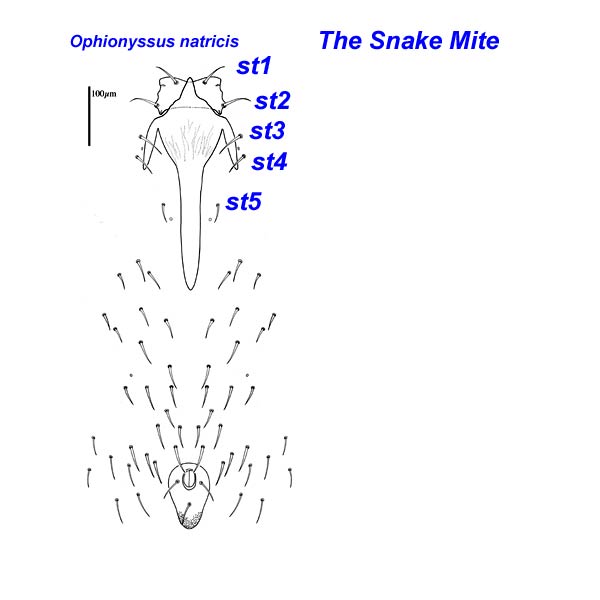
  • Sternal shield entire to eroded sternal shield bearing 2 pairs of setae
  • Genital shield dagger-shaped, nude
  • st3–5 in soft cuticle
  • Anal shield small, with 3 circumanal setae
  • Some ventral and lateral hypertrichy present
  • Chelicerae elongate and edentate stylets
  • Palp genu with 6 setae, palp apotele 2-tined; corniculi membranous.
  • Tritosternum biflagellate with denticulate membranous margin
  • Dorsal shield truncate, opisthonotum exposed

Similar taxa

Laelapid mites are similar, but lack the expanded margins of the tritosternal laciniae and usually have well developed corniculi (horn- to bayonet-shaped). Species of Macronyssus have more extensive dorsal shields.

Similar taxa not in key. Five other families of Mesostigmata are found on reptiles, but none have the dorsal shielding reduced to a podonotal shield. Members of three other families of Dermanyssoidea have been described from reptiles: Entonyssidae (in respiratory tract; lightly sclerotized; peritremes absent), Omentolaelapidae (body reniform, venter with a fringe of flattened setae), and Ixodorhynichidae (entire or incised dorsal shield; palp apotele reduced, 1-tined). Several kinds of trigynaspid mites (with several genital shields) also are associated with snakes and large lizards, especially species of Ophiomegistus and Ophiocelaeno.

Ecology and distribution

The snake mite, Ophionyssus natricis, is a major pest in zoos and has spread to wild snakes and skinks.

References

  • Domrow 1988Domrow 1988:
    Domrow R. 1988. Acari Mesostigmata parasitic on Australian vertebrates: An annotated checklist, keys and bibliography. Invertebrate Taxonomy 1: 817–948.
  • Evans and Till 1979Evans and Till 1979:
    Evans EO, Till WM. 1979. Mesostigmatic mites of Britain and Ireland (Chelicerata: Acari-Parasitiformes): An introduction to their external morphology and classification. Transactions of the Zoological Society of London 35 (2): 145–270.
  • Krantz 1978Krantz 1978:
    Krantz GW. 1978. A manual of acarology [2nd ed.]. Oregon State University Book Stores, Corvallis.
 Ophionyssus natricis
Ophionyssus natricis
 Ophionyssus natricis  podonotal region
Ophionyssus natricis podonotal region
 Ophionyssus natricis  gravid female
Ophionyssus natricis gravid female