Asca

Mesostigmata

t

Taxonomy

updated 2025

Name

Asca von Heyden

Classification

Superorder Parasitiformes » Order Mesostigmata » Suborder Monogynaspida » Infraorder Gamasina » Hyporder Dermanyssiae » Superfamily Ascoidea » Family Ascidae » Subfamily Arctoseiinae » Genus Asca

Diagnostic characters

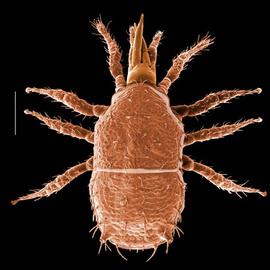
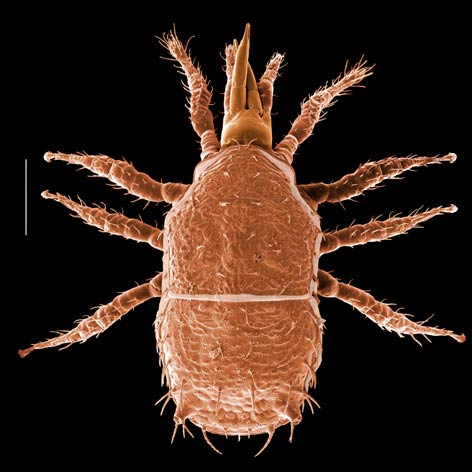
  • Completely divided dorsal shield
  • Opisthonotal shield bearing setae Z4 and S5 usually approximate and inserted together on pair of prominent posterolateral tubercles
  • Podonotal shield lacking setae z1, and with j2 well behind level of j1
  • Peritrematal shields of adults broad, truncate posteriorly; genu I with 12 setae (av2 absent).

Similar taxa

Antennoseius Berlese, Ectoantennoseius Walter, Gamasellodes Athias-Henriot, Protogamasellus Karg, and Diseius Lindquist and Evans lack horns. Some Digamasellidae have horns, but also have sternal shields bearing setae st4.

Key to genera in the subfamily Ascinae

  1. With holodorsal shield that captures the R-series.............................. 2
    - Dorsal shield divided into two subequal shields; R-series setae in softcuticle.............................. 3

  2. Seta z1 present laterad seta j1 on anterior median region of dorsal shield; femur III with 7 setae; genu I with 13 setae; tibia II with 10 setae.............................. Orthadenella (Blattisociidae)
    - Seta z1 absent; femur III with 6 setae; genu I with 12 setae; tibia II with 9 setae.............................. Neojordensia

  3. Opisthonotal shield with 12 pairs of setae (J3, Z2, S1 absent); podonotal shield lacking setae j2, z1, z3; adult leg setation strongly neotenous, genua I–II–III–IV with 11–8–7–7 setae, tibiae with 11–7–7–7 setae; female with anal shield.............................. Diseius
    - Opisthonotal shield with 15 or more pairs of setae (J3, Z2, S1 present); podonotal shield with setae j2, z3, sometimes z1; adult leg setation not strongly neotenous, minimum number of setae on genua 12–11–8–8, on tibiae 13–10–8–9; female with anal or ventrianal shield.............................. 4

  4. Hypostome with corniculi bifid apically; anterior rostral setae thickened, spinelike; dorsal shield setae z1 absent.............................. Anephiasca
    - Hypostome with corniculi entire apically; anterior rostral setae of similar thickness to other hypostomal setae; dorsal shield setae z1 present or absent.............................. 5

  5. Female with epigynial shield strongly rounded posteriorly and with small subtriangular ventrianal or anal shield bearing 3–5 setae; male with ventrianal shield united to peritrematal shields; soft body cuticle often with microtuberculate striae.............................. 6
    - Female with epigynial shield truncate posteriorly and usually with well developed ventrianal shield (rarely anal shield) bearing 3–9 setae (including circumanal setae); male with ventrianal shield separate from peritrematal shields; soft body cuticle striae without microtubercles.............................. 8

  6. Palps elongated, at least half as long as leg I; palp trochanter longer than femur; palp tibia almost 3 times as long as tarsus.............................. Anystipalpus
    - Palps of normal length, about one-third as long as leg I; palp trochanter slightly shorter than femur; palp tibia twice as long as tarsus.............................. 7

  7. Legs I with ambulacra and claws.............................. Antennoseius (Vitzthumia)
    - Legs I without ambulacra and claws.............................. Antennoseius (Antennoseius)

  8. Opisthonotal shield with setae Z4 & S5 usually approximate and inserted together on pair of prominent posterolateral tubercles; podonotal shield lacking setae z1,  j2 well behind level of j1; peritrematal shields of adults broad, truncate posteriorly; genu I with 12 setae (av2 absent).............................. Asca
    - Opisthonotal shield with setae Z4, S5 well separated, not borne on pair of strong tubercles; podonotal shield with setae z1 present; j2 tending to be displaced anteriorly, often in approximately transverse row with z1 and j1; peritrematal shields of adults narrow or of moderate width, tapering posteriorly; genu I with 13 setae (av2 present).............................. 9

  9. Podonotal shield with transverse line extending across surface at level of setae z6, opisthonotal shield with similar line at level of setae J1; paranal setae inserted close to anterior margin of anus; genu IV with 8 setae (pl1 absent); tibia IV with 9 setae (pl2 absent).............................. Protogamasellus
    - Dorsal shields without transverse lines extending completely across surface; paranal setae inserted closer to posterior margin of anus than to anterior margin; genu IV with 9 setae (pl1 present); tibia IV with 10 setae (pl2 present).............................. 10

  10. Sternal pore 3 in soft cuticle; setae r3 and Z5 club-shaped, densely plumose; gnathotectum denticulate; movable digit of chelicerae serrate.............................. Ectoantennoseius
    - Sternal pore 3 on sternal shield; setae r3 and Z5 setiform, smooth to barbed; gnathotectum more or less smoothly trifurcate; movable digit of chelicerae usually with 4–6 teeth, not serrate.............................. Gamasellodes

References

  • Athias-Henriot 1969Athias-Henriot 1969:
    Athias-Henriot C. 1969. Gamasides Chiliens (Acariens Anactinotriches). I - Genre Anephiasca n. g. (Ascidae). Revista de Biologia 7: 123–149.
  • Champ 1966Champ 1966:
    Champ BR. 1966. Insects and mites associated with stored products in Queensland: 4. Acarina and Pseudoscorpiones. Queensland Journal of Agricultural and Animal Sciences 23: 197–210.
  • Evans and Till 1979Evans and Till 1979:
    Evans EO, Till WM. 1979. Mesostigmatic mites of Britain and Ireland (Chelicerata: Acari-Parasitiformes): An introduction to their external morphology and classification. Transactions of the Zoological Society of London 35 (2): 145–270.
  • Halliday et al. 1998Halliday et al. 1998:
    Halliday RB, Walter DE, Lindquist EE. 1998. Revision of the Australian Ascidae (Acarina: Mesostigmata). Invertebrate Taxonomy 12: 1–54.
  • Hurlbutt 1963Hurlbutt 1963:
    Hurlbutt HW. 1963. The genus Asca von Heyden (Acarina: Mesostigmata) in North America, Hawaii and Europe. Acarologia 5: 480–518.
  • Karg 1993Karg 1993:
    Karg W. 1993. Acari (Acarina), Milben Parasitiformes (Anactinochaeta) Cohors Gamasina Leach, Raubmilben. Die Tierwelt Deutschlands 59: 1–523.
  • Kinnear 1991Kinnear 1991:
    Kinnear A. 1991. Acarine communities of semi-arid soils from the Eastern Goldfields region of Western Australia. Pedobiologia 35: 273–83.
  • Kitching and Callaghan 1982Kitching and Callaghan 1982:
    Kitching RL, Callaghan C. 1982. The fauna of water-filled tree holes in box forest in south-east Queensland. Australian Entomological Magazine 8: 61–70.
  • Krantz 1962Krantz 1962:
    Krantz GW. 1962. Acari. Free-living Mesostigmata. II. The family Aceosejidae. Parc National de la Garamba - Mission H. de Saeger 34: 3–29.
  • Krantz 1986Krantz 1986:
    Krantz GW. 1986. A manual of acarology [2nd ed., emended 1986]. Oregon State University Book Stores, Corvallis.
  • Krantz and Ainscough 1990Krantz and Ainscough 1990:
    Krantz GW, Ainscough B. 1990. Mesostigmata. pp. 583–665. In: Dindal DL, ed. Soil biology guide. John Wiley & Sons, Brisbane.
  • Lindquist 1963Lindquist 1963:
    Lindquist EE. 1963. A taxonomic review of the genus Hoploseius Berlese (Acarina: Blattisocidae). The Canadian Entomologist 95: 1175–85.
  • Lindquist and Chant 1964Lindquist and Chant 1964:
    Lindquist EE, Chant DA. 1964. A redescription of Aceodromus Muma and its transfer to the Blattisociinae (Acarina: Blattisociidae). The Canadian Entomologist 96: 500–7.
  • Lindquist and Evans 1965Lindquist and Evans 1965:
    Lindquist EE, Evans GO. 1965. Taxonomic concepts in the Ascidae, with a modified setal nomenclature for the idiosoma of the Gamasina (Acarina: Mesostigmata). Memoirs of the Entomological Society of Canada 47: 1–64
  • Lindquist and Walter 1989Lindquist and Walter 1989:
    Lindquist EE, Walter DE. 1989. Biology and description of Antennoseius janus, new species (Mesostigmata: Ascidae), a mesostigmatic mite exhibiting adult female dimorphism. Canadian Journal of Zoology 67: 1291–1310.
  • Walter 1987Walter 1987:
    Walter DE. 1987. Life history, trophic behavior and description of Gamasellodes vermivorax n. sp. (Mesostigmata: Ascidae) a predator of nematodes and arthropods in semiarid grasslands. Canadian Journal of Zoology 65: 1689–1695.
  • Walter 1998aWalter 1998a:
    Walter DE. 1998a. Ectoantennoseius kitchingi, n. gen., n. sp. (Acari: Mesostigmata: Ascidae) from the rainforest canopy in Australia and a cladistic hypothesis about its relationships. International Journal of Acarology 24: 45–51.
  • Walter 1998bWalter 1998b:
    Walter DE. 1998b. Hoploseius australianus, sp. nov. (Acari: Mesostigmata: Ascidae), a unique element in the Australian acarofauna. The Australian Entomologist 25: 69–74.
  • Walter et al. 1993Walter et al. 1993:
    Walter DE, Halliday RB, Lindquist EE. 1993. A review of the genus Asca (Acarina: Ascidae) in Australia, with the description of three new leaf-inhabiting species. Invertebrate Taxonomy 7: 1327–1347.  
  • Walter and Ikonen 1989Walter and Ikonen 1989:
    Walter DE, Ikonen EK. 1989. Species, guilds and functional groups: Taxonomy and behavior in nematophagous arthropods. Journal of Nematology 21: 315–327.
  • Walter and Lindquist 1989Walter and Lindquist 1989:
    Walter DE, Lindquist EE. 1989. Life history and behavior of ascid mites in the genus Lasioseius (Acari: Mesostigmata) from grassland soils in Colorado with taxonomic notes and a description of new species. Canadian Journal of Zoology 67: 2797–2813.
  • Walter and Lindquist 1997Walter and Lindquist 1997:
    Walter DE, Lindquist EE. 1997. Australian species of Lasioseius (Acari: Mesostigmata: Ascidae): the porulosus group and other species from rainforest canopies. Invertebrate Taxonomy 11: 525–547.
  • Walter and Lindquist 2000Walter and Lindquist 2000:
    Walter DE, Lindquist EE. 2000. Arrhenoseius gloriosus n. g., n. sp. (Acari: Mesostigmata: Ascidae), an arrhenotokous mite from rainforests in Queensland, Australia. Acarologia 41: 53–68.
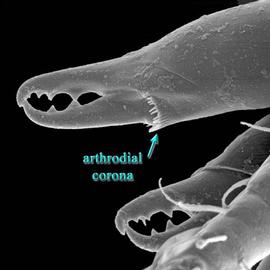
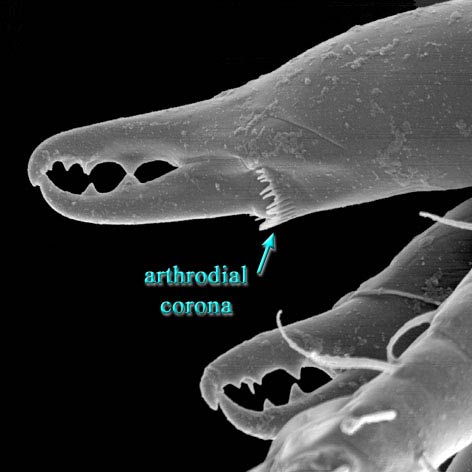
 Asca  female chelicerae
Asca female chelicerae
 Asca  dorsal habitus
Asca dorsal habitus
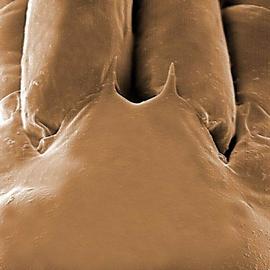
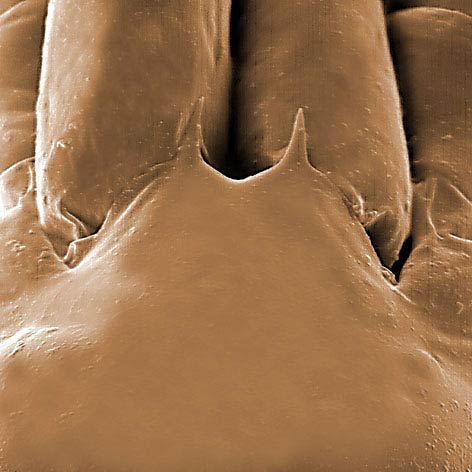
 Asca  bifurcate tectum
Asca bifurcate tectum
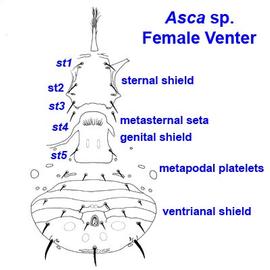
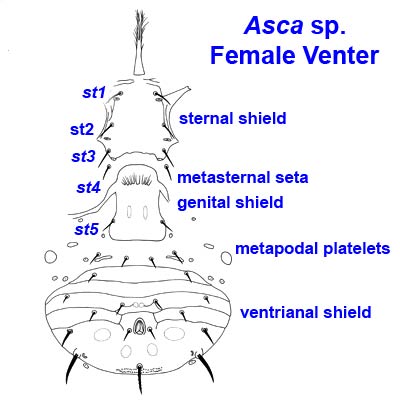
 Asca  sp. female venter
Asca sp. female venter