t
Protogamasellus Karg - mica (=primitivus) species group
Superorder Parasitiformes » Order Mesostigmata » Suborder Monogynaspida » Infraorder Gamasina » Hyporder Dermanyssiae » Superfamily Rhodacaroidea » Family Rhodacaridae » Genus Protogamasellus » Species Protogamasellus mica Group
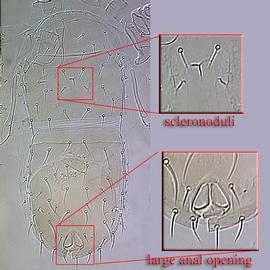
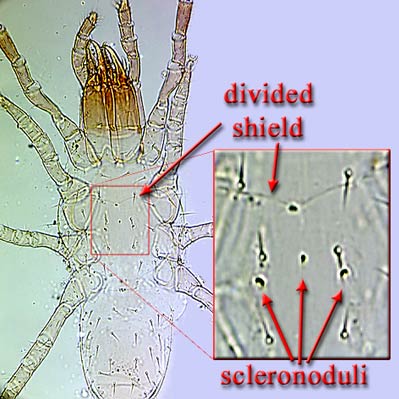
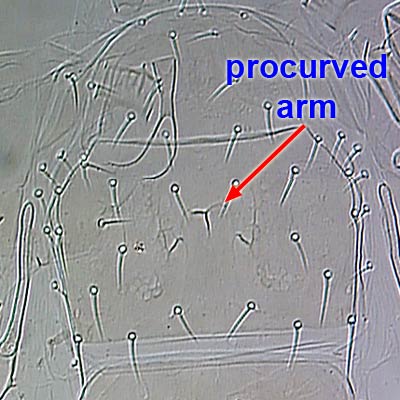
Species in the Protogamasellus hibernicus species group have chelate-dentate chelicerae without the serrate-membranous formation, a normal anal opening, and lack scleronoduli. Members of the hibernicus group and Ectoantennoseius Walter, Gamasellodes Athias-Henriot, Asca von Heyden, Antennoseius Berlese all lack scleronoduli.
Arthrodial process simple.............................. 4
- Arthrodial process produced as a brush.............................. 2
Basitarsus IV with 4 setae (pl4 present).............................. Pararhodacarus
- Basitarsus IV with 3 setae (pl4 absent).............................. 3
Tectum with single median process or dentate.............................. Afrogamasellus
- Tectum with median stalk y-shaped, usually with lateral tines.............................. Afrodacarellus
Scleronoduli present.............................. 5
- Scleronoduli absent.............................. 10
Tibia I with 4 ventral setae; palp apotele 3-tined.............................. 6
- Tibia I with 3 ventral setae; palp apotele 2-tined.............................. 9
3 scleronoduli (median unpaired); j1–2, z1, and s1 on anterior margin of podonotal shield.............................. 7
- 4 scleronoduli (median pair +/- fused); j1 (but not j2), z1 and s1 on anterior margin of shield.............................. 8
Pretarsus I absent; without presternal platelets.............................. Rhodacarus (+Mediorhodacarus)
- Pretarsus I present; with 2 pairs of presternal platelets.............................. Rhodacaropsis
Podonotal shield entire.............................. Rhodacarellus
- Podonotal shield divided between setae j3–j4; tectum denticulate-trifurcate.............................. Minirhodacarellus
Tibia I with 5 (rarely 4) dorsal setae; 2 pairs of scleronoduli; sternal shield with 4 pairs of setae; anal opening normal.............................. Dendrolaelaps (Digamasellidae)
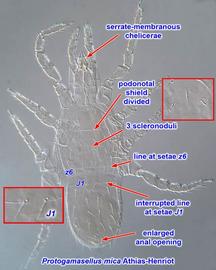
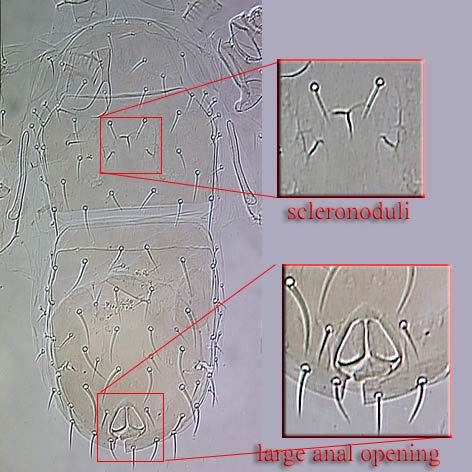
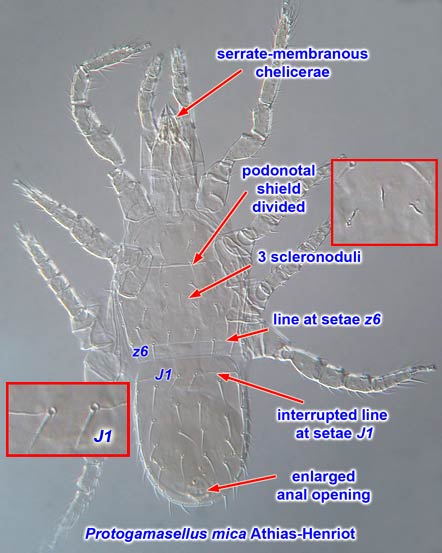
- Tibia I with 6 dorsal setae; 3 scleronoduli; sternal shield with 3 pairs of setae (st4 in soft cuticle); anal opening enlarged.............................. Protogamasellus mica Group (Ascidae)
Sternal seta st4 on sternal shield.............................. 11
- Sternal seta st4 in soft cuticle.............................. 15
Anal opening large; tibia I with 5 dorsal setae.............................. Digamasellus (Digamasellidae)
- Anal opening normal; tibia I with 6 dorsal setae.............................. 12
Sternal shield strongly sclerotized throughout; tibia I with 4 ventral setae.............................. Geogamasus (Ologamasidae)
- Anterior region of sternal shield poorly sclerotized, setae st1 in soft or granulate cuticle; tibia I with 3 ventral setae.............................. 13
Palp apotele 2-tined; coxa I without dorsal spine .............................. 15
- Palpapotele 3-tined: coxa I with dorsal spine.............................. 14
Presternal area granulate.............................. Protogamasellopsis
- Presternal area with paired stacks of 4 presternal platelets.............................. Rhodacarella
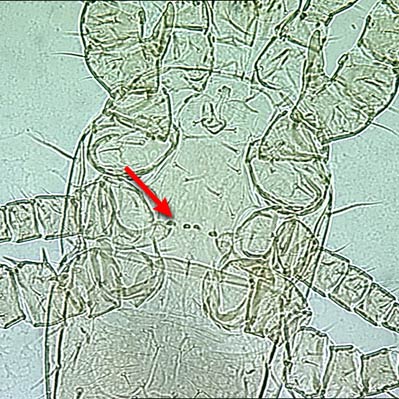
Posterior margin of podonotal (at j6) and anterior margin of opisthonotal (at J1) shields with transverse lines; genu IV with 8 setae, tibia IV with 9 setae.............................. Protogamasellus hibernicus Group (Ascidae)
- Podonotal and opisthonotal shields without transverse lines; genu IV with 9 setae, tibia IV with 10 setae.............................. Gamasellodes (Ascidae)
With holodorsal shield that captures the R-series.............................. 2
- Dorsal shield divided into two subequal shields; R-series setae in softcuticle.............................. 3
Seta z1 present laterad seta j1 on anterior median region of dorsal shield; femur III with 7 setae; genu I with 13 setae; tibia II with 10 setae.............................. Orthadenella (Blattisociidae)
- Seta z1 absent; femur III with 6 setae; genu I with 12 setae; tibia II with 9 setae.............................. Neojordensia
Opisthonotal shield with 12 pairs of setae (J3, Z2, S1 absent); podonotal shield lacking setae j2, z1, z3; adult leg setation strongly neotenous, genua I–II–III–IV with 11–8–7–7 setae, tibiae with 11–7–7–7 setae; female with anal shield.............................. Diseius
- Opisthonotal shield with 15 or more pairs of setae (J3, Z2, S1 present); podonotal shield with setae j2, z3, sometimes z1; adult leg setation not strongly neotenous, minimum number of setae on genua 12–11–8–8, on tibiae 13–10–8–9; female with anal or ventrianal shield.............................. 4
Hypostome with corniculi bifid apically; anterior rostral setae thickened, spinelike; dorsal shield setae z1 absent.............................. Anephiasca
- Hypostome with corniculi entire apically; anterior rostral setae of similar thickness to other hypostomal setae; dorsal shield setae z1 present or absent.............................. 5
Female with epigynial shield strongly rounded posteriorly and with small subtriangular ventrianal or anal shield bearing 3–5 setae; male with ventrianal shield united to peritrematal shields; soft body cuticle often with microtuberculate striae.............................. 6
- Female with epigynial shield truncate posteriorly and usually with well developed ventrianal shield (rarely anal shield) bearing 3–9 setae (including circumanal setae); male with ventrianal shield separate from peritrematal shields; soft body cuticle striae without microtubercles.............................. 8
Palps elongated, at least half as long as leg I; palp trochanter longer than femur; palp tibia almost 3 times as long as tarsus.............................. Anystipalpus
- Palps of normal length, about one-third as long as leg I; palp trochanter slightly shorter than femur; palp tibia twice as long as tarsus.............................. 7
Legs I with ambulacra and claws.............................. Antennoseius (Vitzthumia)
- Legs I without ambulacra and claws.............................. Antennoseius (Antennoseius)
Opisthonotal shield with setae Z4 & S5 usually approximate and inserted together on pair of prominent posterolateral tubercles; podonotal shield lacking setae z1, j2 well behind level of j1; peritrematal shields of adults broad, truncate posteriorly; genu I with 12 setae (av2 absent).............................. Asca
- Opisthonotal shield with setae Z4, S5 well separated, not borne on pair of strong tubercles; podonotal shield with setae z1 present; j2 tending to be displaced anteriorly, often in approximately transverse row with z1 and j1; peritrematal shields of adults narrow or of moderate width, tapering posteriorly; genu I with 13 setae (av2 present).............................. 9
Podonotal shield with transverse line extending across surface at level of setae z6, opisthonotal shield with similar line at level of setae J1; paranal setae inserted close to anterior margin of anus; genu IV with 8 setae (pl1 absent); tibia IV with 9 setae (pl2 absent).............................. Protogamasellus
- Dorsal shields without transverse lines extending completely across surface; paranal setae inserted closer to posterior margin of anus than to anterior margin; genu IV with 9 setae (pl1 present); tibia IV with 10 setae (pl2 present).............................. 10
Sternal pore 3 in soft cuticle; setae r3 and Z5 club-shaped, densely plumose; gnathotectum denticulate; movable digit of chelicerae serrate.............................. Ectoantennoseius
- Sternal pore 3 on sternal shield; setae r3 and Z5 setiform, smooth to barbed; gnathotectum more or less smoothly trifurcate; movable digit of chelicerae usually with 4–6 teeth, not serrate.............................. Gamasellodes
Author: David E. Walter
Content last updated Sept. 2006, unless indicated otherwise
Lucid key player updated Sept. 2025
idtools.org