t
Iphidozercon Berlese
Superorder Parasitiformes » Order Mesostigmata » Suborder Monogynaspida » Infraorder Gamasina » Hyporder Dermanyssiae » Superfamily Ascoidea » Family Ascidae » Subfamily Arctoseiinae » Genus Iphidozercon
Similar taxa not in Lucid key (see below). Arctoseoides Willmann, Arctopsis Athias-Henriot, Leioseius Berlese
Similar taxa in key. Arctoseius Thor, Iphidozercon Berlese, Neojordensia Athias-Henriot, Xenoseius Lindquist & Evans, Zerconopsis Hull
Leg chaetotaxy reduced, maximum setation: genu II = 10, genu IV = 7, tibia III = 7, tibia IV = 7; opisthonotal region of dorsal shield usually with 4 pairs of lateral setae (S1 present, S2 usually absent); deutosternal denticular rows moderately wide, multidenticulate.............................. 2
- Leg chaetotaxy without above reductions, minimum setation: genu II = 11, genu IV = 9, tibia III = 8, tibia IV = 10; opisthonotal region of dorsal shield usually with 5 pairs of lateral setae (S2 present, S1 rarely absent); deutosternal denticular rows narrow, each with few (usually 2–6) denticles.............................. 5
Tarsi II–IV each with dorso-proximal setae ad2, pd2 elongate, curved; genu III usually with 8 setae; female with ventrianal shield bearing 1–6 pairs of ventral setae in addition to circumanal setae.............................. 3
- Tarsi II–IV with dorso-proximal setae not elongate or curved; genu III with 7 setae (pv1 absent); female with anal shield bearing only circum-anal setae (rarely with ventral setae JV3 on shield).............................. 4
Tarsus I without claws; dorsal shield setae j1 and z1 smooth, short and blunt or barbed and variable in length; other dorsal shield setae simple (J5 sometimes barbed), none paddle-shaped.............................. Xenoseius
- Tarsus I with claws; dorsal shield setae j1 and z1 smooth, pointed (j1 rarely paddle-shaped), variable in length; some dorsal shield setae (always s4 and Z5) paddle-shaped.............................. Zerconopsis
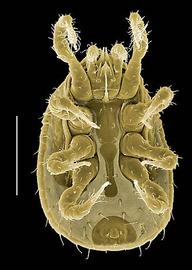
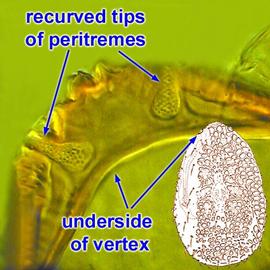
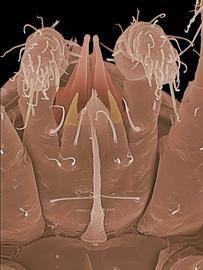
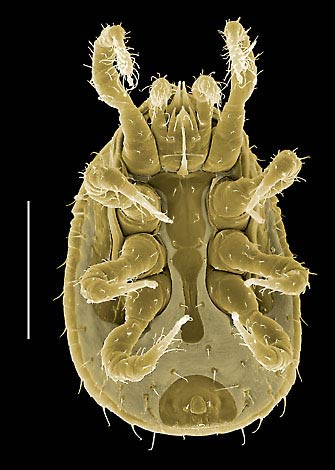
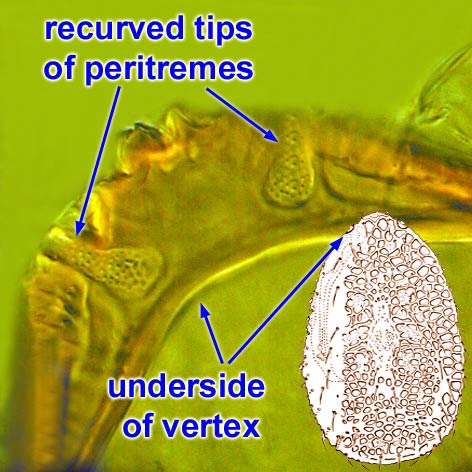
Vertex of dorsal shield strongly arched downward, setae j1 concealed from above; peritremes sharply recurved distally; dorsal shield without midlateral incisions; tarsi II-IV with 1 (al1) or 2 (al1, pl1) dorso-lateral subapical setae very slender and elongate; palp tarsus with macroseta.............................. Iphidozercon
- Vertex of dorsal shield not strongly arched downward, setae j1 visible from above; anterior extremities of peritremes not recurved; dorsal shield with or without midlateral incisions; tarsi II-IV with neither of dorso-lateral subapical setae slender and elongate; palp tarsus without macroseta.............................. Arctoseius
Dorsal shield lacking setae z1; epistome convex and smooth or slightly denticulate; genu I with 12 setae (av2 absent), tibia II with 9 setae (ad2 absent).............................. 6
- Setae z1 present; tectum bi- or triramous; genu I with 13 setae, tibia II with 10 setae.............................. 7
Dorsal shield with midlateral incisions; all r–R marginal setae on soft cuticle flanking dorsal shield; female with: first pair of sternal setae on sternal shield, genital setae and pores on soft cuticle flanking epigynial shield, anal shield bearing only circum-anal setae.............................. Arctopsis
- Dorsal shield lacking midlateral incisions; r-R marginal setae on edges of dorsal shield; female with: first pair of sternal setae on jugular plates separated from sternal shield or on margin of shield, genital setae and pores on epigynial shield, ventri-anal shield incorporating metapodal plates and bearing 4–5 pairs of setae in addition to circum-anal setae.............................. Neojordensia
Dorsal shield lacking setae z3, J2, S1; R3, R4 on dorsal shield, others (r6, R2, R5) absent; genu and tibia I each with 12 setae (av2 absent); genu III with 10 setae, tibia III with 9 setae (pl2 present on both); genu IV with 10 setae (pv1 present).............................. Arctoseoides
- Dorsal shield holotrichous, with z3, J2, S1; 10–11 pairs of marginal r–R setae on soft cuticle laterally, none on dorsal shield; genu and tibia I each with 13 setae (av2 present); genu III with 8–9 setae, tibia III with 8 setae (pl2 absent on both); genu IV with 8–9 setae (pv1 absent).............................. Leioseius
Author: David E. Walter
Content last updated Sept. 2006, unless indicated otherwise
Lucid key player updated Sept. 2025
idtools.org