t
Proctolaelaps Berlese
Proctolaelaps Berlese 1923: 255. Type species: Proctolaelaps productus Berlese, 1923, by monotypy.
Seiopsis Berlese, 1923: 255. Type species Amblyseius (Seiopsis) brevipilis Berlese, 1923, by original designation. Synonymy by Evans (1958)Evans (1958):
Evans GO. 1958. A new mite of the genus Phytoseiulus Evans (Acarina: Phytoseiidae) from Southern Rhodesia. Journal of the Entomological Society of South Africa 21: 306–308..
Jordensia Oudemans, 1936: 214. Type species Gamasus cossi Dugès, 1834, by original designation. Synonymy by Evans (1958)Evans (1958):
Evans GO. 1958. A new mite of the genus Phytoseiulus Evans (Acarina: Phytoseiidae) from Southern Rhodesia. Journal of the Entomological Society of South Africa 21: 306–308..
Chamolaelaps Hull in Turk and Turk, 1952: 482. Type species Hypoaspis hypudaei Oudemans, 1902, by original designation. Synonymy by Evans (1958)Evans (1958):
Evans GO. 1958. A new mite of the genus Phytoseiulus Evans (Acarina: Phytoseiidae) from Southern Rhodesia. Journal of the Entomological Society of South Africa 21: 306–308..
Blattilaelaps Womersley 1956: 566. Type species: Blattilaelaps nauphoetae Womersley, 1956, by original designation. Synonymy by Evans (1958)Evans (1958):
Evans GO. 1958. A new mite of the genus Phytoseiulus Evans (Acarina: Phytoseiidae) from Southern Rhodesia. Journal of the Entomological Society of South Africa 21: 306–308..
Garmaniella Westerboer, 1963: 411. Type species: Garmania (Garmaniella) longisetosa Westerboer, 1963, by original designation. Synonymy by Lindquist and Evans (1965)Lindquist and Evans (1965):
Lindquist EE, Evans GO. 1965. Taxonomic concepts in the Ascidae, with a modified setal nomenclature for the idiosoma of the Gamasina (Acarina: Mesostigmata). Memoirs of the Entomological Society of Canada 47: 1–64.
Paraproctolaelaps Bregetova, 1977: 217. Type species: Proctolaelaps intermedius Athias-Henriot, 1959, by original designation. Synonymy as a subgenus of Proctolaelaps by Karg (1985).
Proctolaelaps (Proctofissus) Karg, 1979: 6; Karg, 1985: 189, 199, unavailable name, no type species designated.
Superorder Parasitiformes » Order Mesostigmata » Suborder Monogynaspida » Infraorder Gamasina » Hyporder Dermanyssiae » Superfamily Ascoidea » Family Ascidae » Subfamily Melicharinae » Genus Proctolaelaps
More about Proctolaelaps on Bee Mite ID
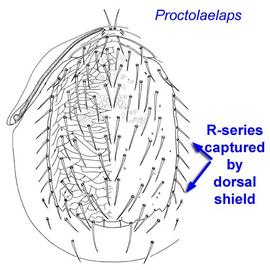
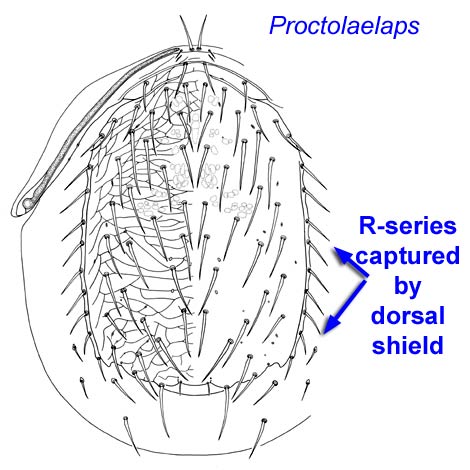
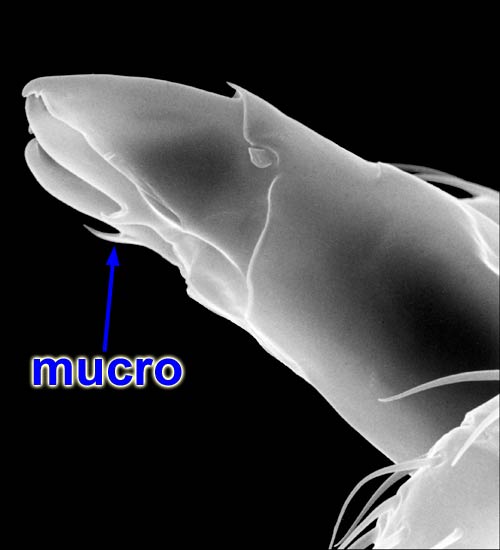
Except for Mycolaelaps, no other Melicharinae have dorsal shields that capture most of the R-series, but the Proctolaelaps hystrix group captures only R1–4 (R5–7 in soft cuticle) and is similar to Mucroseius, but lacks the distal cheliceral process. Also, species of Proctogastrolaelaps have a separate ventral shield; species of Rhinoseius, Tropicoseius, and Xanthippe has incised dorsal shields; species of Mucroseius have macrosetae on telotarsus IV and a distal process on the fixed digit; species of Melichares lack metasternal plates. Species of Neojordensia and Orthadenella capture the R -setae, but have a ventrianal shield.
Similar taxa not in the Lucid key (see below): Orolaelaps De Leon (=Proctolaelaps)
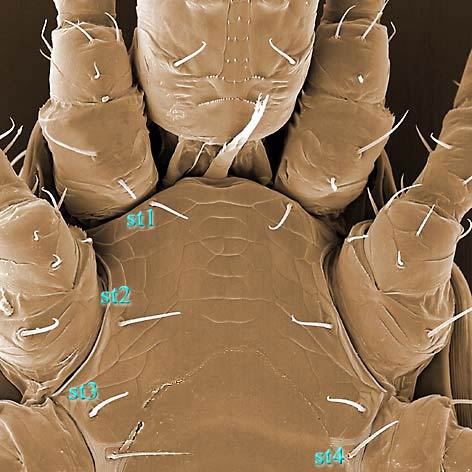
Idiosoma narrow, dorsal shield greater than twice as long as wide; leg setation strongly neotenous, genua I–II–III–IV with 12–7–6–7 setae, tibiae with 11–7–6–6 setae; female lacking metasternal plates and with ventri-anal shield bearing 1–3 pairs of ventral setae in addition to circumanal setae.............................. Mycolaelaps
- Idiosoma broader, legs not strongly neotenous, metasternal plates present or absent, only anal shield or separate anal and ventral shields.............................. 2
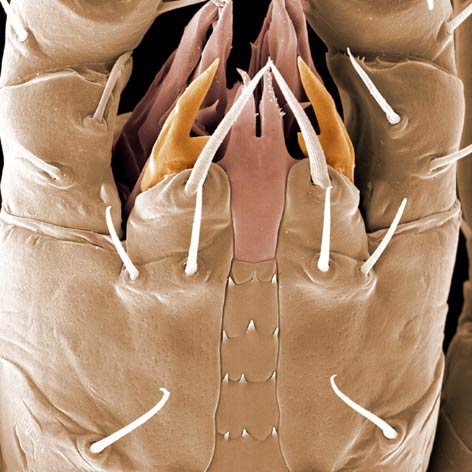
Female with separate ventral shield bearing 4 pairs of setae between genital and anal shields; posterior connection of peritrematal shield to exopodal plate beside coxa IV broad (subequal to width of stigma); corniculi slender, acute; rows of deutosternal denticles narrow, in deep trough; epistome convex, smooth; movable chela of female unidentate.............................. Proctogastrolaelaps
- Ventral area not sclerotized, only small anal shield with 3 circumanal setae present.............................. 3
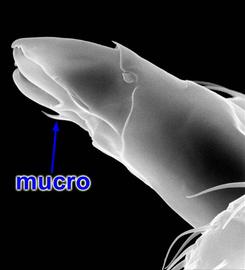
Fixed chela of female and nymphs with pointed or rounded flange-like projection distally; leg IV with 1 or 2 erect macrosetae on telotarsus (pd2, +/- ad2); 3rd pair of sternal pores absent.............................. Mucroseius
- Fixed chela without distal flange-like projection; leg IV usually without macrosetae; 3rd pair of sternal pores usually present.............................. 4
Dorsal shield of adults with pair of deep midlateral incisions, lacking setae z3 on podonotal region; movable chela with 0 or 1 tooth; female without metasternal plates.............................. 6
- Dorsal shield of adults entire, usually with setae z3 on podonotal region; movable chela with 3 teeth; with or without metasternal plates.............................. 5
Adults with 7–13 pairs of marginal (r–R) setae on soft lateral cuticle (rarely fewer if some r–R setae lacking); female with 14–15 pairs of setae on opisthonotal region of dorsal shield and lacking metasternal plates (except in Orolaelaps).............................. Melichares
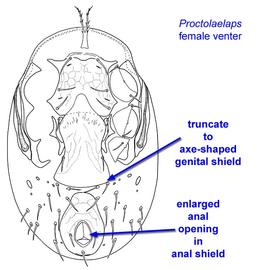
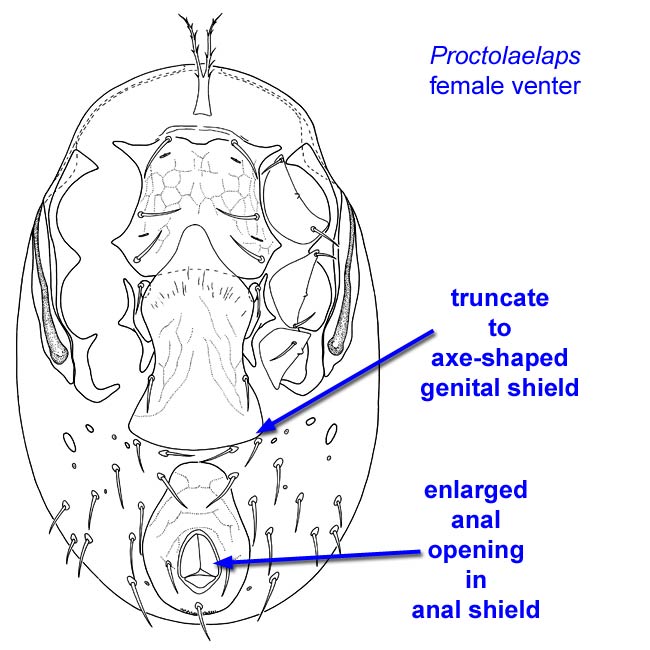
- Adults with 1–4 pairs of posterior marginal (R) setae on soft ventro-lateral cuticle, all others on edge of dorsal shield; female with 18–22 pairs of setae on opisthonotal region of dorsal shield; female usually with metasternal plates.............................. Proctolaelaps
Movable chela unidentate; female with 1st pair of sternal setae on soft cuticle in front of sternal shield; male with separate ventral & anal shields; male leg II with tarsal seta pv1 unmodified.............................. Xanthippe
- Movable chela edentate; female with first pair of sternal setae on sternal shield; male usually with consolidated ventrianal shield; male leg II with apical tarsal seta pv–1 slightly to conspicuously thickened.............................. 7
Tibiae III and IV with 9 and 10 setae respectively (pl2 present); dorsal shield with setae s6; female with hyaline anterior margin of epigynial shield rounded, and with genital setae on lateral edges of this shield; male tarsus II with seta pv–1 knob- or spine-like, and tarsus III with 1–3 setae (always av2) knob-like; male spermatodactyl directed anteriorly.............................. Tropicoseius
- Tibiae III and IV with 8 and 9 setae respectively (pl2 absent); dorsal shield lacking setae s6; female with hyaline anterior margin of epigynial shield usually truncated or emarginated, and with genital setae on soft cuticle flanking this shield; male tarsus II with seta pv1 but slightly thickened, and tarsus III without modified setae; male spermatodactyl directed posteroventrally.............................. Rhinoseius
Author: David E. Walter
Content last updated Sept. 2006, unless indicated otherwise
Lucid key player updated Sept. 2025
idtools.org