t
Mycolaelaps Lindquist
Superorder Parasitiformes » Order Mesostigmata » Suborder Monogynaspida » Infraorder Gamasina » Hyporder Dermanyssiae » Superfamily Ascoidea » Family Melicharidae » Genus Mycolaelaps
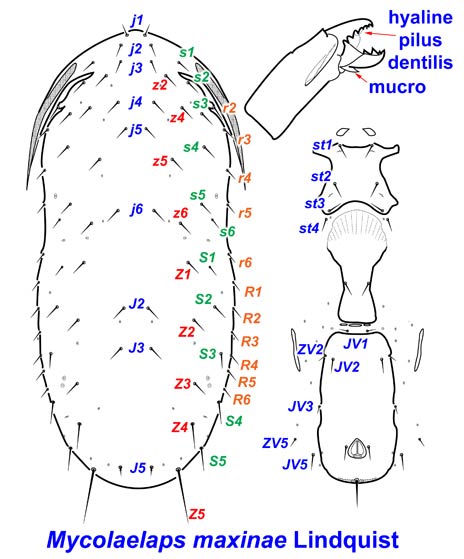
No other Melicharinae except species of Proctolaelaps have dorsal shields that capture most of the R-series. Species of Neojordensia and Orthadenella capture the R-setae, but have a ventrianal shield and a typical oval body shape. Highly elongate mesostigmatans are also found in the Digamasellidae (but have two dorsal shields) and in the genus Hoploseius: H. tenuis also lives in polypore fungi and is superficially similar to M. maxinae, but its dorsal shield does not capture the R-series.
Idiosoma narrow, dorsal shield greater than twice as long as wide; leg setation strongly neotenous, genua I–II–III–IV with 12–7–6–7 setae, tibiae with 11–7–6–6 setae; female lacking metasternal plates and with ventri-anal shield bearing 1–3 pairs of ventral setae in addition to circumanal setae.............................. Mycolaelaps
- Idiosoma broader, legs not strongly neotenous, metasternal plates present or absent, only anal shield or separate anal and ventral shields.............................. 2
Female with separate ventral shield bearing 4 pairs of setae between genital and anal shields; posterior connection of peritrematal shield to exopodal plate beside coxa IV broad (subequal to width of stigma); corniculi slender, acute; rows of deutosternal denticles narrow, in deep trough; epistome convex, smooth; movable chela of female unidentate.............................. Proctogastrolaelaps
- Ventral area not sclerotized, only small anal shield with 3 circumanal setae present.............................. 3
Fixed chela of female and nymphs with pointed or rounded flange-like projection distally; leg IV with 1 or 2 erect macrosetae on telotarsus (pd2, +/- ad2); 3rd pair of sternal pores absent.............................. Mucroseius
- Fixed chela without distal flange-like projection; leg IV usually without macrosetae; 3rd pair of sternal pores usually present.............................. 4
Dorsal shield of adults with pair of deep midlateral incisions, lacking setae z3 on podonotal region; movable chela with 0 or 1 tooth; female without metasternal plates.............................. 6
- Dorsal shield of adults entire, usually with setae z3 on podonotal region; movable chela with 3 teeth; with or without metasternal plates.............................. 5
Adults with 7–13 pairs of marginal (r–R) setae on soft lateral cuticle (rarely fewer if some r–R setae lacking); female with 14–15 pairs of setae on opisthonotal region of dorsal shield and lacking metasternal plates (except in Orolaelaps).............................. Melichares
- Adults with 1–4 pairs of posterior marginal (R) setae on soft ventro-lateral cuticle, all others on edge of dorsal shield; female with 18–22 pairs of setae on opisthonotal region of dorsal shield; female usually with metasternal plates.............................. Proctolaelaps
Movable chela unidentate; female with 1st pair of sternal setae on soft cuticle in front of sternal shield; male with separate ventral & anal shields; male leg II with tarsal seta pv1 unmodified.............................. Xanthippe
- Movable chela edentate; female with first pair of sternal setae on sternal shield; male usually with consolidated ventrianal shield; male leg II with apical tarsal seta pv-1 slightly to conspicuously thickened.............................. 7
Tibiae III and IV with 9 and 10 setae respectively (pl2 present); dorsal shield with setae s6; female with hyaline anterior margin of epigynial shield rounded, and with genital setae on lateral edges of this shield; male tarsus II with seta pv–1 knob- or spine-like, and tarsus III with 1–3 setae (always av2) knob-like; male spermatodactyl directed anteriorly.............................. Tropicoseius
- Tibiae III and IV with 8 and 9 setae respectively (pl2 absent); dorsal shield lacking setae s6; female with hyaline anterior margin of epigynial shield usually truncated or emarginated, and with genital setae on soft cuticle flanking this shield; male tarsus II with seta pv1 but slightly thickened, and tarsus III without modified setae; male spermatodactyl directed posteroventrally.............................. Rhinoseius
Author: David E. Walter
Content last updated Sept. 2006, unless indicated otherwise
Lucid key player updated Sept. 2025
idtools.org