t
Schizosthetus Athias-Henriot
Superorder Parasitiformes » Order Mesostigmata » Suborder Monogynaspida » Infraorder Gamasina » Hyporder Parasitiae » Superfamily Parasitoidea » Family Parasitidae » Subfamily Parasitinae » Genus Schizostethus
Some Laelapidae parasitic on millipedes have split sternal shields but lack parasitine genital regions and enlarged metasternal shields.
Lateral setae of palp genu (al1–2) entire, either setiform or spatulate.............................. 2
- Lateral setae of palp genu (al1–2) bifid.............................. Eugamasus
Posterior ventral region (opisthogaster) with 30 or fewer pairs of setae; associated with a variety of insects, but usually not bumblebees (Bombus).............................. 3
- Opisthogaster with extensive hypertrichy (>40 pairs of setae); associated with bumblebees (Bombus) or their nests.............................. Parasitellus
Corniculi of normal length, not reaching the anterior margin of the palp femur; anterior margin of anterior dorsal shield convex.............................. 4
- Corniculi elongate, extending beyond palp femur-genu articulation; margin of anterior dorsal shield concave.............................. Cornigamasus
Genital shield (or genital region of hologastric shield) subtriangular, acuminate.............................. 5
- Genital region of hologastric shield distally tricuspid.............................. Porrhostaspis
Lateral seta of palp femur (al) entire, usually spatulate..............................8
- Lateral seta of palp femur bifid, serrate, or serrate-spatulate.............................. 6
Setae of dorsal hexagon dissimilar, seta z5 longer and usually thicker than j5 and j6............................... 7
- Setae of dorsal hexagon similar in size and ornamentation.............................. Vulgarogamasus
Sternal shield entire; seta z5 usually thicker than j5 and j6 and distally pilose associated with dung (and dung beetles), compost, etc.............................. Parasitus
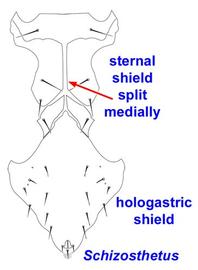
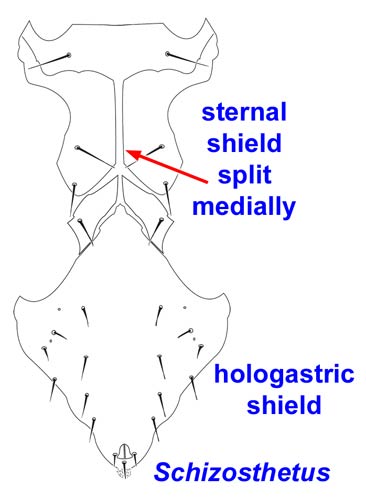
- Sternal shield split medially; seta z5 usually longer than j5 and j6 but similar in form; associated with bark beetles.............................. Schizosthetus
Dorsal shield completely divided.............................. 9
- Schizodorsal shield.............................. Gamasodes bispinosus group
Seta z5 of dorsal hexagon thickened and distally pilose; associated with various insects.............................. 10
- Seta z5 simple; associated with carrion beetles (Silphidae).............................. Poecilochirus
Articulation between sternal and metasternal shields oblique; ambulacra of legs II–IV simple, rounded.............................. Gamasodes
- Articulation (or suture) between sternal and metasternal shields transverse; ambulacra of legs II–IV long and acuminate.............................. Trachygamasus
Predators found in bark beetle galleries; deutonymphs phoretic on bark beetles.
Author: David E. Walter
Content last updated Sept. 2006, unless indicated otherwise
Lucid key player updated Sept. 2025
idtools.org