t
Proctogastrolaelaps McGraw & Farrier
Superorder Parasitiformes » Order Mesostigmata » Suborder Monogynaspida » Infraorder Gamasina » Hyporder Dermanyssiae » Superfamily Ascoidea » Family Ascidae » Subfamily Melicharinae » Genus Proctogastrolaelaps
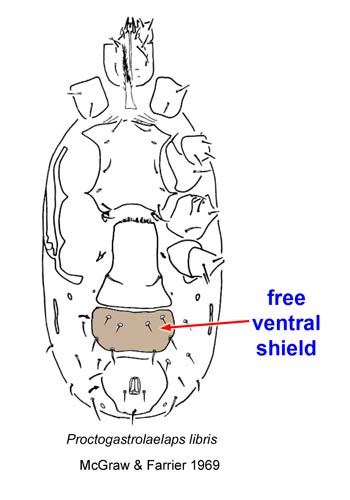
Melicharinae with a free ventral plate in the adult female
Proctogastrolaelaps appear to be intermediate between Proctolaelaps (anal shield, no ventral shield) and Paraproctolaelaps (anal and ventral shields fused into a ventrianal shield). Free ventral plates are very rare in the Monogynaspida, but do occur in the unusual phytoseiid genus Iphiseius (with the strongly reduced dorsal shield chaetome characteristic of Phytoseiidae and a phytoseiid-type of sperm access system) and in some Veigaiidae (palp apotele 3–4 tines and with scale-like process).
Idiosoma narrow, dorsal shield greater than twice as long as wide; leg setation strongly neotenous, genua I–II–III–IV with 12–7–6–7 setae, tibiae with 11–7–6–6 setae; female lacking metasternal plates and with ventri-anal shield bearing 1–3 pairs of ventral setae in addition to circumanal setae.............................. Mycolaelaps
- Idiosoma broader, legs not strongly neotenous, metasternal plates present or absent, only anal shield or separate anal and ventral shields.............................. 2
Female with separate ventral shield bearing 4 pairs of setae between genital and anal shields; posterior connection of peritrematal shield to exopodal plate beside coxa IV broad (subequal to width of stigma); corniculi slender, acute; rows of deutosternal denticles narrow, in deep trough; epistome convex, smooth; movable chela of female unidentate.............................. Proctogastrolaelaps
- Ventral area not sclerotized, only small anal shield with 3 circumanal setae present.............................. 3
Fixed chela of female and nymphs with pointed or rounded flange-like projection distally; leg IV with 1 or 2 erect macrosetae on telotarsus (pd2, +/- ad2); 3rd pair of sternal pores absent.............................. Mucroseius
- Fixed chela without distal flange-like projection; leg IV usually without macrosetae; 3rd pair of sternal pores usually present.............................. 4
Dorsal shield of adults with pair of deep midlateral incisions, lacking setae z3 on podonotal region; movable chela with 0 or 1 tooth; female without metasternal plates.............................. 6
- Dorsal shield of adults entire, usually with setae z3 on podonotal region; movable chela with 3 teeth; with or without metasternal plates.............................. 5
Adults with 7–13 pairs of marginal (r–R) setae on soft lateral cuticle (rarely fewer if some r–R setae lacking); female with 14–15 pairs of setae on opisthonotal region of dorsal shield and lacking metasternal plates (except in Orolaelaps).............................. Melichares
- Adults with 1–4 pairs of posterior marginal (R) setae on soft ventro-lateral cuticle, all others on edge of dorsal shield; female with 18–22 pairs of setae on opisthonotal region of dorsal shield; female usually with metasternal plates.............................. Proctolaelaps
Movable chela unidentate; female with 1st pair of sternal setae on soft cuticle in front of sternal shield; male with separate ventral & anal shields; male leg II with tarsal seta pv1 unmodified.............................. Xanthippe
- Movable chela edentate; female with first pair of sternal setae on sternal shield; male usually with consolidated ventrianal shield; male leg II with apical tarsal seta pv–1 slightly to conspicuously thickened.............................. 7
Tibiae III and IV with 9 and 10 setae respectively (pl2 present); dorsal shield with setae s6; female with hyaline anterior margin of epigynial shield rounded, and with genital setae on lateral edges of this shield; male tarsus II with seta pv–1 knob- or spine-like, and tarsus III with 1–3 setae (always av2) knob-like; male spermatodactyl directed anteriorly.............................. Tropicoseius
- Tibiae III and IV with 8 and 9 setae respectively (pl2 absent); dorsal shield lacking setae s6; female with hyaline anterior margin of epigynial shield usually truncated or emarginated, and with genital setae on soft cuticle flanking this shield; male tarsus II with seta pv1 but slightly thickened, and tarsus III without modified setae; male spermatodactyl directed posteroventrally.............................. Rhinoseius
Author: David E. Walter
Content last updated Sept. 2006, unless indicated otherwise
Lucid key player updated Sept. 2025
idtools.org