t
Ameroseiidae Evans, 1961
Superorder Parasitiformes » Order Mesostigmata » Suborder Monogynaspida » Infraorder Gamasina » Hyporder Dermanyssiae » Superfamily Ascoidea » Family Ameroseiidae
Ameroseiella Berlese, Asperolaelaps Womersley, Brontispalaelaps Womersley, Epicriopsis Berlese, Seritympanum Elsen and Whitaker
Soil/nest/stored product-inhabiting genera:
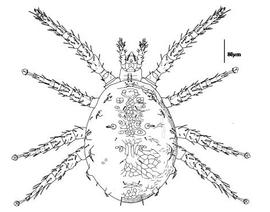
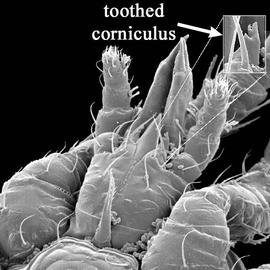
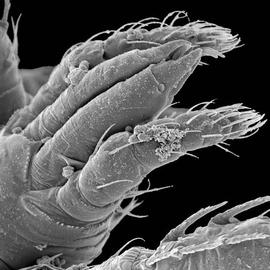
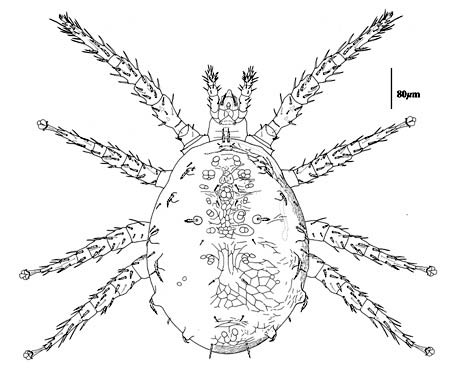
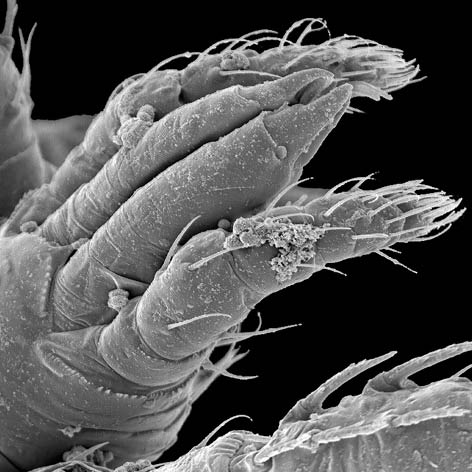
Ameroseiella Bregetova—1 sp. (apodius (Karg)); dorsal shield with 29 pairs of mostly densely barbed, foliose setae; corniculi bifurcate distally; leg I without pretarsus, terminating in long setae; pretarsi 2–4 with claws.
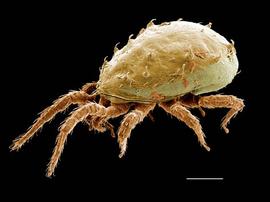
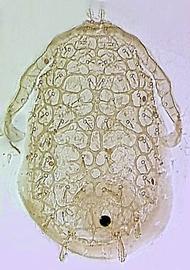
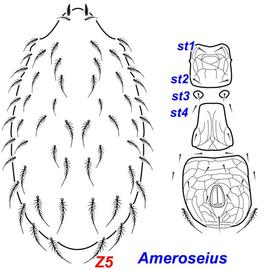
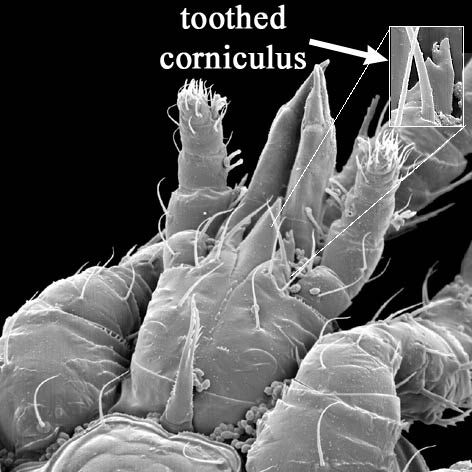
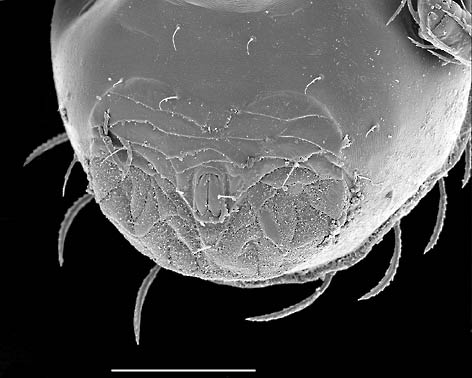
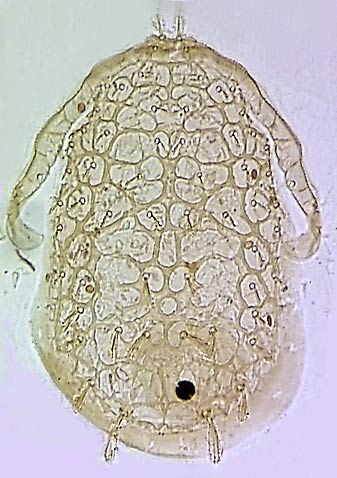
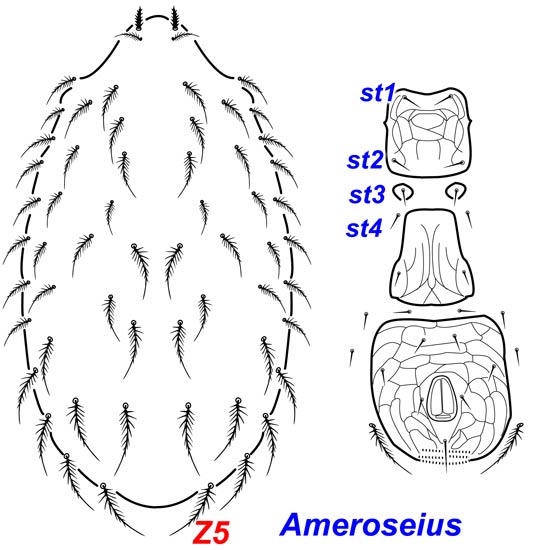
Ameroseius Berlese (including Kleemannia Oudemans =Primoseius Womersley, =Klemannia misspelling)—greater than 30 spp.; dorsal shield strongly ornamented, often with reticulate ridges, with 29 pairs of strongly barbed acuminate to foliose setae; sternal shield with 2–3 pairs of setae; corniculi bifid or toothed distally; genu II with 2 ventral setae; pretarsi with claws; genu II with one or two (Kleemannia) pl setae; palp apotele 3-tined or 2-tined (Kleemannia); with anal or ventrianal (Kleemannia) shield.
Asperolaelaps Womersley—1 sp. (rotundus Womersley); dorsal shield with 29 pairs of setae: j5, z2, z4, z6, s5, Z2 and S5 thick, pilose and mounted on tubercles; pretarsi with claws. Sometimes placed in Neocypholaelaps.
Brontispalaelaps Womersley—2 spp.; dorsal shield strongly ornamented, with 27 pairs of mostly long setae; sternal shield with 3 pairs of setae; corniculi bifid distally; genu II without ventral setae; palp apotele 3-tined; pretarsi with claws.
Epicriopsis Berlese—8 spp.; dorsal shield ornamented with tubercles, with <25 pairs of often elongate, thickened and barbed setae; genu II with 2 ventral setae; palp apotele 3-tined; pretarsi with claws.
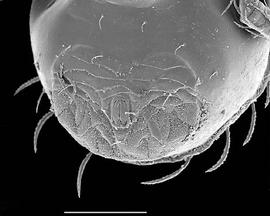
Seritympanum Elsen and Whitaker—3 spp.; dorsal shield strongly sculptured with 28–29 pairs of mostly spatulate to club-shaped setae; setae j1 on bifid, projecting vertex; sternal shield with 2 pairs of setae and three cogwheel-like ornaments; ventrianal shield bearing 2 pairs of ventral setae; corniculi with 3 teeth; palp apotele 2-tined; pretarsi with claws.
Dorsal shield with marginal ring of tubercles bearing setae j5, z2, z4, z6, s5, Z2, and S5; forest litter in eastern Australia.............................. Asperolaelaps
- Not as above.............................. 2
Sternal shield with 3 cog-like circular ornaments; dorsal shield setae short, club-shaped to spatulate; setae j1 on bifid vertex.............................. Seritympanum
- Not as above.............................. 3
Pretarsus I without claws.............................. Ameroseiella
- Pretarsus I with claws.............................. 4
Dorsal shield with 24 or fewer pairs of setae.............................. Epicriopsis
- Dorsal shield with 27–29 pairs of setae.............................. 5
Dorsal shield with 27 pairs of setae; genu II without ventral setae.............................. Brontispalaelaps
- Dorsal shield with 29 pairs of setae; genu II with 2 ventral setae.............................. 6
Anal shield with 3 setae; genu III with 1 pl seta; palp apotele 3-tined.............................. Ameroseius
- Ventrianal shield with 5 or more setae; genu III with 2 pl seta; palp apotele 2-tined.............................. Kleemannia
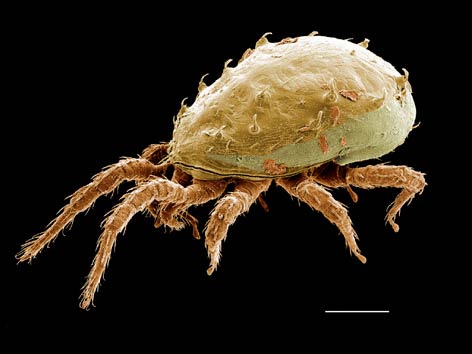
Unusually for Mesostigmata, most ameroseiids feed on non-animal foods, especially fungi, pollen and nectar. Species of Ameroseius Berlese (including Kleemannia) can be found in forest litter, garden mulch, nests, tree hollows, and stored products where they feed on fungi (and possibly on invertebrates). Occasionally, they are pests in buildings where organic matter (including construction materials) has become wet and moldy. Species of Seritympanum Elsen and Whitaker have been collected phoretic on small rodents and presumably inhabit their nests. Epicriopsis walteri Halliday lives in rainforest floor litter and can be reared on fungal hyphae. Asperolaelaps rotundus Womersley also lives in rainforest litter. They are slow moving mites that carry pieces of detritus on their flattened dorsa.
Author: David E. Walter
Content last updated Sept. 2006, unless indicated otherwise
Lucid key player updated Sept. 2025
idtools.org