Neocypholaelaps

Mesostigmata

t

Taxonomy

updated 2025

Name

Neocypholaelaps Vitzthum

Classification

Superorder Parasitiformes » Order Mesostigmata » Suborder Monogynaspida » Infraorder Gamasina » Hyporder Dermanyssiae » Superfamily Ascoidea » Family Ameroseiidae » Genus Neocypholaelaps

Diagnostic characters

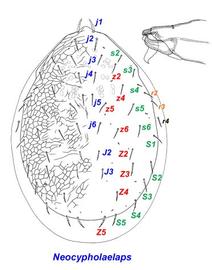
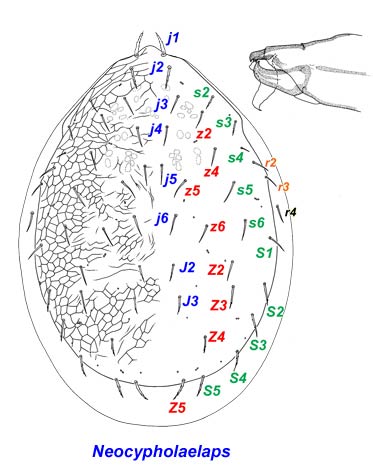
  • Dorsal shield lightly sclerotized, sometimes weakly reticulated, and with 29–30 pairs of setae, setae J5 absent
  • Sternal shield reduced and bearing 1–2 pairs of setae
  • Corniculi simple or bifurcate
  • Chelicerae tong-like, with membranous lobe
  • Tectum simple, smoothly triangular
  • Genu III with 9 setae (2–2/1,2/1–1), tibia III with 8 setae (2–1/1,2/1–1)
  • Pretarsi with claws; palp apotele with 2-tines.

More about Neocypholaelaps on Bee Mite ID

Similar taxa

The most reliable character for the Ameroseiidae is the lack of setae J5 on the posterior dorsal shield. However, among the taxa with toothed or bifurcate corniculi, ameroseiids are likely to be commonly confused only with species of Proctolaelaps, which occur in similar habitats, but Proctolaelaps have numerous dorsal shield setae (including most of the r–R rows) and a ventral mucro on the chelicerae. Species of Hattena and Afrocypholaelaps also live in flowers, eat pollen and nectar, and use birds or insects for transport and can be differentiated in the key below.

Key to flower-inhabiting Ameroseiidae (females)

  1. Dorsal setae in s- and r-series setae leaf-like and biserrate.............................. Neocypholaelaps stridulans group
    - Dorsal setae acicular, simple or weakly barbed.............................. 2

  2. Pretarsi with distinct claws; often some dorsal shield setae thickened and barbed.............................. Neocypholaelaps
    - Pretarsi without distinct claws, only pad-like pulvillus; dorsal shield setae fine, simple.............................. 3

  3. Dorsal shield with 29 pairs of setae; ducts fused above spermatheca.............................. Afrocypholaelaps
    - Dorsal shield with 25 or fewer pairs of setae; ducts separate.............................. Hattena

Ecology and distribution

Species of Neocypholaelaps inhabit flowers and feed on pollen and nectar. They are phoretic on flower-visiting insects and sometimes on birds.

References

  • Domrow 1963Domrow 1963:
    Domrow R. 1963. New records and species of Austromalayan laelapid mites. Proceedings of the Linnean Society of New South Wales 88: 199–220.
  • Domrow 1966bDomrow 1966b:
    Domrow R. 1966b. Some mite parasites of Australian birds. Proceedings of the Linnean Society of New South Wales 90: 190–217.
  • Domrow 1979Domrow 1979:
    Domrow, R. 1979. Ascid and ameroseiid mites phoretic on Australian mammals and birds. Records of the Western Australian Museum 8: 97–116.
  • Elsen 1972Elsen 1972:
    Elsen P. 1972. Afrocypholaelaps gen. nov., un nouveau genre pour Neocypholaelaps africana Evans, 1963, et redescription de cette espèce (Acari: Mesostigmata). Revue de Zoologie et de Botanique Africaines 86: 158–162.
  • Evans 1963Evans 1963:
    Evans GO. 1963. The genus Neocypholaelaps Vitzthum (Acari: Mesostigmata). Annals and Magazine of Natural History (13th ser.) 6: 209–230.
  • Halliday 1997aHalliday 1997a:
    Halliday RB. 1997a. Revision of the Australian Ameroseiidae (Acarina: Mesostigmata). Invertebrate Taxonomy 10: 179–201.
  • Seeman 1996Seeman 1996:
    Seeman OD. 1996. Flower mites and phoresy: The biology of Hattena panopla Domrow and Hattena cometis Domrow (Acari: Mesostigmata: Ameroseiidae). Australian Journal of Zoology 44: 193–203.
  • Seeman and Walter 1995Seeman and Walter 1995:
    Seeman OD, Walter DE. 1995. Life history of Afrocypholaelaps africana (Evans) (Parasitiformes: Ameroseiidae), a mite inhabiting mangrove flowers and phoretic on honeybees. Journal of the Australian Entomological Society 34: 45–50.
 Neocypholaelaps
Neocypholaelaps