Mesostigmata
t
Taxonomy
updated 2025
Classification
Superorder Parasitiformes » Order Mesostigmata » Suborder Monogynaspida » Infraorder Gamasina » Hyporder Dermanyssiae » Superfamily Phytoseioidea » Family Blattisociidae » Subfamily Platyseiinae » Genus Cheiroseius
Diagnostic characters
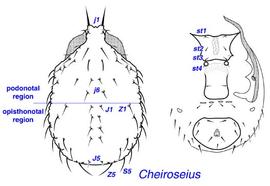
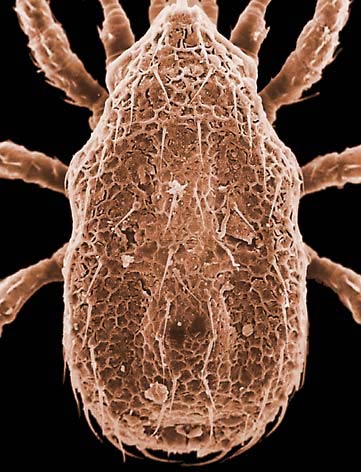
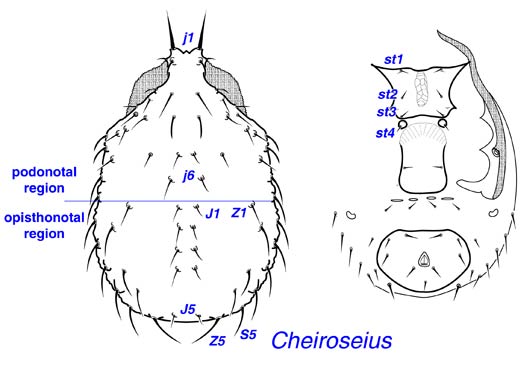
- Opisthonotal region of dorsal shield with 12–15 pairs of setae, including J1–5
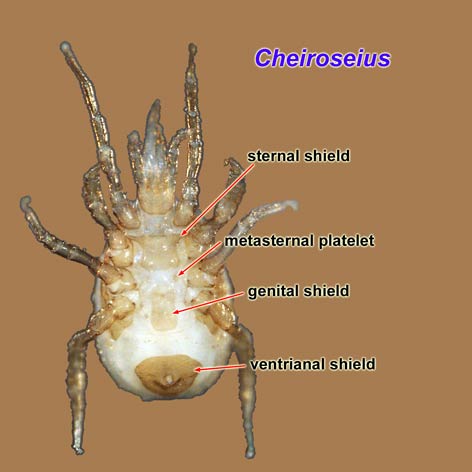
- Female with sternal setae st1 and st3 subequal in length
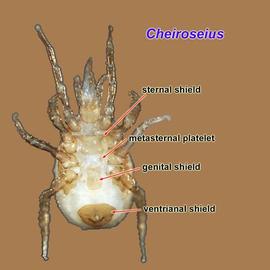
- Metasternal plates and ventrianal shield
- Male with metasternal setae; median lobes of pulvillus of legs II–IV acute
- Genu II with 10 setae (pl2 present)
- Legs II–IV with median lobe of pulvillus slender, acute or narrowly rounded
- Para-anal setae inserted level with or posterior to hind margin of anus, and usually longer than post-anal seta
- Femora I and II with 11 and 10 setae respectively (each lacking v–3)
- Anterior rostral and internal palp trochanter setae extremely long, whip-like, tapering only near tip
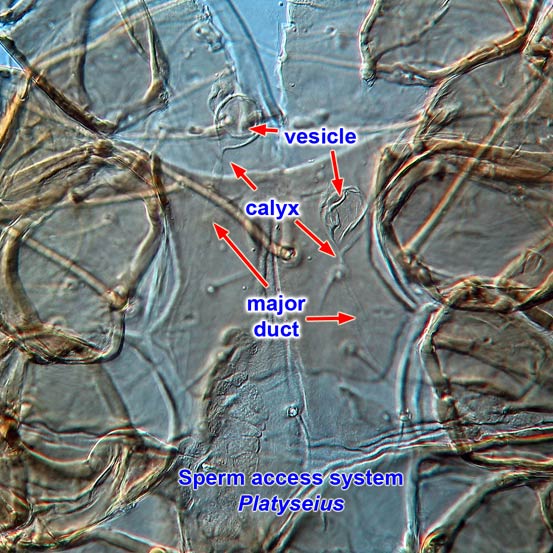
- Phytoseiid-type sperm access system
- Fixed cheliceral digit with a deep receptacle that receives the tip of the movable digit
- Often with a long post-stigmatic arm of the peritreme extending along coxa IV
- Male with or without metasternal setae
Similar taxa
Key to females of genera of Platyseiinae
-
Opisthonotal region of dorsal shield markedly hypotrichous, with only 5 pairs of setae (Z1, Z4, Z5, S4, J5); sternal setae st4 in soft cuticle; with anal shield; median lobes of pulvillus of legs II–IV blunt.............................. Cheiroseiulus
- Opisthonotal region of dorsal shield with 12–15 pairs of setae; with metasternal plates bearing st4 and ventrianal shield; median lobes of pulvillus of legs II–IV acute.............................. 2
-
Opisthonotal region of dorsal shield with 2–4 pairs of setae in J-series; first pair of sternal setae (st1) distinctly shorter than third pair (st3); distance between fifth and sixth rows of deutosternal denticles nearly twice that between fourth and fifth rows; tibia II with 9 setae (pd1 absent)............................. Platyseius
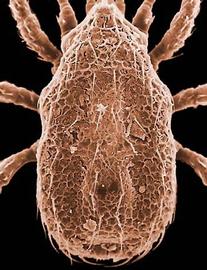
- Opisthonotal region of dorsal shield with 5 pairs of setae in J-series; 1st and 3rd pairs of sternal setae subequal in length; distance between 5th and 6th rows of deutosternal denticles similar to that between 4th and 5th rows; tibia II with 10 setae (pd1 present).............................. Cheiroseius
Ecology and distribution
Mites of the genus Cheiroseius feed on nematodes in moist soils, and are abundant in wet forest litter, especially along lake and stream margins; these mites often have extensive peritrematal surfaces that appear to act as plastrons. Others are found in treeholes, decaying logs, and on bracket fungi. About 65 species have been described and many more remain to be described. Many species appear to be subaquatic and able to tolerate flooding. Often the peritreme is plastron-like. Some adult female Cheiroseius are phoretic on tipulid flies and others have been found associated with.
References
- Evans and Hyatt 1960Evans and Hyatt 1960:
Evans GO, Hyatt KH. 1960. A revision of the Platyseiinae (Mesostigmata: Aceosejidae) based on material in the collections of the British Museum (Natural History). Bulletin of the British Museum (Natural History) Zoology 6 (2): 27–101.
- Evans and Till 1979Evans and Till 1979:
Evans EO, Till WM. 1979. Mesostigmatic mites of Britain and Ireland (Chelicerata: Acari-Parasitiformes): An introduction to their external morphology and classification. Transactions of the Zoological Society of London 35 (2): 145–270.
- Halliday et al. 1998Halliday et al. 1998:
Halliday RB, Walter DE, Lindquist EE. 1998. Revision of the Australian Ascidae (Acarina: Mesostigmata). Invertebrate Taxonomy 12: 1–54.
- Karg 1993Karg 1993:
Karg W. 1993. Acari (Acarina), Milben Parasitiformes (Anactinochaeta) Cohors Gamasina Leach, Raubmilben. Die Tierwelt Deutschlands 59: 1–523.
- Kitching and Callaghan 1982Kitching and Callaghan 1982:
Kitching RL, Callaghan C. 1982. The fauna of water-filled tree holes in box forest in south-east Queensland. Australian Entomological Magazine 8: 61–70.
- Krantz 1962Krantz 1962:
Krantz GW. 1962. Acari. Free-living Mesostigmata. II. The family Aceosejidae. Parc National de la Garamba - Mission H. de Saeger 34: 3–29.
- Krantz 1986Krantz 1986:
Krantz GW. 1986. A manual of acarology [2nd ed., emended 1986]. Oregon State University Book Stores, Corvallis.
- Krantz and Ainscough 1990Krantz and Ainscough 1990:
Krantz GW, Ainscough B. 1990. Mesostigmata. pp. 583–665. In: Dindal DL, ed. Soil biology guide. John Wiley & Sons, Brisbane.
- Lindquist 2003Lindquist 2003:
Lindquist EE. 2003. Observations on mites of the subfamily Platyseiinae, with descriptions of two new species of Platyseius from North America (Acari: Mesostigmata: Ascidae). pp. 155–182. In: Smith IM, ed. An acarological tribute to David R. Cook. Indira Publishing House, West Bloomfield.