t
Podocinidae Berlese, 1913
Superorder Parasitiformes » Order Mesostigmata » Suborder Monogynaspida » Infraorder Gamasina » Hyporder Dermanyssiae » Superfamily Phytoseioidea » Family Podocinidae
Podocinum Berlese, Podocinella Evans & Hyatt
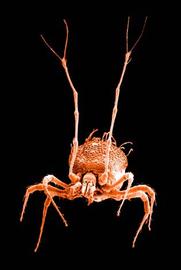
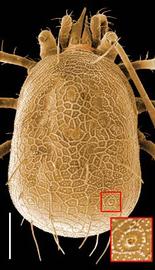
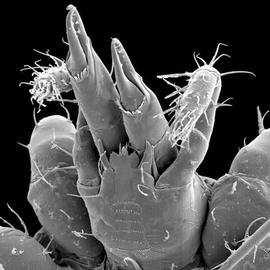
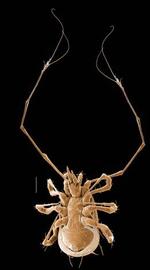
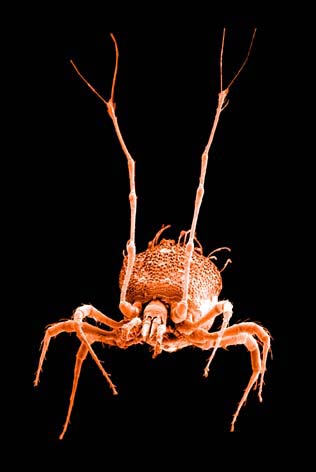
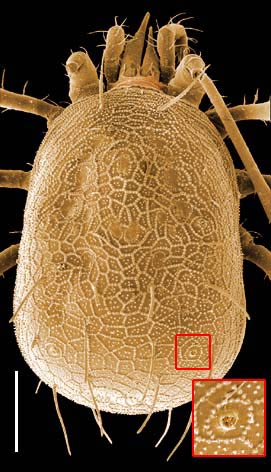
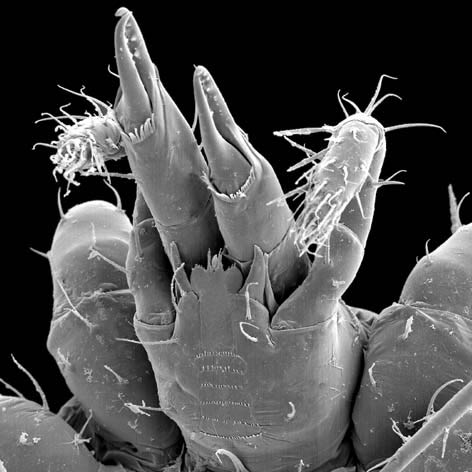
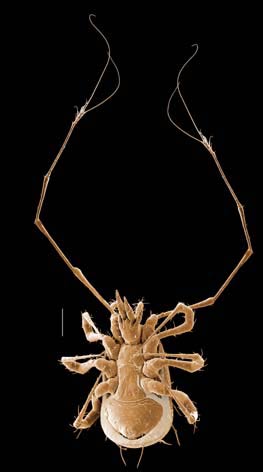
Yellow to orange-brown hypotrichous dermanyssine mesostigmatans with holodorsal shield with 16–17 pairs of setae, a cerotegument in the form of a polygonal arrays of small tubercles, and with a pair of large gland openings posteriorly. Peritremes typical running to or past coxa I; peritrematal shield usually narrow, joining podonotal shield anteriorly. Sternal shield bearing 3 pairs of setae (st1–3) and 2 pairs of lyrifissures (stp1–2); metasternal shields subtriangular and bearing st4, stp3; genital shield usually trapezoidal and bearing 1 pair of setae; ventrianal shield broad, free, and bearing several pairs of ventral setae and 3 circumanal setae. Tarsus I slender, elongate, without claws, but with 1 (Podocinella) or 2 (Podocinum) whip-like setae; trochanter I with 6 setae; tibia I and genu I each with 4/3 dorsal/ventral setae; genu IV with 4/1–2 dorsal/ ventral setae. Chelicerae chelate-dentate; movable digit without excrescences. Palp genu with 6 setae, palp apotele 3 tined; corniculi horn-like. Tritosternum biflagellate with columnar base. Tectum with 3 subequal tines each usually divided or toothed distally; subcapitular gutter with numerous denticles per row. Female sperm induction pores near base of coxae IV. Males with genital opening at base of tritosternum in sternogenital shield; spermatodactyl simple.
Mesostigmatans with oval bodies covered by a single dorsal shield with tuberculate ornamentation and very long legs I that lack ambulacra are likely to be Podocinidae or Epicriidae. Epicriids have a small anal or ventrianal shield and several of the long setae on tarsus I end in small knobs. Species of Epicriopsis (Ameroseiidae) also have anal or small ventrianal shields and have claws and empodium on legs I. Species of Euepicrius (Ologamasidae) and Antennoseius (Ascidae) somewhat resemble podocinids, but have 2 subequal dorsal shields.
Author: David E. Walter
Content last updated Sept. 2006, unless indicated otherwise
Lucid key player updated Sept. 2025
idtools.org