Dermanyssiae immature stage

Mesostigmata

t

Taxonomy

updated 2025

Name

Dermanyssiae Evans and Till, 1979Evans and Till, 1979:
Evans EO, Till WM. 1979. Mesostigmatic mites of Britain and Ireland (Chelicerata: Acari-Parasitiformes): An introduction to their external morphology and classification. Transactions of the Zoological Society of London 35 (2): 145–270.

Classification

Superorder Parasitiformes » Order Mesostigmata » Suborder Monogynaspida » Infraorder Gamasina » Hyporder Dermanyssiae

Children

Superfamilies: Veigaioidea, Rhodacaroidea, Eviphidoidea, Ascoidea, Phytoseioidea, Dermanyssoidea

Diagnostic characters

  • Usually translucent or pale white due to little sclerotization
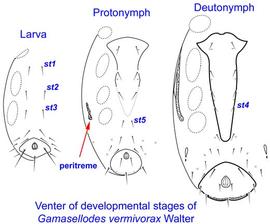
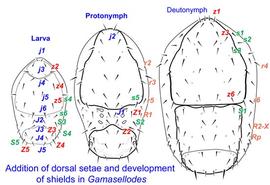
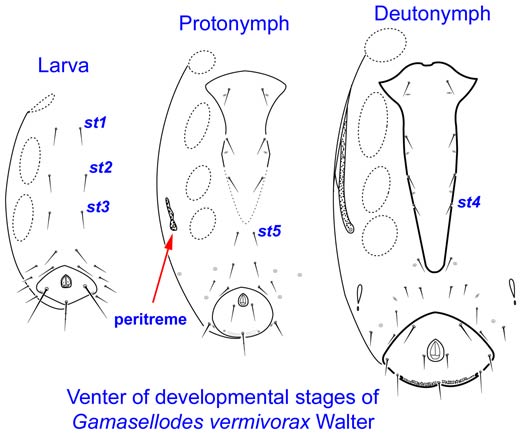
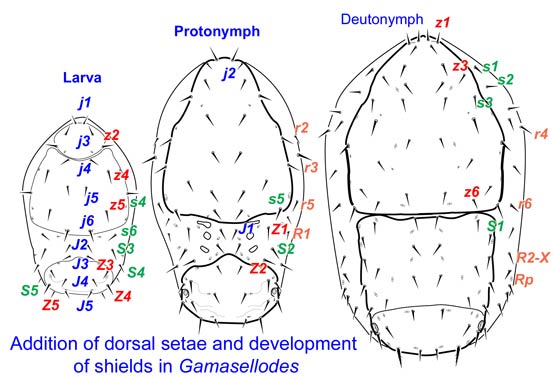
  • In comparison to adults the dorsal shields of the larvae and protonymphs are more fragmented and the dorsal and ventral setation is reduced (setae are added at the protonymphal and at the deutonymphal molts)
  • Deutonymphs have the full adult complement of setae, but when adults have entire dorsal shields, the deutonymphs typically have divided or incised dorsal shields
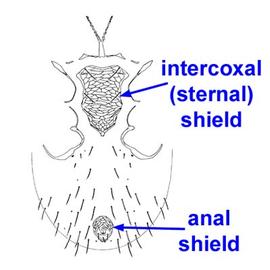
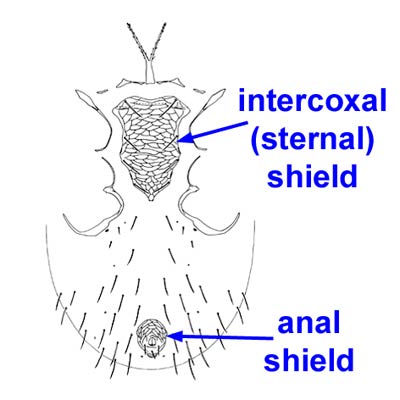
  • The intercoxal shield is without valves in all immatures (the genital opening appears only at the adult molt), and the peritreme is reduced in the protonymph and absent in the larva

Similar taxa

Adult males always have a genital opening associated with the intercoxal area (except in the uropodid genus Metagynella where the opening is postcoxal).

Comments

In general, immature mites can only be identified if they can be associated with adult females. However, some of the bingo characters may work on immatures.

References

  • Krantz 1986Krantz 1986:
    Krantz GW. 1986. A manual of acarology [2nd ed., emended 1986]. Oregon State University Book Stores, Corvallis.
Immatures have no genital opening
Venter of developmental stages of  Gamasellodes vermivorax;  larval, protonymphal, deutonymphal venters
Venter of developmental stages of Gamasellodes vermivorax; larval, protonymphal, deutonymphal venters
Addition of dorsal setae and development of shields in  Gamasellodes ; larval, protonymphal, and deutonymphal dorsums
Addition of dorsal setae and development of shields in Gamasellodes; larval, protonymphal, and deutonymphal dorsums