Major mite taxa
test
Taxonomy
updated 2025
Name
Mixonomata Grandjean, 1969
Children
superfamilies: Nehypochthonioidea, Eulohmannioidea, Perlohmannioidea, Epilohmannioidea, Collohmannioidea, Phthiracaroidea, Euphthiracaroidea
Common names
box mites, eulohmanniid, epilohmanniid & perlohmanniid oribatid mites
Probability of encounter
low
Quarantine importance
No known quarantine importance.
Diagnosis
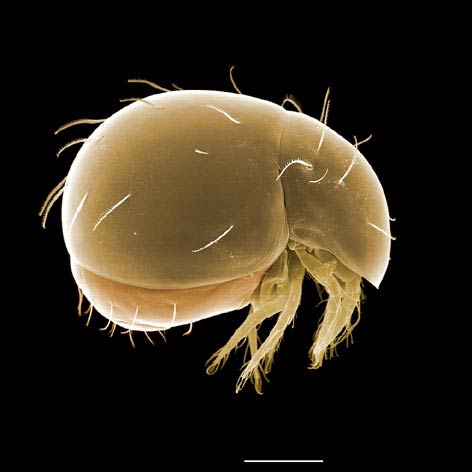
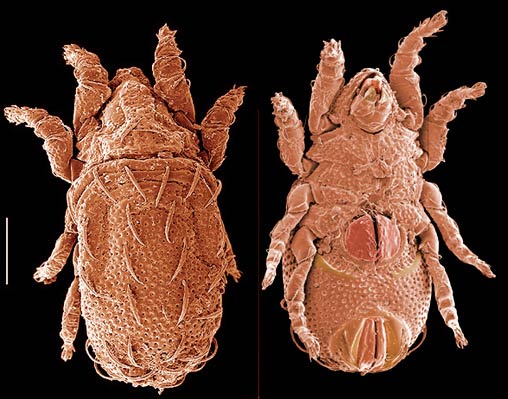
Brown, reddish, beige or yellowish dichoid or ptychoid (Phthiracaroidea, Euphthiracaroidea) oribatid mites with the capitulum withdrawn within a camerostome. Notogastral shield entire; ventral plate sometimes divided (Epilohmannia) or incised (Eulohmannia); discrete aggenital plates present (Epilohmannia, Perlohmannia, box mites). Macropyline, genital valves sometimes divided (Perlohmannia); 3 pairs of genital papillae. Palps with 2–5 free segments. Lateral opisthonotall glands present or absent.
Similar taxa
Some Enarthronota (Mesoplophoridae, Protoplophoridae) resemble true box mites, but lack the elongate genital and anal valves. Some Nothrina (e.g., Nanhermaniidae) are superficially similar to Epilohmanniidae and Eulohmanniidae but have an incised, rather than split ventral shield and are holoid rather than dichoid.
Ecology and distribution
Box mites occur in most litter habitats and range in size from fairly small to very large. They often burrow in woody litter and are also frequently found on bark. Perlohmannia are large, more or less dorso-ventrally flattened mites. Collohmannia are not flattened and are one of the few oribatid mites known to have direct contact between the sexes during mating. Epilohmannia are subcylindrical and reasonably common. Eulohmannia are relatively small and seem characteristic of disturbed soils.
References
- Balogh and Balogh 1987aBalogh and Balogh 1987a:
Balogh J, Balogh P. 1987a. Identification keys of the ptychoid Mixonomata of the Neotropical region (Acari, Oribatei). Acta Zoologica Academiae Scientiarum Hungaricae 33: 1–36.
- Colloff and Niedbala 1996Colloff and Niedbala 1996:
Colloff MJ, Niedbala W. 1996. Arboreal and terrestrial habitats of phthiracaroid mites (Oribatida) in Tasmanian rainforests. pp. 607–612. In: Mitchell R, Horn DJ, Needham GR, and Welbourn WC, eds. Acarology IX, Vol. 1. Ohio Biological Survey, Columbus.
- Colloff and Halliday 1998Colloff and Halliday 1998:
Colloff M, Halliday B. 1998. Oribatid mites: A catalogue of Australian genera and species. Monograph on Invertebrate Taxonomy, Vol. 6. CSIRO Publishing, Melbourne.
- Fujikawa and Aoki 1969Fujikawa and Aoki 1969:
Fujikawa T, Aoki J. 1969. Notes on two species of the genus Perlohmannia Berlese (Acari, Perlohmanniidae). Taxonomic notes on Oribatid mites of Hokkaido. II. Annotationes Zoologicae Japonenses 42: 220–225.
- Gilyarov and Krivolutsky 1975Gilyarov and Krivolutsky 1975:
Gilyarov MS, Krivolutsky DA, eds. 1975. Handbook for the identification of soil-inhabiting mites, Sarcoptiformes. Zoological Institute of the Academy of Sciences, Petrograd.
- Hunt et al. 1998Hunt et al. 1998:
Hunt GS, Norton RA, Kelly JPH, Colloff MJ, Lindsay SM, Dallwitz MJ, Walter DE. 1998. Oribatid Mites: An Interactive Glossary of Oribatid Mites, An Interactive Key to the Oribatid Mites of Australia [Intkey software and user guide on CD-ROM]. CSIRO Publishing, Collingwood.
- Lee 1982Lee 1982:
Lee DC. 1982. Sarcoptiformes (Acari) of South Australian soils. 3. Arthronotina (Cryptostigmata). Records of the South Australian Museum 18: 327–359.
- Luxton 1985Luxton 1985:
Luxton M. 1985. Cryptostigmata (Arachnida: Acari) - a concise review. Fauna of New Zealand 7: 1–106.
- Niedbała 1992Niedbała 1992:
Niedbała W. 1992. Phthiracaroidea (Acari, Oribatida). Systematic studies. Elsevier / PWN Polish Scientific Studies, Amsterdam, Warsaw. 612 pp.
- Niedbała 2000Niedbała 2000:
Niedbała W. 2000. The ptyctimous mites fauna of the Oriental and Australian regions and their centres of origin (Acari: Oribatida). Genus (Wrocław), Supplement: 1–493.
- Niedbała 2002Niedbała 2002:
Niedbała W. 2002. Ptyctimous mites (Acari, Oribatida) of the Nearctic region. Monographs of the Upper Silesian Museum 4: 1–261.
- Niedbała and Colloff 1997Niedbała and Colloff 1997:
Niedbała W, Colloff MJ. 1997. Euptyctime oribatid mites from Tasmanian rainforest (Acari: Oribatida). Journal of Natural History 31: 489–538.
- Shtanchaeva 1996Shtanchaeva 1996:
Shtanchaeva UY. 1996. The world fauna of oribatid mites of the family Epilohmanniidae. Zoologicheskii Zhurnal 75: 516–531.