Opilioacarida

Major mite taxa

test

Taxonomy

updated 2025

Name

Opilioacarida Zakhvatkin, 1952

Classification

Superorder Parasitiformes » Order Opilioacarida

Children

superfamily: Opilioacaroidea

Common names

opilioacarans, opilioacarids

Probability of encounter

very low

Quarantine importance

None. These mites are rare and of no known quarantine importance.

Diagnosis

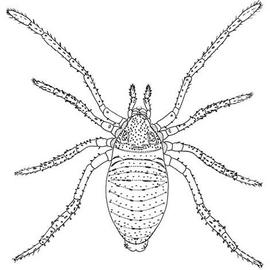
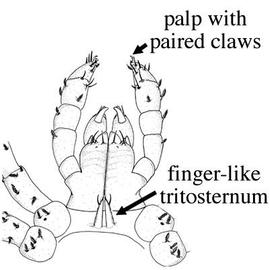
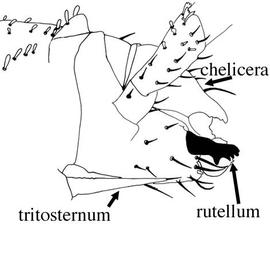
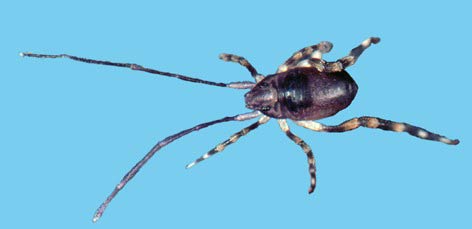
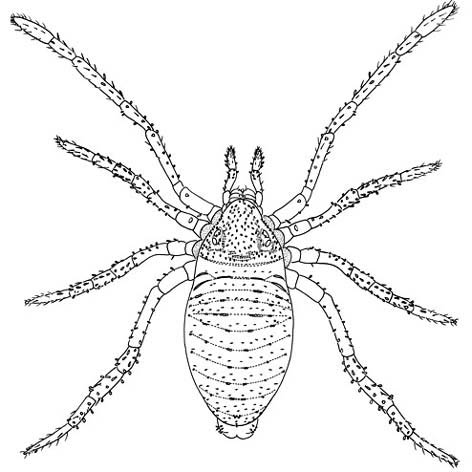
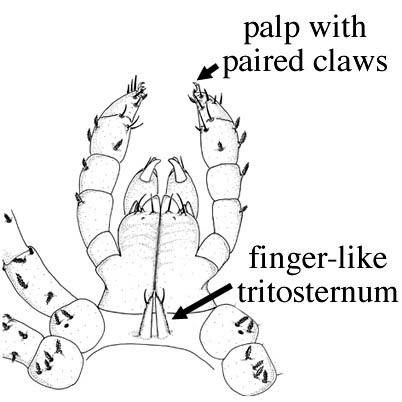
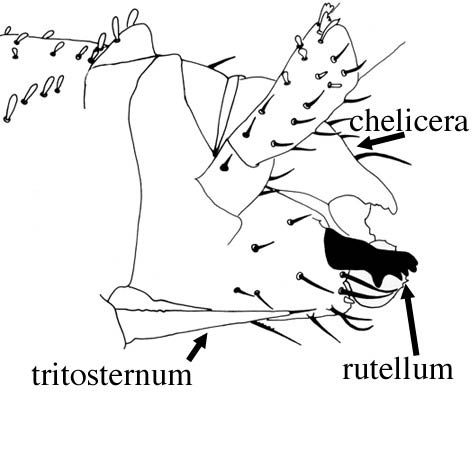
Primitive mites related to the Parasitiformes and resembling small opilionids. Soft-bodied, grey-blue to lilac in colour, usually with white bands or stripes. Peritremes absent; opisthosoma bearing four pairs of dorso-lateral spiracles (adults and tritonymphs); prosoma with 2–3 pairs of lateral ocelli; gnathosoma bearing >4 pairs of ventral setae, rutella and With’s organ; chelicerae 3-segmented, with 3–5 setae and 2 lyrifissures on middle article; palps with 5 segments and well developed claw; tritosternum unfused, with finger-like processes; coxae free; trochanters III and IV divided; all pedal tarsi divided.

Similar taxa

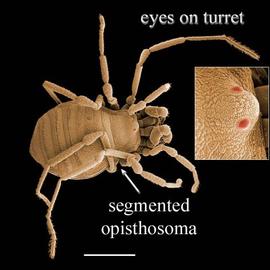
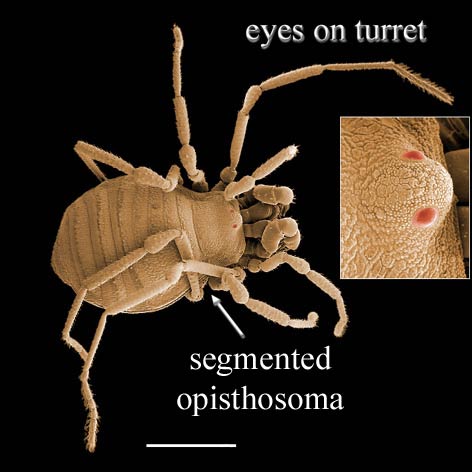
Opilionida (harvestmen) which have segmented opisthosomas and eyes (when present) on a median turret, and Eupodidae (Prostigmata), which have 2-segmented chelicerae, genital papillae, and often have swollen femora IV for jumping. The only known Australian representative of the group is currently undescribed, but has been collected in the Kimberleys, Kakadu, and Far North Queensland.

Ecology and distribution

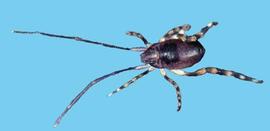
Predators and scavengers in Mediterranean and tropical habitats including rainforest litter and caves. Australian opilioacarans can be found under rocks in mesic gullies in dry, tropical habitats. Adults are less than 3 mm in length, purplish brown with white striped legs, fast moving, and feed on pollen, fungi, and small arthropods. 

References

  • Grandjean 1936aGrandjean 1936a:
    Grandjean F. 1936a. Un acarien synthetique: Opilioacarus segmentatus With. Bulletin de la Société d'Histoire Naturelle de l'Afrique du Nord 27: 413–444.
  • Hammen 1966Hammen 1966:
    Hammen L van der. 1966. Studies on Opilioacarida (Arachnida). I. Description of Opilioacarus texanus (Chamberlin and Mulaik) and revised classification of the genera. Zoologische Verhandelingen 86: 1-80.
  • Hammen 1968Hammen 1968:
    Hammen L van der. 1968. Studies on Opilioacarida (Arachnida). II. Redescription of Paracarus hexophthalmus (Redikorzev). Zoölogische Mededelingen 43: 57-76.
  • Hammen 1969bHammen 1969b:
    Hammen L van der. 1969b. Studies on Opilioacarida (Arachnida). III. Opilioacarus platensis Silvestri and Adenacarus arabicus (With). Zoölogische Mededelingen 44: 113-131.
  • Kaiser and Alberti 1991Kaiser and Alberti 1991:
    Kaiser T, Alberti G. 1991. The fine structure of the lateral eyes of Neocarus texanus Chamberlin and Mulaik, 1942 (Opilioacarida, Acari, Arachnida, Chelicerata). Protoplasma 163: 19–33.
  • Klompen 2000Klompen 2000:
    Klompen JSH. 2000. Prelarva and larva of Opilioacarus (Neocarus) texanus (Chamberlin and Mulaik) (Acari: Opilioacarida) with notes on the patterns of setae and lyrifissures. Journal of Natural History 34: 1977–1992.
  • Walter and Proctor 1998aWalter and Proctor 1998a:
    Walter DE, Proctor HC. 1998a. Feeding behaviour and phylogeny: Observations on early derivative Acari. Experimental and Applied Acarology 22: 39–50.
Opilioacarid from Kakadu (HCP, DEW)
Opilioacarid dorsal (JC)
Anterior venter (JC, DEW)
Anterior lateral (JC, DEW)
Harvestmen opilionid with segmented opisthosoma and eyes