t
Lordalicidae Grandjean
Hybalicus Berlese, 1913
Lordalycus Grandjean 1939Grandjean 1939:
Grandjean F. 1939. Quelques genres d’acariens appartenant au groupe des Endeostigmata. Annales des Sciences Naturelles, Zoologie 11 (ser. 2): 1–122.
Superorder Acariformes » Order Trombidiformes » Suborder Sphaerolichida » Superfamily Lordalycoidea » Family Lordalycidae » Genus Hybalicus
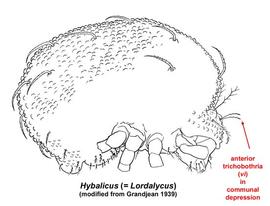
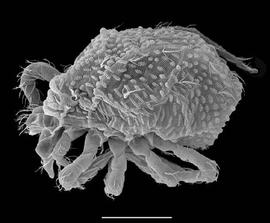
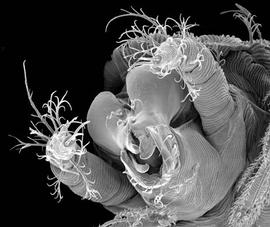
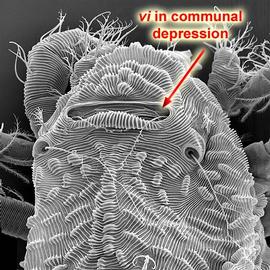
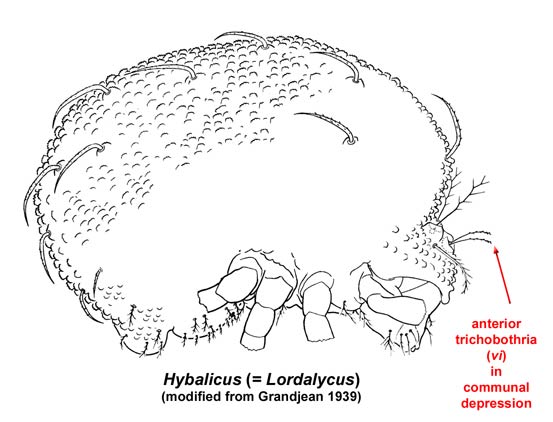
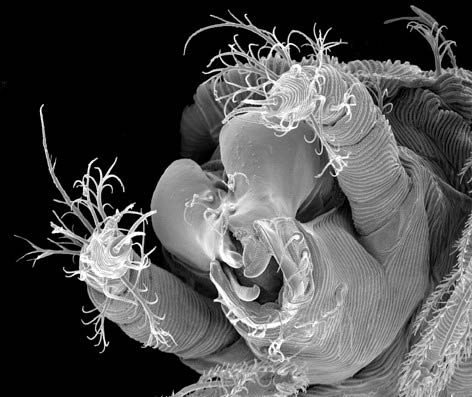
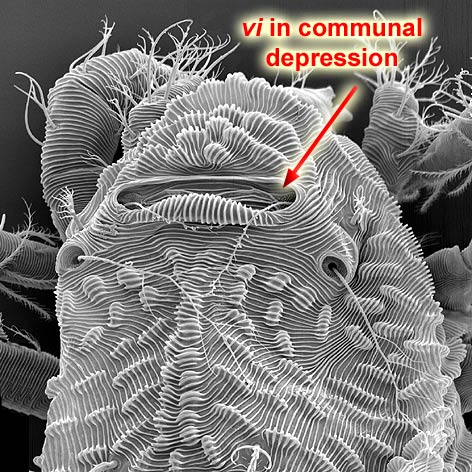
Prodorsum with 2 pairs of filamentous trichobothria (anterior pair in a communal depression) and 1 pair of setae, without naso or eyes. Subcapitulum with 4 pairs of setae, rutella absent; chelicerae with 2 pairs of setae, fixed digit truncate, with distal process, movable digit serrulate; palps with 4–5 free segments. Body globular, usually with pustulate ornamentation and bearing 9 pairs of dorsal setae, c3–4, f3 absent; 5–8 pairs of genital setae; 2–3 pairs of genital papillae; 2–3 pairs of anal setae. Coxal bases I–IV continuous; all pretarsi with paired claws and rayed empodium.
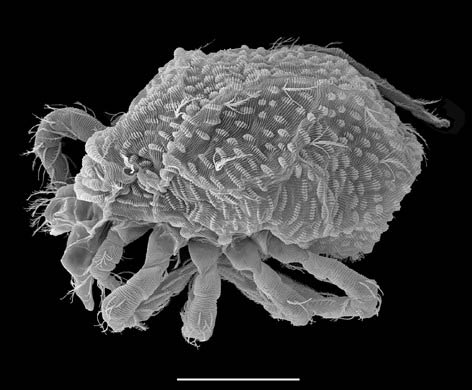
These are distinctive mites with globular bodies and strongly ornamented cuticle and are common worldwide. Little is known about the biology of any species, although species of Hybalicus often have poorly consolidated fungal materials in their guts (Theron 1979Theron 1979:
Theron PD. 1979. The functional morphology of the gnathosoma of some liquid and solid feeders in the Trombidiformes, Cryptostigmata and Astigmata (Acarina). pp. 575–579. In: Piffl E, ed. Proceedings of the 4th International Congress of Acarology. Akadémiai Kiadó, Budapest., Walter 1988cWalter 1988c:
Walter DE. 1988c. Predation and mycophagy by endeostigmatid mites (Acariformes: Prostigmata). Experimental and Applied Acarology 4: 159–166.) and an inactive prelarva with well-developed dorsal setae.
Author: David E. Walter
Content last updated Sept. 2006, unless indicated otherwise
Lucid key player updated Sept. 2025
idtools.org