Phytoseiulus
t
Taxonomy
Name
Phytoseiulus persimilis Athias-Henriot
Synonyms
P. riegli Dosse, Amblyseius tardi Lombardin
Diagnostic characters of adult female
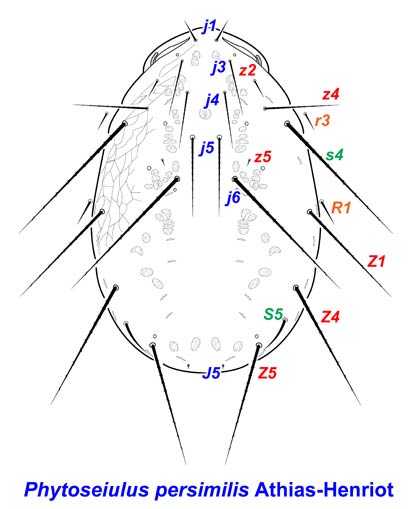
- Dorsal shield ca. 0.315–0.330 mm long
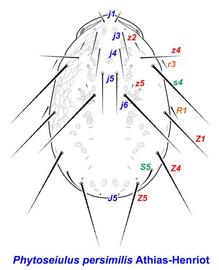
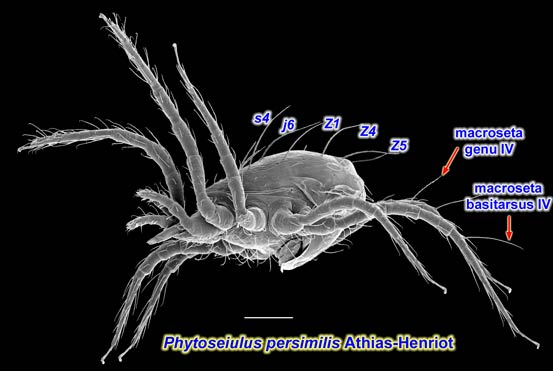
- Dorsal shield setae j5 and S5 both present, j5 barbed and reaching insertion of j6; j6 barbed and as long or longer than Z1; R1 and r3 simple, similar in length.
- Peritrematal shield fused to dorsal shield anteriorly
- Fixed digit of chelicera elongate and with row of 7–8 teeth
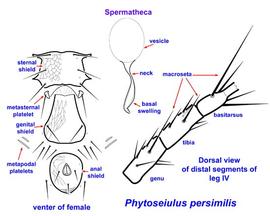
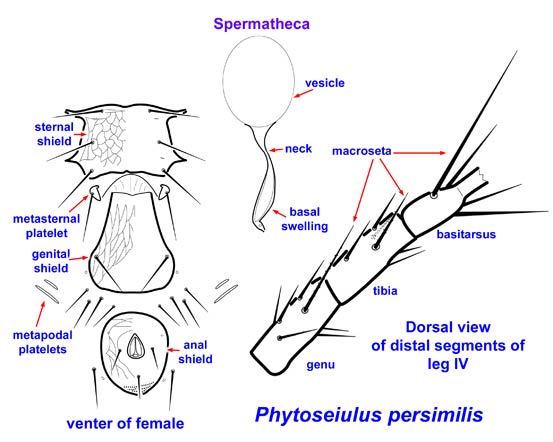
- Calyx of spermatheca vase-shaped with neck
- Sternal shield with 3 pairs of setae; st4 on small platelets.
- Anal opening on ianal shield with 3 setae; setae JV2 in the soft cuticle
- Ventral setae JV4 absent
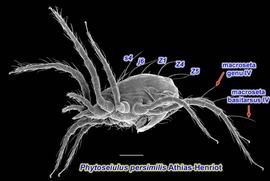
- Genu IV with barbed macroseta (ca. 0.085 mm long); macroseta on basitarsus IV simple (ca. 0.125 mm long)
Similar species
Phytoseiulus longipes has a sternal shield with only 2 pairs of setae (
st1–
2) and lacks dorsal shield setae
j5 and
S5.
Phytoseiulus fragariae has simple setae
j6 shorter than
Z1 and setae
JV4 present laterad the ventrianal shield.
Phytoseiulus macropilis usually has a ventrianal shield with 4–5 setae (rarely an anal shield with 3 setae) and a barbed macroseta on basitarsus IV.
Ecology and distribution
Phytoseiulus persimilis is perhaps the most successful and widely distributed biological control agent of the two-spotted spider mite
Tetranychus urticae and of other spider mites that form dense webbing.
References
- Athias-Henriot 1957Athias-Henriot 1957:
Athias-Henriot C. 1957. Phytoseiidae et Aceosejidae (Acarina: Gamasina) d'Algérie. I. Genres Blattisocius Keegan, Iphoseius Berlese, Amblyseius Berlese, Phytoseius Ribaga, Phytoseiulus Evans. Bulletin de la Société d'Histoire Naturelle de l'Afrique du Nord 48: 319–352.
- Schicha 1987Schicha 1987:
Schicha E. 1987. Phytoseiidae of Australia and neighbouring areas. Indira Publishing House, Oak Park, Michigan.
- Schuster and Pritchard 1963Schuster and Pritchard 1963:
Schuster RO, Pritchard EA. 1963. Phytoseiid mites of California. Hilgardia 43 (7): 191–285.
- Takahashi and Chant 1993Takahashi and Chant 1993:
Takahashi F, Chant DA. 1993. Phylogenetic relationships in the genus Phytoseiulus Evans (Acari: Phytoseiidae). II. Taxonomic Review. International Journal of Acarology 19: 23–37.
- Tseng 1976Tseng 1976:
Tseng YH. 1976. Systematics of the mite family Phytoseiidae from Taiwan, with a revised key to the genera of the world (II). Journal of the Agricultural Association of China 94: 86–128.
- Walter et al. 1998Walter et al. 1998:
Walter DE, Azam G, Waite G, Hargreaves J. 1998. Risk assessment of an exotic biocontrol agent: Phytoseiulus persimilis (Acari: Phytoseiidae) does not establish in rainforest in south-east Queensland. Australian Journal of Ecology 23: 587–592.