Tetranychinae
t
Taxonomy
Common names
citrus red mite, European red mite, raspberry red mite
Probability of encounter
very high
Quarantine importance
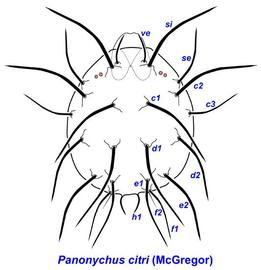
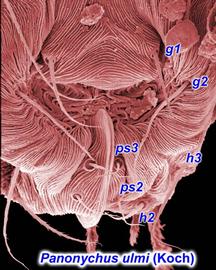
High. Panonychus is a small genus of about 15 described species including a couple of broadly distributed and highly polyphagous pests such as the European red mite P. ulmi (Koch), the raspberry mite P. caglei Mellot, and the citrus red mite P. citri McGregor. At the current time, the U.S. has most of the important pests and only one exotic species of Panonychus is considered of high quarantine interest:
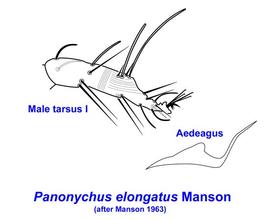
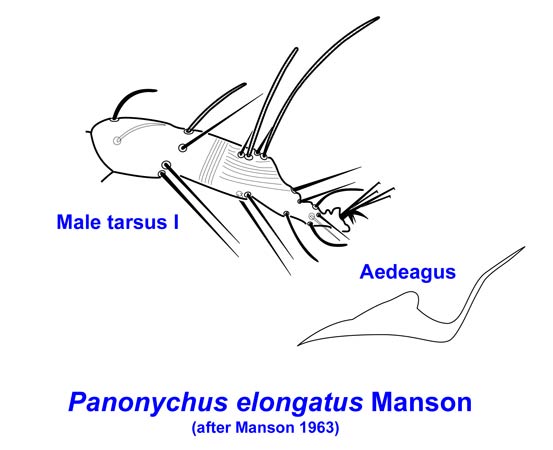
- Panonychus elongatus Manson attacks beans, citrus, figs, papaya, passion fruit, pear, and ornamentals such as rose in Asia, Australia, and New Guinea.
Diagnosis
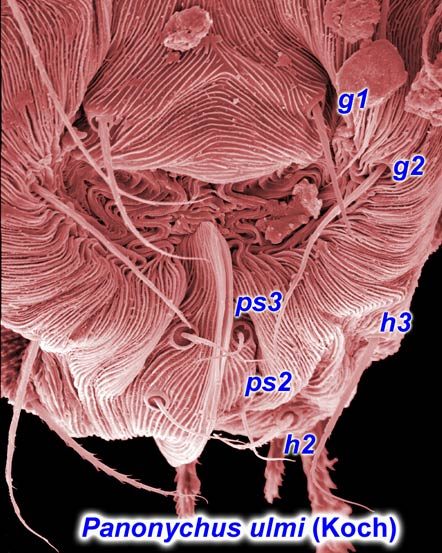
- With 2 pairs of paranal setae (h2–h3); 2 pairs of anal setae.
- Empodium claw-like and as long or longer than the proximoventral hairs
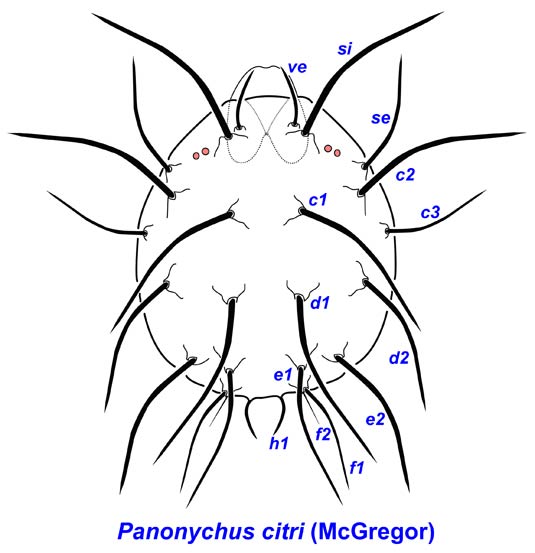
- Dorsal setae are usually set on strong tubercles
- Peritremes recurved distally
Similar taxa
Other Tetranychini have either 1 pair of paranal setae (e.g., Oligonychus, Tetranychus, Amphitetranychus) or have the empodium split distally, ending in a tuft of hairs, or divided into 2–3 claws or lack proximoventral hairs or have hairs longer than the claw (Allonychus).
References
- Baker and Pritchard 1960Baker and Pritchard 1960:
Baker EW, Pritchard AE. 1960. The tetranychoid mites of Africa. Hilgardia 29 (11): 455–574.
- Baker and Tuttle 1994Baker and Tuttle 1994:
Baker EW, Tuttle DM. 1994. A guide to the spider mites (Tetranychidae) of the United States. Indira Publishing House, West Bloomfield, Michigan. 347 pp.
- Beard et al. 2003Beard et al. 2003:
Beard JJ, Walter DE, Allsopp P. 2003. Spider mites of sugarcane in Australia: A review of grass-feeding Oligonychus Berlese (Acari: Prostigmata: Tetranychidae) with the description of four new species. Australian Journal of Entomology 42: 51–78.
- Bolland et al. 1998Bolland et al. 1998:
Bolland HR, Gutierrez J, Flechtmann CHW. 1998. World catalogue of the spider mite family (Acari: Tetranychidae). Brill, Leiden.
- Helle and Sabelis 1985Helle and Sabelis 1985:
Helle W and Sabelis MW, eds. 1985. Spider mites: Their biology, natural enemies, and control. World Crop Pests, Vol. 1A. Elsevier, New York.
- Jeppson et al. 1975Jeppson et al. 1975:
Jeppson LR, Keifer HH, Baker EW. 1975. Mites injurious to economic plants. University of California Press, Berkeley.
- Meyer 1974Meyer 1974:
Meyer MKPS. 1974. A revision of the Tetranychidae of Africa (Acari) with a key to the genera of the world. Republic of South Africa, Department of Agricultural Technical Services, Entomology Memoir No. 36: 291 pp.
- Meyer 1987Meyer 1987:
Meyer MKPS. 1987. African Tetranychidae (Acari: Prostigmata) - with reference to the world genera. Republic of South Africa, Department of Agriculture and Water Supply, Entomology Memoir No. 69: 175 pp.
- Navajas et al. 1997Navajas et al. 1997:
Navajas M, Gutierrez J, Gotoh T. 1997. Convergence of molecular and morphological data reveals phylogenetic information in Tetranychus species and allows the restoration of the genus Amphitetranychus (Acari: Tetranychidae). Bulletin of Entomological Research 87: 283–288.
- Ochoa et al. 1994Ochoa et al. 1994:
Ochoa R, Aguilar H, Vargas C. 1994. Phytophagous mites of Central America: An illustrated guide. CATIE, Turrialba, Costa Rica.
- Tseng 1990Tseng 1990:
Tseng Y-H. 1990. A monograph of the mite family Tetranychidae (Acarina: Trombidiformes) from Taiwan. Taiwan Museum Special Publication Series 9. 224 pp.
- Zhang 2003Zhang 2003:
Zhang Z-Q. 2003. Mites of greenhouses: Identification, biology and control. CABI Publishing, Wallingford. 244 pp.