Tetranychinae
t
Taxonomy
Common names
fruittree spider mite, hawthorn spider mite, red spider mite
Probability of encounter
high
Quarantine importance
Very high. The genus Amphitetranychus consists of only 3 described species, all of which were originally described as species of Tetranychus and all of which infest woody dicots. Amphitetranychus quercivorous (Eharah & Gotoh) and A. savenkoe (Reck) feed on oaks in Japan and Russia, respectively. The remaining species, however, the fruittree spider mite A. viennensis (Zaqcher) is a significant pest of a variety of fruit trees and ornamentals and of especial concern to quarantine in the U.S.
- Hawthorn spider mite or fruittree spider mite—Amphitetranychus viennensis (Zacher) (=Tetranychus viennensis Zacher, T. crataegi Hirst, Apotetranychus longipenis Ugarov & Nikolskii) attacks apple, apricot, most cherries, peach pear, logan berry, hazel nut, and a variety of ornamentals including poppy, crab apple, oak, and ash in Europe, Turkey, mainland Asia, and Japan.
Diagnosis
- With 1 pair of paranal setae (h3); setae h2 terminal.
- Empodium split distally into 3 pairs of hairs
- Empodial spur absent
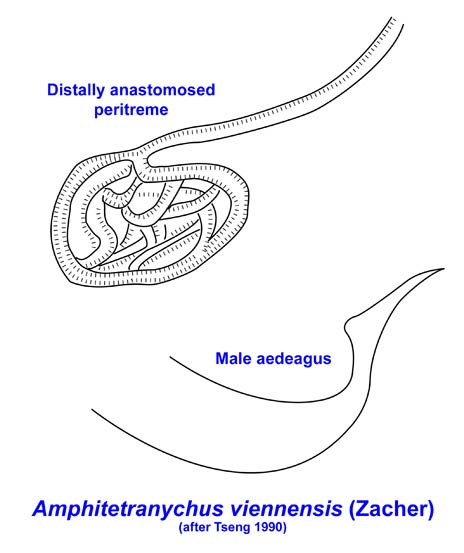
- Peritremes anastomosed distally
Similar taxa
The empodia have tenent hairs in the Bryobiinae. Eutetranychini (e.g., species of Eutetranychus) have a claw-like or highly regressed empodium. Other Tetranychini have either 2 pairs of paranal setae (e.g., Allonychus, Panonychus) or have hooked empodia with proximoventral hairs and the duplex setae of tarsus I distal and adjacent (e.g., Oligonychus) or have an empodial spur and have peritremes recurved distally (Tetranychus).
References
- Baker and Pritchard 1960Baker and Pritchard 1960:
Baker EW, Pritchard AE. 1960. The tetranychoid mites of Africa. Hilgardia 29 (11): 455–574.
- Baker and Tuttle 1994Baker and Tuttle 1994:
Baker EW, Tuttle DM. 1994. A guide to the spider mites (Tetranychidae) of the United States. Indira Publishing House, West Bloomfield, Michigan. 347 pp.
- Beard et al. 2003Beard et al. 2003:
Beard JJ, Walter DE, Allsopp P. 2003. Spider mites of sugarcane in Australia: A review of grass-feeding Oligonychus Berlese (Acari: Prostigmata: Tetranychidae) with the description of four new species. Australian Journal of Entomology 42: 51–78.
- Bolland et al. 1998Bolland et al. 1998:
Bolland HR, Gutierrez J, Flechtmann CHW. 1998. World catalogue of the spider mite family (Acari: Tetranychidae). Brill, Leiden.
- Helle and Sabelis 1985Helle and Sabelis 1985:
Helle W and Sabelis MW, eds. 1985. Spider mites: Their biology, natural enemies, and control. World Crop Pests, Vol. 1A. Elsevier, New York.
- Jeppson et al. 1975Jeppson et al. 1975:
Jeppson LR, Keifer HH, Baker EW. 1975. Mites injurious to economic plants. University of California Press, Berkeley.
- Meyer 1974Meyer 1974:
Meyer MKPS. 1974. A revision of the Tetranychidae of Africa (Acari) with a key to the genera of the world. Republic of South Africa, Department of Agricultural Technical Services, Entomology Memoir No. 36: 291 pp.
- Meyer 1987Meyer 1987:
Meyer MKPS. 1987. African Tetranychidae (Acari: Prostigmata) - with reference to the world genera. Republic of South Africa, Department of Agriculture and Water Supply, Entomology Memoir No. 69: 175 pp.
- Navajas et al. 1997Navajas et al. 1997:
Navajas M, Gutierrez J, Gotoh T. 1997. Convergence of molecular and morphological data reveals phylogenetic information in Tetranychus species and allows the restoration of the genus Amphitetranychus (Acari: Tetranychidae). Bulletin of Entomological Research 87: 283–288.
- Navajas et al. 1999Navajas et al. 1999:
Navajas M, Gutierrez J, Lagnel J, Fauvel G, Gotoh T. 1999. DNA sequences and cross-breeding experiments in the hawthorn spider mite Amphitetranychus viennensis reveal high genetic differentiation between Japanese and French populations. Entomologia Experimentalis et Applicata 90 (2): 113–122.
- Ochoa et al. 1994Ochoa et al. 1994:
Ochoa R, Aguilar H, Vargas C. 1994. Phytophagous mites of Central America: An illustrated guide. CATIE, Turrialba, Costa Rica.
- Tseng 1990Tseng 1990:
Tseng Y-H. 1990. A monograph of the mite family Tetranychidae (Acarina: Trombidiformes) from Taiwan. Taiwan Museum Special Publication Series 9. 224 pp.
- Zhang 2003Zhang 2003:
Zhang Z-Q. 2003. Mites of greenhouses: Identification, biology and control. CABI Publishing, Wallingford. 244 pp.