Bryobiinae
t
Taxonomy
Taxonomic position
Superfamily Tetranychoidea » Family Tetranychidae » Subfamily Bryobiinae » Tribe Petrobiini » Genus Petrobia
Common names
brown wheat mite, legume mite, oxalis spider mite
Probability of encounter
high
Quarantine importance
High. The genus Petrobia contains more than 30 species often grouped into 3 subgenera of which several polyphagous species are important pests.
- The brown wheat mite (also large brown wheat mite, garlic mite) P. (Petrobia) latens (Müller) attacks onion, galic, asparagus, strawberries, cucumber, spice crops, clover and other legumes, and a variety of grains. P. latens is one of the few spider mites that is a proven vector, of barley yellow streak mosaic virus and probably carries the virus transovarially.
- P. (Mesotetranychus) tunisiae Manson feeds on grains and chrysanthemum in the Mediterranean region and Iran.
- The legume mite P. (Tetranychina) apicalis (Banks) attacks onions, peas, clover, vetch and other legumes in Europe and the USA.
- P. (Tetranychina) harti (Ewing) feeds on a variety of weeds, especially certain species of Oxalis, but also attacks citrus, tea, strawberry, apple, grape, sugarcane, clover and a variety of ornamentals and has been dispersed to most of the world.
Diagnosis
- With reddish brown cuticle, dark body contents, and very long legs I.
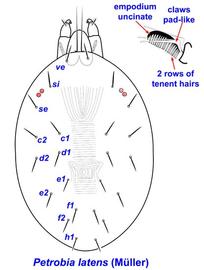
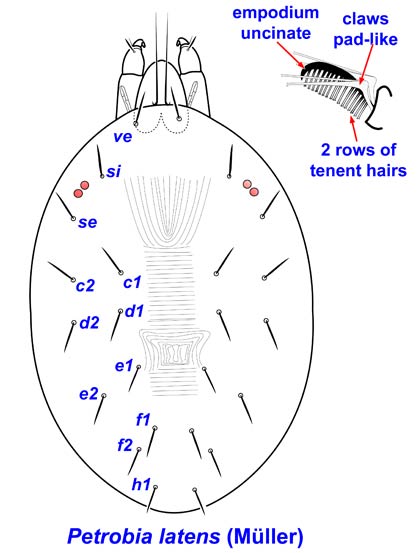
- Claws pad-like; empodium hooked and with more than 1 pair of tenent hairs.
- Prodorsum with 3 pairs of setae (ve, sci, sce), without prominent lobes over gnathosoma.
- Paranal setae (h2–3) in a ventral position.
Similar taxa
The true spider mites in the Tetranychinae do not have empodia with tenent hairs. The claws are pad-like in other tribes of Bryobiinae.
References
- Baker and Pritchard 1960Baker and Pritchard 1960:
Baker EW, Pritchard AE. 1960. The tetranychoid mites of Africa. Hilgardia 29 (11): 455–574.
- Baker and Tuttle 1994Baker and Tuttle 1994:
Baker EW, Tuttle DM. 1994. A guide to the spider mites (Tetranychidae) of the United States. Indira Publishing House, West Bloomfield, Michigan. 347 pp.
- Bolland et al. 1998Bolland et al. 1998:
Bolland HR, Gutierrez J, Flechtmann CHW. 1998. World catalogue of the spider mite family (Acari: Tetranychidae). Brill, Leiden.
- Helle and Sabelis 1985Helle and Sabelis 1985:
Helle W and Sabelis MW, eds. 1985. Spider mites: Their biology, natural enemies, and control. World Crop Pests, Vol. 1A. Elsevier, New York.
- Jeppson et al. 1975Jeppson et al. 1975:
Jeppson LR, Keifer HH, Baker EW. 1975. Mites injurious to economic plants. University of California Press, Berkeley.
- Meyer 1974Meyer 1974:
Meyer MKPS. 1974. A revision of the Tetranychidae of Africa (Acari) with a key to the genera of the world. Republic of South Africa, Department of Agricultural Technical Services, Entomology Memoir No. 36: 291 pp.
- Meyer 1987Meyer 1987:
Meyer MKPS. 1987. African Tetranychidae (Acari: Prostigmata) - with reference to the world genera. Republic of South Africa, Department of Agriculture and Water Supply, Entomology Memoir No. 69: 175 pp.
- Robertson and Carroll 1988Robertson and Carroll 1988:
Robertson NL, Carroll TW. 1988. Virus-like particles and a spider mite intimately associated with a new disease of barley. Science 240: 1188–1190.
- Smidansky and Carroll 1996Smidansky and Carroll 1996:
Smidansky ED, Carroll TW. 1996. Factors influencing the outcome of barley yellow streak mosaic virus-brown wheat mite-barley interactions. Plant Disease 80 (2): 186–193.