Bryobiinae
t
Taxonomy
Taxonomic position
Superfamily Tetranychoidea » Family Tetranychidae » Subfamily Bryobiinae » Tribe Hystrichonychini » Genus Tetranycopsis
Common names
clover mites
Probability of encounter
medium
Quarantine importance
Medium. The genus Tetranycopsis has few economically important pests. Fewer than 10 species are described and most do not infest agricultural crops.
- T. zambezianus feeds on soybean and cotton in parts of southern Africa and Madagascar.
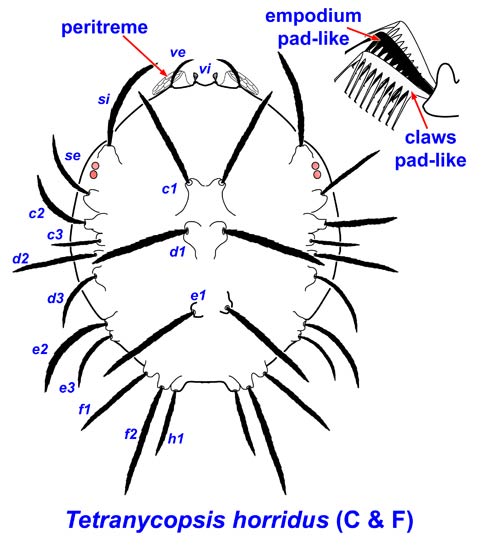
- The hazelnut mite T. horridus (C&F) is a pest of filberts in Europe, Asia, and Oregon and also feeds on yarrow, walnut, spruce, pine, red cedar, and beans.
Diagnosis
- Claws and empodium pad-like
- Prodorsum with 4 pairs of setae (vi, ve, sci, sce); without prominent lobes over the gnathosoma.
- Opisthosoma with 12 pairs of setae (c1–3, d1–3, e1–3, f1–2, h1)
Similar taxa
The true spider mites in the Tetranychinae do not have empodia with tenent hairs. Either the claws or the empodia are hooked in other tribes of Bryobiinae.
References
- Baker and Pritchard 1960Baker and Pritchard 1960:
Baker EW, Pritchard AE. 1960. The tetranychoid mites of Africa. Hilgardia 29 (11): 455–574.
- Baker and Tuttle 1994Baker and Tuttle 1994:
Baker EW, Tuttle DM. 1994. A guide to the spider mites (Tetranychidae) of the United States. Indira Publishing House, West Bloomfield, Michigan. 347 pp.
- Bolland 2001Bolland 2001:
Bolland HR. 2001. Mites (Acari: Tetranychidae and Phytoseiidae) from the Tatra Mountains in Slovakia, with special remarks on Tetranycopsis hystriciformis Reck. International Journal of Acarology 27 (3): 225–227.
- Bolland et al. 1998Bolland et al. 1998:
Bolland HR, Gutierrez J, Flechtmann CHW. 1998. World catalogue of the spider mite family (Acari: Tetranychidae). Brill, Leiden.
- Helle and Sabelis 1985Helle and Sabelis 1985:
Helle W and Sabelis MW, eds. 1985. Spider mites: Their biology, natural enemies, and control. World Crop Pests, Vol. 1A. Elsevier, New York.
- Jeppson et al. 1975Jeppson et al. 1975:
Jeppson LR, Keifer HH, Baker EW. 1975. Mites injurious to economic plants. University of California Press, Berkeley.